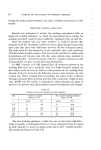
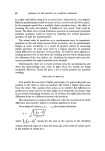
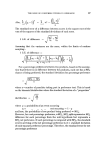
THE ROLE OF CONSUMER STUDIES IN RESEARCH 41 freshly recruited panel is somewhat atypical by virtue of their willingness to co-operate. Also, experience of verbalising thoughts and feelings about test products can be very useful in research guidance testing and on the whole, providing panelists are not over-worked to the extent of rarely having to buy products because test ones are supplied all the time, such experience is an advantage. The size of a panel depends on the object and design of the test. For example, if two products were to be tested in a paired comparison test and the product development chemist felt that a 10% net preference for one of them would be important and meaningful, then a panel size can be calculated so that such a difference would be significant at a level of, say, 1 in 20. Difference in net percentage preference Standard error of net percentage preference The standard error of net percentage preference -- where n: panel size .'. In this example 10 1.9t3 , • lOO 1.913 100 (See section below v/•- on Analysis of results) n 384 i.e. a panel size in excess of :384 is necessary to meet these requirements. PRESENTATION OF PRODUCTS As soon as panelists' opinions are sought, the visual presentation of the product becomes very important. No one is going to have much confidence in a positively unpleasant looking product and/or container. On the other hand, since final pack, perfume, colour etc., will probably be decided later by the marketing department it is important that these aspects of the product do not have undue influence at this stage of testing. Normally, when one uses a purchased product, one's expectations for that product are conditioned by the pack, the name, the price and the brand image and advertising claims. With a test product the appearance of the product and pack are the only prior indication to the consumer of "what to expect". Therefore care in choosing the visual aspects of the

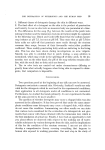
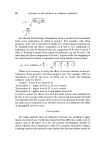
42 JOURNAL OF THE SOCIETY OF COSMETIC CHEMISTS product and pack are necessary although they may be irrelevant to the test. It may be advisable to get some indication of the size of this unknown factor by testing the product in two different packs or two different colours or perfumes. In this type of consumer testing, products are usually presented under codes. The choice of suitable codes in order to avoid bias from this source is very important especially when there is only a small difference between products. As well as avoiding the use of letters which form well known initials, the letters A and X and the number 1 or 99, etc., it is best to choose codes of equivalent visual appeal. Horton and Mecherikoff (1) asked a sample of 100 college students to rank the alphabet according to their preferences for the appearance of the capital letter and they give a list of letters in rank order. Letters close in rank order should be selected but it is usually wise to make sure also that letters of very different shape are used. This avoids possible confusion when letters are written badly on question- naires. When a combination of letters and/or numbers are used it may be worth while testing them on a small panel for visual appeal to check that one is not more appealing than another. Another effect of codes was illustrated by Appel and Hernandez (2). Certain letters can be read either way up i.e. S H 0 WZ M I N X In a test of powdered products bearing only a code letter and no indication of which was the top of the box, boxes bearing a reversible letter were opened at the bottom more often than boxes bearing a non- reversible letter. Since the finer particles settled to the bottom, panelists opening the box at the bottom obtained a different impression of the particle size from those opening the box at the top. THE DESIGN OF THE TEST The design of the test follows from the objects. When the relative merits of a product with a special ingredient versus the product alone are to be examined, a paired comparison of the two products is usually suitable for a subjective panel test. In preliminary tests on panelists at the laboratory, the untreated substrate may also be assessed as a control. For example, if an ingredient X has been formulated into a skin cream, examination could be made of skin treated with cream con- taining X and of untreated skin to find the effects of the cream plus X.
Purchased for the exclusive use of nofirst nolast (unknown)
From: SCC Media Library & Resource Center (library.scconline.org)