JOURNAL OF THE SOCIETY OF COSMETIC CHEMISTS detergents, these positive patch tests do not give conclusive evidence that the "normal" use of a detergent will cause undesired effects. One of the conditions attributed by Jacobi (2), Bettley (3), Cooke (4), and others to the use of detergents is a so-called chapped skin. This condition was described earlier by Gaul and Underwood (5). It consists of a rough, scaling skin with superficial fissures in the stratum corneum reaching into the rete malphighi. The original authors attributed this disorder to changes in atmospheric conditions, such as occur in sudden drops of the dewpoint. They considered the principal cause to be loss of water from the stratum corneum. At this point I want to stress the fact that "dry" is not only the opposite of "fatty" but also the opposite of "wet". Already in 1952, Blank (6) pointed out that callus becomes brittle in a dry atmosphere and becomes supple again when it is allowed to take up water the cosmetic industry recently seems to have appreciated this fact too. Many advertise- ments at present stress, as an advantage of certain creams, that they bring moisture to the skin. Formerly, it was more usual to emphasize the fat content. I will not at this moment bring up the question of whether it is possible to introduce moisture into the skin directly, or whether the ad- ministration of emulsifiers is more advisable when we want to make a brittle skin supple again. At this point in our discussion we come to the second question--whether chapped skin may be caused by detergents in addition to atmospheric conditions. Theoretically it is not unlikely that the answer to this question could be affirmative, because detergents are able to leach out substances from the stratum corneum that normally bind water. But the only definite proof would be the observation of chapped skin caused, beyond any reasonable doubt, by detergents. This proof is lacking for the moment. Carter and Griffith (7) while observing the skin of housewives exposed to various detergents, found a marked correlation between chapped skin and meteoro- logical conditions, but stated that the additional effect of water and detergents in causing chapped skin was slight. If we turn to the question of whether water and detergents may cause eczema, we find that most people, and doctors as well as patients, are con- vinced that this is so. We must now examine the evidence brought forward to support this contention and see whether it can withstand criticism. Arguments in favour are the "observation" that much wet work may cause or worsen eczema, and that stopping this work is followed by improve- ment. Now, the fact that cessation of wet work is followed by improvement

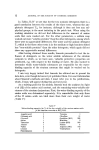
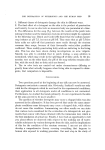
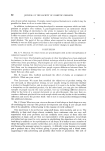
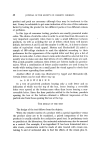
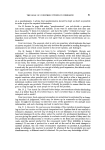
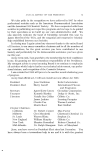
THE INTERACTION OF DETERGENTS AND THE HUMAN SKIN 7 does not constitute definite proof that the wet work was the cause of the eczema. These objections, valid though they may be, sound somewhat far fetched, and so I too was rather startled when the experiments of Suskind et al (8) became known. Suskind et al (8) (after previous work by Jambor (9), which already had pointed in this direction) hospitalized a number of patients with eczema of the hand and, as the only additional measure, one hand was immersed twice or six times daily in a solution of a synthetic detergent or a soap, in a suitable concentration. The other hand served as a control, and was im- mersed for the same time in tap water. 23 normal subjects were exposed to the same procedure. Contrary to expectations, not least of all of the experimenters--in most patients both hands improved equally, as can be seen from Table I (8). Table I Summary of observations: Household washing products Number of subjects 1 Test and control hands improved 49 2 No change in test or control hands 31' 3 Test hand unchanged, control hand improved 1 4 Test hand improved, control hand unchanged 2 5 Test and control hands worse 3 6 Test and control hands worse in first week of test but improved in second week Test hand worse, control hand improved or unchanged 3 7 o *Fifteen of these were subjects with normal hands. 89 In my opinion, this experiment, although it does not give us the right to extend its results to all detergents, opens up wide the question whether detergents and/or water damage a normal or eczematous skin. Moreover, it stresses once again the favourable influence of hospitalization itself on various skin conditions--a so called sanatio spontanea nosocomialis. It remains possible that the favourable influence of the hospitalization in Suskind's experiments more than compensated for the unfavourable in- fluences of the detergents. Whatever the final explanation of the facts observed by Suskind proves to be, it remains desirable to study the interaction of water, detergents and skin. Furthermore, it remains necessary for the manufacturer of a nex
Purchased for the exclusive use of nofirst nolast (unknown)
From: SCC Media Library & Resource Center (library.scconline.org)