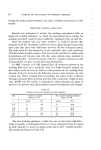
52 JOURNAL OF THE SOCIETY OF COSMETIC CHEMISTS THE LECTURER: On a small panel in the laboratory it may be possible to test products 'one on each side'. Panelists would need to get used to this method of testing which is reasonably objective. For consumer opinions, which are subjective, it is necessary to have only one product assessed at a time so that it can be used in the usual way. DR. A. W. MIDDLETON: Reverting to your list in page 008 - what is the effect of the order in which these questions are asked? THE LECTURER: I suspect that panelists tick the first statement that they agree with. The order is, therefore, very important and placing favourable statements first on the questionnaire may lead to a more favourable rating for the product than if unfavourable statements were placed first. This is something that I would like to test. DR. K. H. HARPER: I gather that the Inethod of sequential analysis offers many advantages in a study where you are asking for a preference. Does this have any application in product testing of cosmetics? THE LECTURER: Sequential testing is very useful for small tests involving labora- tory personnel. However, for tests when products are sent outside to panelists it is usually simpler to estimate the expected degree of difference, and to calculate the panel size to give this difference the required significance. All the products can then be sent out at the same time and all the answers will come back at approximately the same time.

Book reviews ADVANCED CHEMISTRY OF RARE ELEMENTS. $. Prakash. Pp. viii q- 808 + Ill. (10137). Chemical Publishing Co., New York. $113.50. The simpler undergraduate courses, particularly of the British "General" B.Sc. type, tend to concentrate on the systematic structural and analytical chemistry of the commoner and economically more important elements. This author suggests that there is a lack of a text for "Honours" undergraduates and inorganic post- graduate students who need to study the less familiar elements. He has culled out 35 commonly treated elements and for the remainder presented a conventional dis- sertation. The first part plunges unhesitatingly straight into Bohr, Sommerfeld, de Broglie and Schr6dinger: brief consideration is given to angular probability distributions and simple solutions of the wave equation for hydrogen atom orbitals and then he explains the principles of consecutive electron occupation of higher atomic orbitals. The second chapter considers ionic and covalent radii, and the third provides a fairly elementary introduction to molecular orbitals. This is followed by a wave-mechanical discussion of the valence bond, leading naturally into short chapters on hybridisation, a LCAO treatment of the chemical bond, and magnetic moments. Part I concludes with a detailed appraisal of electron shell filling in the transitional elements and brief MO and ligand field treatments of inorganic complexes. This necessary but not excessively long theoretical introduction (125 pages) sets the modern tone of the book. The remaining two parts comprise 33 chapters (t375 pages) divided between the non-transitional and transitional rarer elements. The organisation of the chapters is on a conventional contemporary pattern: general physical and structural characteristics, similarities with other elements, history, occurrence, extraction of the element, analytical reactions, valency coordination and ligands, preparation and properties of compounds. There is a final chapter dealing with the transuranics: this has clearly been extensively revised and updated, and is reasonably comprehensive. However, the text does bear evidence of hurried in- sertions, e.g. the varying type size of the section on the nuclear pile production of plutonium, and occasional repetition such as the few paragraphs on the fundamentals of nuclear fission which oddly and abruptly conclude the chapter. The book is couched in a terse monographic style suitable to the student notebook. The printing, although mostly on the small side, is generally good formulae, tables and equations are well set, although one block was found to be upside down. The index, though not very long, appears to casual inspection to cover adequately the more important matters discussed. Whilst space considerations have prevented the provision of references to original papers--and indeed it is arguable that they would be out of place in this type of text, essentially systematic with little speculation and only incidental topicality--there is nevertheless an adequate bibliography in the preface to the first (1054, Indian) edition and this has been updated in the third (Indian and first U.S.) version. It may reasonably be concluded that as a source book 53
Purchased for the exclusive use of nofirst nolast (unknown)
From: SCC Media Library & Resource Center (library.scconline.org)