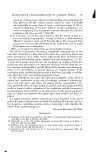
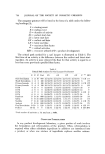
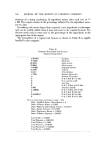
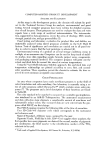
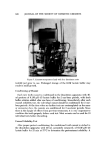
792 JOURNAL OF THE SOCIETY OF COSMETIC CHEMISTS elements of a string numbering 12 ingredient names after each row of V • x 100. The output consists of the percentage followed by the ingredient name, one to a line. By making each matrix larger than required, a new ingredient or subcompo- nent can be readily added when it does not occur in the original formula. The chemist needs only to enter zero or the percentage of the ingredients in the appropriate line of the matrix. The formulation of a typical nail lacquer as shown in Table II is rapidly handled by the computer. Table II Computer-Formulated Nail Lacquer (Typical Composition) 0.785481 8.71251 34.4034 15.2004 9.05484 19.8769 9.241 1.7625 0 0 0 0 0 0.705 0.132062 0 2.40428E-2 0 Camphor Plasticizer Butyl acetate Ethyl acetate Isopropyl alcohol Toluene Nitrocellulose Bentone 38 powder Bentone 27 po vder D & C Red •P 7 Ca lake Iron cosmetic oxide Iron blue D & C Yellow # 5 Zr lake Titanium dioxide D & C Yellow •p 6 A1 lake D & C Red •P 9 Ba lake D & C Red •P 6 Ca lake D&CRed #34Calake Do you want ratios and totals or stop? YES Ratio-Modified Resins: Nitrocellulose = 0 Ratio-Gel]ants: Resins -- 0.1907 Ratio-Pigments and Gellants: Resins --_ 0.283871 Ratio-Resins: Solvents: 0.117682 Ratio-Plasticizers: Resins: 1.03145 Ratio-Gellants: Pigments = 2.04679 Total Solids -- 12.3007 Total Pigments -- 0.861105 Total Gellants: 1.7625 Total Solvents: 78.5355 Total Plasticizers = 9.53289 Total Resins -- 9.24224

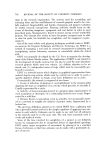
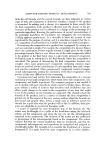
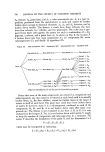
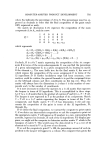
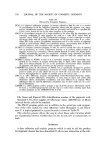
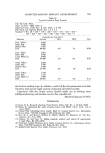
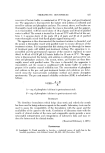
COMPUTER-ASSISTED PRODUCT DEVELOPMENT 793 ANALYSIS AND EVALUATION At this stage in the development project, the chemist will submit his prod- uct to the Technical Services Group for analysis, environmental and panel testing. Several computer programs have been written for detailed examina- tion of nail lacquers. These programs are used to evaluate the data and write reports from a wide range of analytical instrumentation. The instrumenta- tion, supported by data processing, covers the areas of theology, DSC, tensile strength, particle size, and gas permeability (5). Panel testing and laboratory evaluation for product likes and dislikes are statistically analyzed using stored prograins available on the G-E Mark II System. Tests of significance and correlation are carried out in all panel stu- dies in order to insure that the best prototype is selected (6). Environmental testing of a product at several storage conditions seems to multiply at an enormous rate. Computers can be used to keep track of stabil- ity studies, store data regarding sample formula, project name, components, and packaging material involved. The computer program will print out the actual analytical data for several lots stored at various temperatures. Using the Van't Hoff-Arrhenius Stability approach, the analytical data and temperature relationships are plotted according to zero, first, and second- order equations. These equations permit the chemist to estimate the time re- quired to meet minimum acceptable concentration. COLOR FORMULATION An area where computers have made significant progress is in the field of color formulation and color matching. Our laboratory is currenfiy using a se- ries of color programs called Chroma-Pac©* xvhich contains seven color pro- grmns (7). The programs and a brief description of their functions are found in Table III. The color standard to be matched is measured on a suitable spectrophotmn- eter interfaced to an ASR-33 Teletypewriter. The automated measurement and data collection steps eliminate a considerable mnount of man-hours and substantially reduce errors. The measured data are next entered into the pro- gram called PMAT, via the teletype. The PMAT program requires the following data at the time of execution: User ID Code-4-5 character code which corresponds to the instrument and reference used. Name of Standard-Arbitrary nmne. assigned by the user. Pigments/Comb., Field Size & Sub. ID#-User supplies three numbers, the first specifies how many pigments are desired, the second, number of pigments per combination, the third numl)cr is the identification nnmber of the TIO• substrate to be used. * Trade mark of Applied Color Systems, 221 Nassau St., Princeton, N.J. 08540.
Purchased for the exclusive use of nofirst nolast (unknown)
From: SCC Media Library & Resource Center (library.scconline.org)