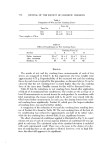
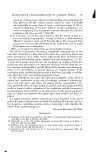
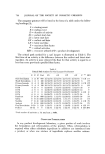
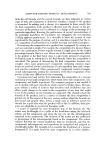
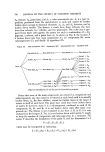
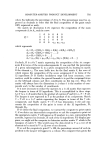
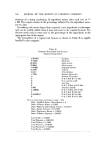
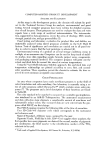
78O JOURNAL OF THE SOCIETY OF COSMETIC CHEMISTS Table IV Effect of Resins on Dry Combing Force a Resin Type 3% Aqueous Solution Prototype Formulation __ Combing Force Residual Combing Force Residual (g) Combing Force (%) (g) Combing Force (%) Cationic 31 200 21 150 Carboxylated 34 240 35 250 Vinyl 24 170 27 190 SAverage control force = 14 g. Table V Effect of Bleaching on Combing Force Experiment Initial No. of After After No. Force Bleach Treatments Bleaching Conditioning i 80 4- 12 i 225 q- 30 50 4- 10 9. 75+__ 5 2 320 q- 50 75 4-•5 the pH of the solution was 9.4. Tensile strength measurements of the bleached hair were made on a model TM-M Instron* by determining the Fa,5 of indi- vidual hairs before and after bleaching (7). The tensile strength of the hair bleached 30 min was reduced to approximately 85% of its initial value, while that of the hair bleached for 1 hour was 70%. As summarized in Table V, the bleaching caused a large increase in the wet combing force of the hairs. When the tresses were treated with 0.2 ml of conditioner D, a large decrease in the combing force resulted. Although both of these effects have long been known to formulators and consumers alike, the above data represent a quantitative determination of their extent. DISCUSSION The interaction of water with hair and wool and the effects of this interac- tion on the properties of the fibers have been studied and documented for many years ( 8, 9). Two of these interactions that must be considered in trying to understand the much larger amount of force needed to pass a wet tress of hair through the teeth of a comb are discussed below: _ a) The saturation of hair with water will increase its diameter by approxi- mately 14% above that found at an ambient relative humidity of 30 to 40% (9, 10). Therefore, wet hair would occupy that much more volume and be expected to offer more resistance to the passage of the comb. The quantitative effect of swelling on the combing force could be deter- *Instron Corp., Canton, Mass.

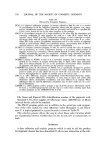
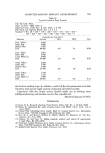
QUANTITATIVE CHARACTERIZATION OF COMBING FORCE 781 mined by studying tresses placed in both swelling and nonswelling liq- uids. However, the 14% volume increase caused by water is probably not responsible for more than, at most, a small percentage of the in- creased combing force of wet hair (Table I), for the combing force of a wet tress weighing 2.75 g is found to be greater than that of a dry tress weighing nearly twice as much (Table III ). b) It is obvious, even to the casual observer, that the strands of hair in a wet tress tend to cling together, so much so that it is often somewhat difficult to separate a single strand from the others. The amount of force necessary to overcome this interaction by the comb teeth must be a part of the higher wet combing force. Other, as yet unknown, interactions are also probably involved. The effects of quaternary ammonium compounds containing one or two long alkyl chains that are discussed in this report have long been known and these materials have been widely used to soften textile fibers and fabrics dur- ing processing and washing and to condition hair after shampooing (11-13). A great deal is known about the rate and mechanism of sorption of these ma- terials onto hair and textiles (14). Much has also been learned about the sur- face structure of keratin fibers and the effect of this structure upon their prop- erties (1, 2). Nevertheless, at present, there is no complete picture of the mechanism of the conditioning process and of how these materials so dramati- cally affect the "feel" and combing properties of hair. In 1971, Finkelstein and Laden described an investigation of the effect of various hair conditioners on the ease of combing (evaluated subjectively) when used both above and below the critical micelle concentration (15). They studied the effect of chain length of cationic used and interpreted their results in terms of surface adsorption of the conditioner and the formation of two-dimensional "hemi-micelles" on the hair surface. To the best of our knowl- edge, no further investigations developing upon these results have been re- ported. It is hoped that future studies, using the procedure described in this report and/or the many techniques now available for studying fiber friction and sur- face properties (including scanning electron microscopy), will elucidate the nature of the conditioning process. (Received December 22, 1972) REFERENCES (1) Makinson, K. R., Some observations on the effects of mild shrinkproofing treatments in wool fibers, Text. Res. J., 38, 831-42 (1968). (2) Hepworth, A., et al., The surface topography of chemically treated wool fibers, J. Text. Inst., 60, 513-46 (1969). (3) Wolfram, L. J., and Lindemann, M. K. O., Some observations on the hair cuticle, J. Soc. Cosmet. Chem., 22, 839-50 (1971). (4) Schwartz, A.M., and Knowles, Jr., D.C., Frictional effects in human hair, Ibid., 14, 455-63 (1963.)
Purchased for the exclusive use of nofirst nolast (unknown)
From: SCC Media Library & Resource Center (library.scconline.org)