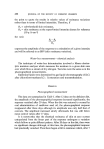
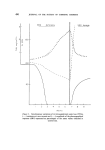
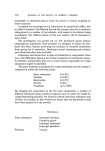
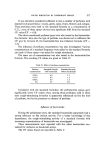
488 JOURNAL OF THE SOCIETY OF COSMETIC CHEMISTS the point to quote the results in relative values of resistance variations rather than in terms of liminal intensities. Therefore, if sub-threshold skin resistance, skin resistance at the supra-liminal intensity chosen for reference (10 It A cm -•) the ratio R! expresses the amplitude of the response to a stimulation of a given intensity and will be referred to as SRV (skin resistance variation). -Waterdoss measurements--chemical analysis The technique of water-loss determination involved a Meeco electro- lytic moisture analyser which measures the moisture in a given skin area over which flows a stream of dry nitrogen. Test sites were the same as in the phoreographical measurements. Epidermal lipids were determined by gas liquid chromatography (GLC) after chloroform-methanol (2 .' 1) extraction and transmethylation. RESULTS Phoreographical measurement The data are summarized in Table [. After 12 days on the deficient diet, the amplitude of the phoreographical response decreased significantly the response vanished after 20 days. When the diet was restored to normal by oral administration of sunflower seed oil, the phoreographical response reappeared after three days although its amplitude was only half that of controls. The amplitude increased slowly afterwards but was still below mean control values after 17 days. It is noteworthy that the electrical resistance of skin at zero current extrapolated from the linear part of the response undergoes a variation which follows a quite different pattern. After 20 days on the diet, there were no significant changes although, at this time, the phoreographical response had practically vanished. Then there began a fall in resistance which, after 7

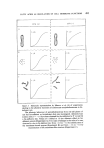
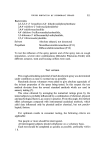
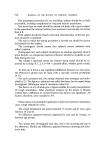
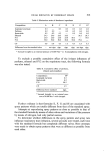
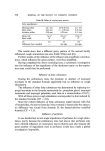
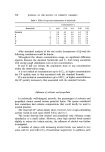
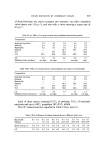
FATTY ACIDS AS REGULATORS OF CELL MEMBRANE FUNCTIONS 489 Table I. Amplitudes of the phoreographical response SRV (see text) in % of the subthreshold resistance. Animals are fed on a deficient diet for 28 days (period I) then transferred on control diet (period II) Days Animals on deficient diet Days Animals on control diet 6 rats 6 rats r • • mean 4- SD no. 1 no. 2 no. 3 no. 4 no. 5 no. 6 Mean 4-SD .• 7th 17 23 2 38 4 16 17 -½ 6 24 -½ 5 • 12th 3 12 2 2 4 3 4 4- 1.5 11 4- 0.5 '•'• 20th 2 0 0 0 2 2 1 4- 0.2 18 4- 0.5 m • 28th 0 0 0 0 0 0 0 15 4- 2 2nd 0 0 0 0 0 0 0 17 _-k 2 .. '• • • 3rd 10 20 5 0 8 10 12 4- 3.5 25 4- 3 •o '• 5th 20 20 12 16 12 dead 16 4- 3.5 23 4- 6 • 9th 14 12 18 14 10 ,, 13 4- 0.2 22 4- 6 17th 13 19 23 17 14 ,, 17 4- 0.5 26 4- 5 weeks, reached about 60}/0 of the initial value. On another hand, SSO dosage caused a dramatic increase in skin resistance values as these, after only 1 week, are more than double the initial values (see Fig. 2). Transepidermal water loss An increase in transepidermal water loss was observed which was very slow at the beginning of the experiment (no significant increase after 3 weeks), then became faster. Conversely, a sharp decrease occurred within 2 weeks of sunflower seed oil dosage until the transepidermal water loss returned to the initial value after 3 weeks (Table II). Table I[. Variation of transcutaneous water loss (TWL) in rats during EFA-deficiency and after returning to control diet (means of six measurements expressed in mg H,•O cm -a h 4, 4- SD) Start EFA-deficiency 1 week on normal 3 weeks 4 weeks 7 weeks diet Deficient Control 0.30 4- 0.1 0.80 4- 0.1 1.9 4- 0.30 2.8 4- 0.20 0.60 4- 0.30 0.30 4- 0.1 0.60 4- 0.1 0.80 4- 0.30 0.70 4- 0.10 0.60 4- 0.30
Purchased for the exclusive use of nofirst nolast (unknown)
From: SCC Media Library & Resource Center (library.scconline.org)