320 JOURNAL OF THE SOCIETY OF COSMETIC CHEMISTS Three kinds of differences in odour perception between men and women will be discussed: (a) differences in sensitiv/ty to low concentrations of odours (b) differences in variability of the sensitivity to odours (c) differences in the qualitative appreciation of odours. DIFFERENCES IN OLFACTORY SENSITIVITY In 1899 Toulouse and Vaschide (1) reported on the already conflicting results of research workers concerning differences in olfactory sensitivity between men and women. Since then there have been a number of authors who found no such differences but others, often using more refined techniques and more carefully selected odorous substances, reported that women were often more sensitive to odours than men. However, even today there is conflicting evidence. Le Magnen (2) used among other substances a musk-like odour called 'exaltolide' (cyclo-pentadecanolide) and found that for this substance the sex difference was rather large. According to him adult women are very sensitive to cyclo-pentadecanolide whereas young children and adult men do not perceive the odour at all, or find it very weak. Le Magnen (2) claimed that these differences were specific for the sensitivity to cyclo-pentadecanolide and urinoid odours like pyridine. On the basis of these findings he formulated the hypothesis that the sensitivity of these 'biologically significant' odours is determined by sex hormones. Oestrogens would improve sensitivity to them whereas androgens would diminish the sensitivity to the biologically significant odours but in contrast would improve the sensitivity to other odours like safrol, phenol etc. Le Magnen (3) reported that in rats, androgens seem to develop the sensitivity to the musky odour to which adult male rats are the most sensitive. Pietras and Moulton (4) also found that male rats are, on the average, more sensitive than female rats, not only for exaltolide, but also for 'neutral' odours. Le Magnen's (2) 'specific' hypothesis stands in contrast to a more 'general' hypothesis formulated by Broverman et al. (5). Broverman (5) supposed that sex differences in cognitive tasks, conditioning and in sensory thresholds are reflections of the balance be- tween the activating influence of central adrenergic processes and the inhibitory influence of central cholinergic processes, which in turn, are influenced by the gonadal steroid sex hormones, androgens and oestrogens. Since the oestrogens are more potent activating agents than the androgens, females are more activated, or less inhibited than males. This would manifest itself also in a higher feminine sensory sensitivity. Koelega (6) Koelega and K6ster (7) tested these hypotheses. The olfactory thresholds of adult men and women and of children before and during puberty were determined. A number of different substances both from a 'biologically

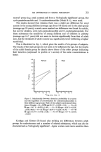
SEX DIFFERENCES IN ODOUR PERCEPTION 321 neutral' group (e.g. amyl acetate) and from a 'biologically significant' group, like cyclo-pentadecanolide and 11-oxahexadecanolide (Musk R-I), were used. The results showed that whereas there was a slight sex difference for amyl acetate in the young children (average age about 9.0 years) and in the adult group (average age 20 years), a much more marked sex difference was found for adults, but not for children, with cyclo-pentadecanolide and 11-oxahexadecanolide. For these substances the sensitivity of young children and of children in puberty (average age 16.7 years) did not seem to deviate significantly from that of adult men, but the threshold of adult women was significantly lower (reflecting a higher sensitivity). This is illustrated in Fig. 1, which gives the results of six groups of subjects. The results of the male groups do not seem to be influenced by age, but the results of the adult female group lie clearly above those of the other groups indicating their detection (expressed in probits or z-scores) of the same concentrations is better. +4 Female Male -•1 ._ o -1 -4 -9 -7 -5 -• -I -9 -7 -5 -• -I 2Lo• conc. (mol. /I) Figure 1. Relationship between detection probability in z-scores and the logarithm of concentration for cyclopentadecanolide in three different age groups. Each of the subjects participated three times. (Female :--N = 58 M age 20.1 Y= 0.24X + 1.18 ß --. N =43 l•l age= 16.7 Y=0.47X+ 1.09 - - - N=32 • age= 10.0 Y=0.33X 40.66. Male :--N= 52 M age=20.4 Y=0.27X+0.54 .--. N=48 • age=16.7 Y=0.37X+l.04 - - - N=37 • age=9.7 Y=0.33X 40.62.) Koelega and K/Sster (7) found also striking sex differences between adult groups for androstenone and a number of related substances, which can also be characterized as 'biologically significant'. Again women were more sensitive than
Purchased for the exclusive use of nofirst nolast (unknown)
From: SCC Media Library & Resource Center (library.scconline.org)