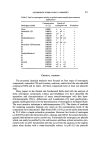
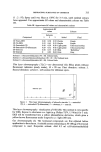
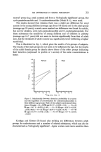
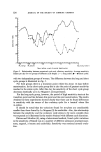
324 JOURNAL OF THE SOCIETY OF COSMETIC CHEMISTS 4O 35 30 25 2O I,,• I I I I 12181 I .... ......... I I I I I I ..... -33 - - 5 - o -15 -io -5 o M t (tong) M t (short) M 2 (tong +short) Doys before onset of second menstruotlon Figure 2. Relationship between menstrual cycle and olfactory sensitivity. Average sensitivity indices per day for two groups of different cycle length. O--O long cycles O- - -O short cycles. with two independent groups of women. The difference between the long and short cycle groups is illustrated in Fig. 2. For both groups there is a transition point which lies about 14 days before menstruation. In the short cycle group this is also the point of greatest sensitivity reached in the entire cycle. After this day the sensitivity of the short cycle group decreases drastically as in Le Magnen's (2) experiments. For the long cycle group, however, the period of high sensitivity starts at the transition point and lies between this point and the next menstruation. The results obtained in these experiments showed clearly that there can be found differences in sensitivity with the course of the ovulatory cycle for a 'neutral' odour like m-xylene. It should be noted that the variations found for m-xylene are considerably smaller than those found by Le Magnen (2) for exaltolide. Also, the relationship between the sensitivity and the ovulatory cycle seems to be more complex than was expected as is illustrated in the results obtained with different cycle durations. Pietras and Moulton (4), using a behavioural method, found cyclic variations in the sensitivity of female rats to a number of different substances (cyclopentane- none, eugenol, a-ionone and exaltolide). Sensitivity was maximal around ovula- tion.

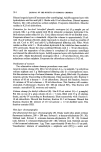
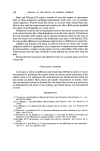
SEX DIFFERENCES IN ODOUR PERCEPTION 325 Amoore et al. (17) failed to demonstrate cyclic changes in women's sensitivity to the odour of pentadecalactone (Thibetolide), but Schiffman (18)found an in- creased sensitivity at the eleventh day of the cycle for cyclopentadecanone. Good et al. (19) with a signal detection procedure also confirmed Le Magnen's (2) findings and found further indications of a hormonal influence on olfactory sensitivity with pregnant and hypogonadal subjects. DIFFERENCES IN THE QUALITATIVE APPRECIATION OF ODOURS For most odours men and women do not differ in their appreciation in a systematic way. However, there are some odours in the 'biologically significant' group which seem to smell differently to men and women. Moncrieff (20) in- vestigated odour preferences within a group of ten odours with a large number of subjects. Men and women did not differ of opinion when very agreeable or very bad odours were concerned. Men preferred the smell of musklactone more than women did. This difference in preference seems to develop around puberty and is less outspoken after the age of 40, because after that age the odour is much more preferred by women than before it. Men seem to be more stable in their preferences through life than women (see Fig. 3). ? I I I I I 1 i 0 20 30 40 50 60 Age {years) Figure 3. Relationship between age and preference for the odour of musk lactone (from Moncrieff (18)). x-- x males ¸- - -¸ females. One group of substances, androstenone and related substances, demands special attention here, since these odours seem to be perceived very differently by different people.
Purchased for the exclusive use of nofirst nolast (unknown)
From: SCC Media Library & Resource Center (library.scconline.org)