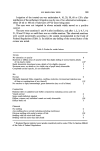
304 JOURNAL OF THE SOCIETY OF COSMETIC CHEMISTS RESULTS Effects of various exposure times (Table II) In every rabbit where irrigation of the eye was commenced after a delay of 20 s or longer after instillation of sodium lauryl sulphate, corneal opacity or a dulling of the normal corneal lustre was produced. The reaction observed in the eyes of animals exposed to sodium lauryl sulphate for 20 or 30 s was similar to the effect seen in the eyes of animals where irrigation was delayed for up to 2 min, and only slightly better than that seen in eyes receiving no irrigation at all. Where the exposure time was reduced to under 20 s, fewer rabbits showed any corneal damage, and where there was corneal involvement, this was less severe, and less persistent (Table III). Only one of twenty-four rabbits developed a corneal opacity when irrigation was initiated within 10 s. Exposure of the eyes to sodium lauryl sulphate for 4 s did not elicit any opacities, although a dulling of the corneal lustre was seen in four animals. It may be concluded therefore that the critical exposure time before corneal damage is produced in the rabbit eye after instillation of a 10•o sodium lauryl sulphate is in the region of 4-10 s. Table II. Numbers of rabbits showing corneal damage after instillation of 10 % sodium lauryl sulphate Delay time before irrigation of eyes (s) No 4 10 20 30 60 120 irrigation No opacity 7 4 ..... Lack of lustre 4 8 5 7 5 4 2 Opacity grade 1 -- 1 3 2 5 4 8 2 -- -- -- I -- -- 1 3 -- -- -- ! -- -- -- Total no. eyes treated 11 13 8 11 10 8 11 Table III. Mean duration of corneal damage and conjunctival irritation after instillation of 10% sodium lauryl sulphate (days) Delay time before irrigation of eye after instillation of 10 % sodium lauryl sulphate (s) 4 10 20 30 60 120 No irrigation Cornea 0.5 2 3 8 4 4 Conjunctiva 4 5 5 9 8 9 4.5 9

EYE IRRITATION TESTS 305 In addition to corneal damage, considerable conjunctival redness and swelling were produced, even when the eye was irrigated after 4 s. However, the conjunctiva returned to normal much more quickly in rabbits that were exposed to sodium lauryl sulphate for the shorter period of time. Effects of volume of irrigant No further reduction in the irritant response was observed when volumes of 100 ml of water were used in preference to 20 ml volumes for irrigation of the eyes. However, inexperienced operators may find some difficulty in adequately rinsing certain test materials from the eye when using only 20 ml, and perhaps the larger amount may be advisable for routine experimentation. DISCUSSION Great care is required in the design of laboratory test methods, and in particu- lar it is essential not to lose sight of the objective of the test. Thus, if we decide to irrigate the eye after instillation of a test material we must be sure of our reasons for so doing. For example, we may wish to know if irrigation with water will be beneficial in alleviating the irritation produced by a product accidentally entering the eye of a human being, and how soon after the accident must the treatment begin? If in order to achieve these objectives the rabbit eye is chosen as the 'laboratory model', it must first be accepted that the rabbit eye is different from the human eye. Once this point is accepted it is obviously unreasonable then to apply human standards. Thus to argue that a human being might take 5 min before applying remedial irrigation following the accidental instillation of a product into the eye, and to transpose this time requirement onto the laboratory model, is illogical. In this paper we have only examined the effects of a single test compound, the anionic surfactant, sodium lauryl sulphate. This material was chosen because of its wide use in eye irritation research and because previously it was a common base material in shampoo formulations. The 10•o dilution represented a typical level of surfactant that might enter the eye in a shampoo formulation. Cationic sur- factants were not considered, because of their severe effects on the eye mucosa. However, other types of surfactant, especially where there may be differences in the substantive effects on the eye, clearly need to be investigated. Although individual animals show a wide variation in their response to the same treatment the results obtained in this series of experiments indicate that irrigation must be initiated within 10 s for optimal benefit. The National Academy of Sciences (4) recommended irrigation of some treated eyes 20-30 s after instil- lation as 'there would seem to be some merit in knowing whether prompt washing would prevent injury in the case of accidental contamination with a household
Purchased for the exclusive use of nofirst nolast (unknown)
From: SCC Media Library & Resource Center (library.scconline.org)