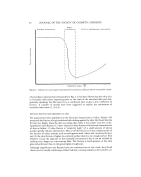
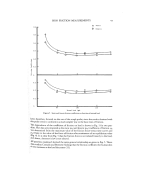
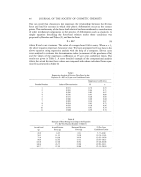
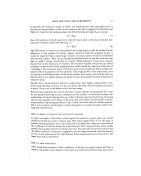
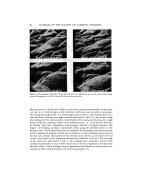
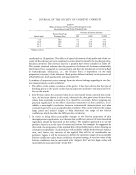
SKIN FRICTION MEASUREMENTS 47 In general, the equation seems to satisfy the experimental data reasonably well. A theoretical interpretation of the above equation has been suggested by Bowden and Tabor (2), based on the simple premise that if the shearing strength, Sm is constant F = ASm (7) then, the variation of the friction force with the load is due to the way in which A (the real area of contact) varies with the load, i.e., A = K•L n (8) The differences in behavior of the polished and rough probes could be ascribed to the difference in the number of contact regions involved. With the polished probe, it would be expected that a much larger number of contact points would be established with the skin surface. Thus, upon rotating the polished probe on the skin substrate, the skin is "pulled" along, conceivably as a result of high adhesion. Continuous rotation should lead to the formation of wrinkles. The formed wrinkles will present an added resistance to the motion of the polished probe, which would be a function of the rate of "wrinkling." The measured value of the force under such conditions will not reflect the inherent friction properties of the substrate. The rough probe on the other hand, does not produce wrinkling because of the much smaller real contact area with the skin, so .• that the skin is not pulled along as the probe rotates, presumably because of the lack of adequate "grip." :• Friction force measurements with the rough probe were highly reproducible at the :•: lower loads showing variation of 2 per cent about the mean, but the variation increases to about 10 per cent at the higher end of the load range. ß :' We have also examined the state of skin after contact with the rotating probe for 3 min ß :11':::i:. for any possible plowing action or disruption in the surface. As mentioned earlier, the .::'5 combination of a hard sliding probe on a softer substrate may lead to plowing. Scanning "i ::: electron micrographs were taken of the same skin area before and after probe contact, , using standard replicating procedures. Fig. 6 shows two such sites of a female panelist. .)..:, There is no evidence of plowing or surface disruption as a result of contact of the rotat- ing probe with the skin. EFFECT OF SPEED OF ROTATION AND SITE-TO-SITE VARIATION A study was made of the effect of the speed of rotation at a given skin site on the coefficient of friction under constant load. The speed ranged from 3.6 to 583 rpm. A number of measurements were also conducted to establish any variation in the value of :• the coefficient of friction along the volar forearm. Such measurements were usually ½•:i' carried Out at a given speed of rotation and load. The general conclusions indicate that 'ilil. the effect of speed of rotation is negligible over the range examined, and that there is no site-to-site variation on the volar forearm if the measurements are restricted to the / larger area close to the elbow. ., ß ß EFFECT OF SKIN HYDRATION After initial determination of the coefficient of friction at a given speed and load, a .'::': number of panelists were asked to rinse their arm with water and blot away any excess.

48 JOURNAL OF THE SOCIETY OF COSMETIC CHEbIISTS ./ Figure 6. Photographs coded 6917 B and 6918 B show two different sites on skin surface before probe contact. Photographs coded 69l 3 B and 6914 B show the after effect Measurements of the friction coefficient were then repeated immediately on the same test site. A 2-3 fold increase in the coefficient of friction was recorded on most pan- elists using the rough probe. It is interesting to note, however, that normal values of/c, obtained before rinsing, were again achieved after about 2 min. It is also worth noting that during the first measurement, immediately after rinsing and blotting, the rough probe exhibited a response similar to the polished probe, i.e., an increase of the force of friction with time. Subsequent measurements showed a normal. response. The degree of wrinkling increased substantially when using the polished probe on the hydrated skin. These observation'• can be explained by assuming a substantial decrease in the compression modulus of skin due to presence of water, leading to an increase in the size and, perhaps, the number of the junction zones (hence, an increase in the real contact area) which would ultimately increase the coefficient of friction. The decrease in the value of/c, after about 2 min, to the original value, indicates a return of the mechanical properties to the normal values due to the fast evaporation of water from the skin surface. These findings support Appeldoorn and Barnett's observations con- ' cerning the effect of skin hydradon on friction properties (11).
Purchased for the exclusive use of nofirst nolast (unknown)
From: SCC Media Library & Resource Center (library.scconline.org)