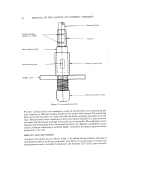
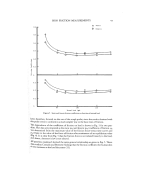
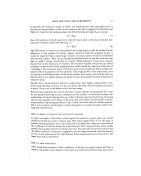
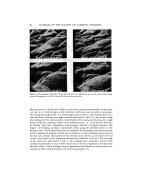
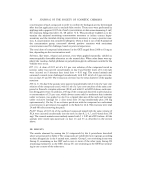
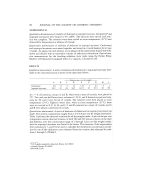
SKIN FRICTION MEASUREMENTS 41 relates well with their observations on the behavior of skin friction. They concluded that the property of skin that gives it the unusual and characteristic behavior is not its roughness nor chemical composition, but its "flexibility." Like rubber, the skin can flex to conform to the shape of another surface. This gives it a relatively large area of contact and, therefore, a high coefficient of friction as compared to the relatively unflexible metal or plastic materials. These results have been confirmed by Prall (12) and by Comaish and Bottoms (13) on skin under in vivo conditions. EXPERIMENTAL TECHNIQUE Earlier experimental techniques for skin friction measurements have been reviewed by Prall (12). Traditionally, friction measurements involve the sliding of a probe over the skin and the force is determined as a function of load. Prall describes a friction dyna- mometer which features a constant-thrust friction head whereby a standard ground glass disc was pressed against the skin with a force of 200 g/cm 2. The friction head was attached to the shaft of an ac motor, which was energized by a variable transformer. In use, the friction head was presented to the skin, and the power to the motor gradually increased until the friction head just started to rotate. In this work, we employ a modified Haake viscometer (RV-1)* to measure the friction behavior of skin in vivo with the help of a rotating stainless steel probe in contact with the arm (or any other part) surface. Preliminary experiments have shown the need for controlling the •ontact pressure between the skin surface and the probe. To this end, a special probe assembly was designed such that a constant load was maintained in contact with the skin surface in the course of the experiment. The assembly is depicted schematically in Fig. 2. The assembly features an adapter which fits tightly onto the shaft of the Haake measuring head. The part carrying the load and the probe is precisely machined so that it slides smoothly over the cylindrical adapter. The extent of vertical movement of the probe attachment is controlled by the size of the slit and a protruding knob on the adapter body. Loads can be added to the assembly by screwing on metal discs of known weight. The load is, thus, suspended and floats freely between the two ends of the slit. This design offers a convenient means to ensure a constant load contacting the skin. The panelist is only required to maintain the knob approximately in the middle of the slit during the experiment. The measuring principle is as follows. The control console of the Haake RV-1 houses the operating controls, synchronous motor, electrical circuitry, and indicating meters. It drives the measuring head and the meter reading indicates only the torque induced by the frictional resistance to the rotating probe, and not the friction in the trans- mission. Torque is measured by the angular displacement of a creep-resistant torsion spring, mounted between two concentric conical shafts. The displacement angle is converted into an electrical signal by means of a high-precision potentiometer. The voltage output of the potentiometer is linear to the angular displacement of the spring. Thus, the torque exerted on the probe is proportional to the signal registered on the console meter. *Haake Inc., Saddle Brook, N.J.

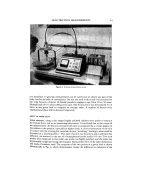
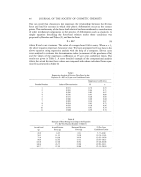
42 JOURNAL OF THE SOCIETY' OF COSMETIC CHEMISTS Rotating Shaft Screws Holding Adapter to Shaft Adapter Main Adapter Body Positioning Knob Sliding Connection Normal Load Stainless Steel Probe Figure 2. Friction probe assembly We have calibrated the scale readings in terms of absolute force by determining the scale response to different weights attached to the probe with a thread. The measuring head was laid horizontally on a table such that the probe assembly protruded over the edge. Measurements were conducted at the lowest speed available (3.6 rpm) and care was taken that the thread winding• • did not pile up on the probe. The calibration curve obtained representing the force versus load was linear. Joy, Machin, and McGaw used a similar technique employing a modified Haake viscometer for measuring skin friction properties in vivo (14). RESULTS AND DISCUSSION A general view of the set-up is shown in Fig. 3. As will be discussed below, the state of skin hydration affects its friction properties, and, hence, it was necessary to conduct the measurements under controlled temperature and humidity (22øC and 55 per cent rela-
Purchased for the exclusive use of nofirst nolast (unknown)
From: SCC Media Library & Resource Center (library.scconline.org)