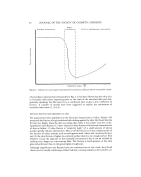
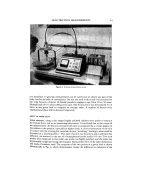
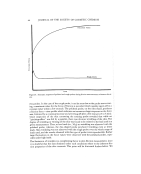
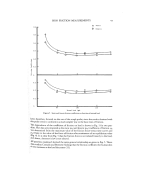
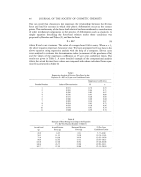
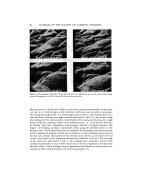
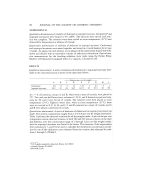
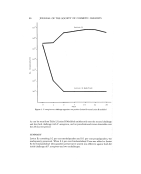
SKIN FRICTION MEASUREMENTS '• • • • .5• • •. '•. -v ,•-:' •- •,•'• ,•,. • ..... '•, ß '.-•'•.•.• • ? ..=,• .. • - • -'• . - . •:: -.,,.r ' :•'"• • a• ..... ' •'• .. ' . :• .... ":' •. •.' • ' :•- • '• .•-- • .... ?•.•-.•:•.'•.•,• ' '2• •:' '•:E ':. ,•, Figure 3. Friction measurement set-up tive humidity). In general, measurements can be carried out on almost any part of the body, but for the sake of convenience, the test site used in this study was restricted to the volar forearm of about 20 female panelists ranging in age from 20 to 50 years. Normal loads of 0 to about 200 g were used. The friction force was determined 3 to 4 times at any given load to compute an average value. A number of factors were examined and these will be discussed separately. EFFECT OF PROBE SHAPE Initial attempts, using a disc-shaped highly polished stainless steel probe to measure the friction force, led to an interesting observation. It was found that in the course of the measurement, the friction increased with time accompanied by a certain degree of discomfort to the panelist, especially at higher loads. A closer examination of the skin in contact with the rotating disc revealed obvious "wrinkling," leading to what could be described as a "pinching-effect." This type of probe was discarded, and to alleviate this difficulty, we resorted to the use of a hemispherical probe (radius 0.6 cm). Two such probes were employed in this work one probe was highly polished, and the other was intentionally roughened using emery paper. Both probes were of the same dimensions and made of stainless steel. The response of the two probes at a given load is shown schematically in Fig. 4, which demonstrates clearly the difference in behavior of the

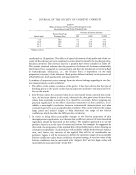
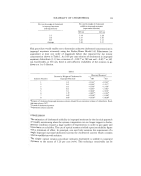
44 JOURNAL OF THE SOCIETY OF COSMETIC CHEMISTS Polished Probe Rough Probe Time Figure 4. Schematic response of polished and rough probes during friction measurements on human skin in vivo two probes. In the case of the rough probe, it can be seen that as the probe starts rotat- ing, a maximum value for the force of friction is recorded which quickly tapers off to a constant value within a few seconds. The polished probe, on the other hand, produces a friction force--time profile which indicates an instaneous large response on the force axis, followed by a continual increase and a leveling off after a few minutes (3 to 4 min). Close inspection of the skin contacting the rotating probe revealed that while no "pinching-effect" was felt by a panelist, there was obvious wrinkling of the skin. The degree of wrinkling or twisting of the skin was found to be related to the load used in a given measurement. Thus, at low loads (ca., 50 g) no wrinkling was observed with the polished probe, whereas, the disc-shaped probe produced wrinkling even at lower loads. Skin wrinkling was not observed with the rough probe over the whole range of loads used, and the results obtained with this type of probe were reproducible. Rather large fluctuations in the force values were observed with the polished probes, espe- cially under high loads. The formation of wrinkles is a complicating factor in skin friction measurement, since it is doubtful that the data obtained under such conditions relate to the inherent fric- tion properties of the skin corneum. This point will be discussed further below. We
Purchased for the exclusive use of nofirst nolast (unknown)
From: SCC Media Library & Resource Center (library.scconline.org)