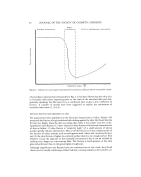
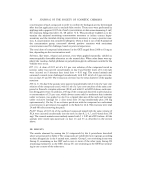
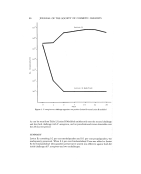
SKIN FRICTION MEASUREMENTS 39 where A• denotes the width of the plowed track. Usually, the plowing term is im- por,•ant only for the case of a hard material rubbing against a soft one if both are hard, the" friction is due mostly to the shear term. As an approximation, then, A may be eliminated from equations (1) and (2) to give F = L (Sin/Pro) (4) or /.6 = Sin/Pro = constant (5) This is Amonton's law as stated earlier. A point in connection with this law is that the two quantities, Sm and Prn, represent the resistance to plastic flow of the softer of the contacting materials to shear and compression, respectively. The coefficient of friction may also depend on the relative velocity of the two surfaces. This will, for example, affect the local temperature, the extent of work hardening of metals, and the relative importance of the plowing and shearing terms. These facts work out such that the coefficient of friction tends to decrease with increasing sliding speeds (4, 5) contrary to Coulomb's law, which holds that/x should be independent of sliding velocity. At very low speeds, the effect is small. A number of friction studies have been carried out on organic polymers in recent years (4-6). The detailed results show some serious complications, however. The coefficient of friction was shown to be dependent on the load as has been illustrated, for example, in the case of a copolymer of hexafluoroethylene and hexafluoropropylene (7), where it was suggested that the area of contact is determined more by elastic than by plastic de- formation. The difference observed between the static and kinetic coefficients of fric- tion (the force required to initiate sliding of the load gives/xs, where s refers to static, and the force requires to sustain the motion gives/xk, where k refers to kinetic) was at- tributed to the transfer of an oriented film of polymer to the steel rider used in the ex- periment during sliding and to low adhesion between this film and the polymer surface. An important aspect of friction measurements in relation to cosmetic applications is the friction between lubricated surfaces. Two limiting conditions exist where lubrica- tion is used. In the first case, the oil film (lubricant) is thick enough so that the surface regions are essentially independent of each other, and the coefficient of friction de- pends on the hydrodynamic properties, especially the viscosity, of the oil. Amonton's law is not involved in this situation, nor is the specific nature of the solid surfaces. As load is increased and relative speed is decreased, the film between the two surfaces be- comes thinner and increasing contact occurs between the surface regions. The coefficient of friction rises from the very low values possible for fluid friction to some value that is usually less than that for unlubricated surfaces. This type of lubrication, i.e., where the nature of the surface region is important, is known as boundary lubrica- tion and involves a strong physical adsorption of lubricant on the surface or even a sur- face chemical reaction leading to a very strong bond between the lubricant and the substrate. The general feature of friction between lubricated surfaces is usually represented by what is known as the Stribeck curve, which is a plot between the coefficient of friction and the so-called Sommerfeld number, wV/P. • is the viscosity of the lubricant film, V is the speed of sliding, and P is the normal load per unit area. This

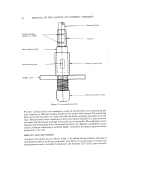
4O JOURNAL OF THE SOCIETY OF COSMETIC CHEMISTS Boundary Lubrication Mixed Lubrication• Fluid or Hydrodynamic Lubrication I I I I I I I I I I I I I I I So•erfeld Number (•p•) Figure 1. Stribeck curve showing the relationship between friction coefficient and the Sommerfeld number relationship is represented schematically in Fig. 1. It has been shown that the value of/x in boundary lubrication depends greatly on the state of the adsorbed film and that, generally speaking, the film must be in a condensed state to give a low coefficient of friction. A number of models have been suggested to explain the mechanism of boundary lubrication (1, 4, 8, 9). PKEVIOUS FRICTION MEASUREMENTS ON SKIN Few papers have been published on the frictional characteristics of skin. Naylot (10) measured the friction of a polyethylene ball rubbing against the skin. He found that the friction was higher when the skin was damp than when it was either very wet or dry. Appeldoorn and Barnett (11) have observed other distinctive frictional characteristics of skin as follow: (1) skin friction is "relatively high " (2) a small amount of talcum powder greatly reduces skin friction. This is well known, but it is not a characteristic of the friction of other systems such as steel-against-steel, where talc increases friction and (3) the skin friction is higher on a smooth surface than it is on a rough surface. This behavior is just the opposite to that normally encountered, but it can be verified by rubbing one's finger on a microscope slide. The friction is much greater on the clear glass (smooth) part than on the ground glass (rough) part. Although Appeldoorn and Barnett have not conducted any in vivo work, they found that an in vitro model combining a rubber ball and a rotating stainless steel cylinder cot-
Purchased for the exclusive use of nofirst nolast (unknown)
From: SCC Media Library & Resource Center (library.scconline.org)