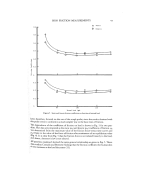
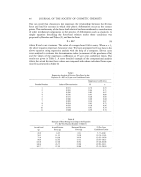
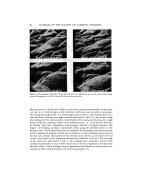
38 JOURNAL OF THE SOCIETY OF COSMETIC CHEMISTS range of speeds, and the resistance to the rotating motion can be measured directly via a torque measuring device. Specifically, we have set out to examine the applicability of the general laws of friction, derived mainly for metallic materials, to human skin as a substrate. A basic premise of modern friction theories relates to the distinction between the real area of contact between sliding materials and the geometrical area. The real area of contact is much smaller than the geometrical area due to surface rough- hess. This point has been examined in some detail using a rough and highly polished probe made from the same material. Also, the effect of Lubricants (talcum powder and silicone oil) has been examined and an attempt was made to elucidate the lubrication mechanism of these materials. THEORETICAL BACKGROUND The coefficient of friction/a between two solids is defined as F/L, where F denotes the frictional force and L is the load or force normal to the surfaces. When/a is constant, • = F/L is known as Amonton's law and expresses two important observations: (1) the friction force is proportional to the normal force and (2) the friction force is inde- pendent of the apparent area of contact. There is abundant evidence that even microscopically smooth surfaces are irregular on a molecular scale of distance. As a result of irregularities, two surfaces brought into contact will touch only in isolated regions. The true area of contact is then much less than the apparent area it can be estimated, for example, from a measurement of the electrical conductivity between the two solids. it is also known that high local tempera- tures can develop during rubbing, as well as high local pressures, which can lead to plucking out of portions of the softer material by the harder one (1-4). As the two surfaces are brought together, the pressure is large at the initial few points of contact, and deformation immediately occurs to allow more and more contact to develop. This plastic flow continues until there is a total area of contact such that the local pressure has fallen to a characteristic yield pressure Pm of the softer material. Thus, around each region of contact, there is a plastic zone, with further elastic de- formation outside (2). The actual contact area is then determined by the yield pressure, so that A = L/Pro (1) In a typical measurement of friction, a slider is pressed against a stationary block and the force F required to move the slider is measured. This force, in general, will consist of 2 terms. First, there is the force F required to shear the junctions at the pointõ of actual contact. This is given by F = ASm (2) where Sm is the shear strength per unit area. The second term, F•, is the force required to displace the softer material from the front of the harder one. With metals of dif- ferent hardness, the harder one, if used as a slider, will plow a track in the softer, and F• is, therefore, a work term associated with this plowing action. In a general way, one ex- pects F• to be proportional to the width of the slider, i.e. F• = K A• (3)

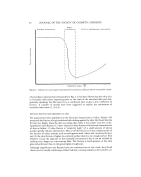
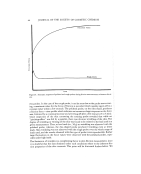
SKIN FRICTION MEASUREMENTS 39 where A• denotes the width of the plowed track. Usually, the plowing term is im- por,•ant only for the case of a hard material rubbing against a soft one if both are hard, the" friction is due mostly to the shear term. As an approximation, then, A may be eliminated from equations (1) and (2) to give F = L (Sin/Pro) (4) or /.6 = Sin/Pro = constant (5) This is Amonton's law as stated earlier. A point in connection with this law is that the two quantities, Sm and Prn, represent the resistance to plastic flow of the softer of the contacting materials to shear and compression, respectively. The coefficient of friction may also depend on the relative velocity of the two surfaces. This will, for example, affect the local temperature, the extent of work hardening of metals, and the relative importance of the plowing and shearing terms. These facts work out such that the coefficient of friction tends to decrease with increasing sliding speeds (4, 5) contrary to Coulomb's law, which holds that/x should be independent of sliding velocity. At very low speeds, the effect is small. A number of friction studies have been carried out on organic polymers in recent years (4-6). The detailed results show some serious complications, however. The coefficient of friction was shown to be dependent on the load as has been illustrated, for example, in the case of a copolymer of hexafluoroethylene and hexafluoropropylene (7), where it was suggested that the area of contact is determined more by elastic than by plastic de- formation. The difference observed between the static and kinetic coefficients of fric- tion (the force required to initiate sliding of the load gives/xs, where s refers to static, and the force requires to sustain the motion gives/xk, where k refers to kinetic) was at- tributed to the transfer of an oriented film of polymer to the steel rider used in the ex- periment during sliding and to low adhesion between this film and the polymer surface. An important aspect of friction measurements in relation to cosmetic applications is the friction between lubricated surfaces. Two limiting conditions exist where lubrica- tion is used. In the first case, the oil film (lubricant) is thick enough so that the surface regions are essentially independent of each other, and the coefficient of friction de- pends on the hydrodynamic properties, especially the viscosity, of the oil. Amonton's law is not involved in this situation, nor is the specific nature of the solid surfaces. As load is increased and relative speed is decreased, the film between the two surfaces be- comes thinner and increasing contact occurs between the surface regions. The coefficient of friction rises from the very low values possible for fluid friction to some value that is usually less than that for unlubricated surfaces. This type of lubrication, i.e., where the nature of the surface region is important, is known as boundary lubrica- tion and involves a strong physical adsorption of lubricant on the surface or even a sur- face chemical reaction leading to a very strong bond between the lubricant and the substrate. The general feature of friction between lubricated surfaces is usually represented by what is known as the Stribeck curve, which is a plot between the coefficient of friction and the so-called Sommerfeld number, wV/P. • is the viscosity of the lubricant film, V is the speed of sliding, and P is the normal load per unit area. This
Purchased for the exclusive use of nofirst nolast (unknown)
From: SCC Media Library & Resource Center (library.scconline.org)