82 JOURNAL OF THE SOCIETY OF COSMETIC CHEMISTS extended to include the deter•nination of the solubility of cholesterol, cholesterol esters, and other optically active cholesterol congeners in isopropyl myristate and other optically inactive solvents. The optical rotation procedure described above is particularly attractive as compared to other analytical procedures (4) used to determine cholesterol content quantitatively with respect to speed and simplicity of the measure- ment. REFERENCES (1) E. S. Lower, "Cholesterol in Cosmetic Formulations--A Review," Drug Cosmet. Ind., 116, 54 (1975). (2) E. S. Lower, "Cholesterol in Cosmetic Formulations--A Review," Drug Cosmet. Ind., 116, 48 (1975). (3) E. S. Lower, "Cholesterol in Cosmetic Formulations--A Review," Drug Cosmet. Ind., 116, 57 (1975). (4) T. Higuchi and E. Brochmann--Hanssen, PharmaceuticalAnalysis, Interscience Publishers, New York, 1961, Pp. 119-25.

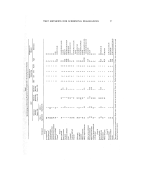
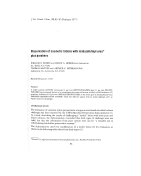
j. Soc. Cosmet. Chem., 28, 83-87 (February 1977) Preservation of cosmetic lotions with imidazolidinyl urea* plus parabens WILLIAM E. ROSEN and PHILIP A. BERKESutton Laboratories Inc., Roselle, N.J. 07203. THOMAS MATZIN and ARTHUR F. PETERSON Wells Laboratories, Inc.,Jersey City, N.J. 07306. Received February 27, 1976. :' Synopsis A model cosmetic LOTION containing 0.2 per cent METHYLPARABEN plus 0.1 per cent PROPYL- PARABEN was previously shown to be unsatisfactorily preserved because it failed to kill Pseudomonas (P.) aeruginosa. Addition of 0.3 per cent IMIDAZOLIDINYL UKEA to the lotion gave an Imidazolidinyl Urea- !i:.' PARABEN PRESERVATIVE SYSTEM, which was effective against both an initial challenge of P. ae- ruginosa and two rechallenges. INTRODUCTION The evaluation of cosmetic lotion preservation using pure and mixed microbial culture challenges has been reported by the CTFA Microbial Preservation Subcommittee (1). In a study describing the results of challenging a "model" lotion with both pure and mixed cultures, the Subcommittee concluded that both types of challenge tests are valid, but that the information from pure culture tests can be "a valuable aid in reformulating borderline preservative systems." The Subcommittee used two modifications of a model lotion (2) for evaluation, as shown in the following table taken from their report (1). *Germall 115, registered trademark of Sutton Laboratories, Inc., Roselie, New Jersey 07203. 83
Purchased for the exclusive use of nofirst nolast (unknown)
From: SCC Media Library & Resource Center (library.scconline.org)