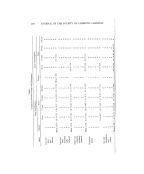
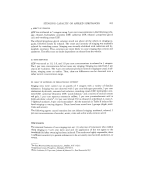
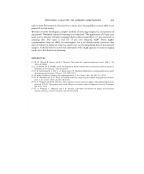
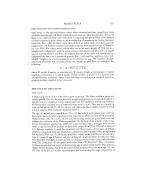
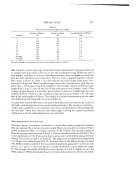
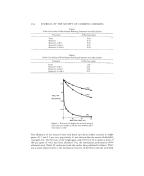
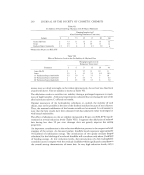
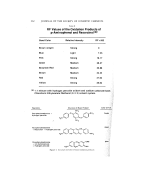
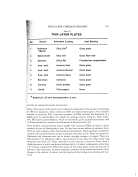
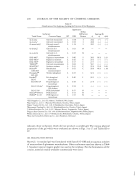
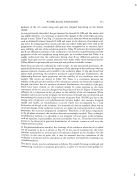
HYDROPHOBIC BONDS AND HAIR T1LEATMENTS Table IV Effect of Time on the Alkylation of Hair with N-Ethyl and N-Hexyl Maleimide '• 237 Time, Minutes Degree of Alkylarion, Per Cent N-Ethyl Maleimide N-Hexyl Maleimide 30 75 82 60 81 94 120 86 100 .i •[Maleimide] = 0.01 M Solvent = 20 per cent n-propanog0.04 M phosphate (pH 7) buffer temperature ½ 35øC bath Ratio = 100:1. approximately 15 per cent of the SH remained unreacted after 2 h, while a cor- responding sample of hair treated with the N-hexyl maleimide contained no residual SH (Table IV). This finding was in accord with the data presented by Heitz (6), who determined the second-order rate constants for the binding of N-heptyl maleimide to i::i.i yeast alcohol dehydrogenase. There, it was shown that the reaction rate for the N- ß heptyl maleimide reaction was approximately 8.4 times that observed with N-ethyl :'•': maleimide. This was somewhat unexpected, since a chainlength effect was not ob- ::: served in the reactions of these maleimides with cysteine and glutathione (6). We ob- served similar enhancement of the rate of alkylation in the case of reduced hair. .:'.:'::: Following reduction with thioglycolic acid, the sample was rinsed only briefly prior to the alkylation, and thus, residual thioglycolic acid remained in the fiber. At the end of a 24-h treatment, the cysteinyl residues were completely blocked by N-heptyl maleimide, while free thioglycolic acid was still detected in the alkylating solution. This observation and the previous results on the alkylation of reduced keratin indicate that •: an increase in the alkyl sidechain of the maleimide leads to faster rates of alkylation in spite of the .unfavorable diffusion factor. Such an enhancement in the reactivity may be '•i tentatively ascribed to the interaction between the alkyl sidechain of the reactant and the nonpolar residues of the keratin, which apparently provide an effective hydro- phobic environment for the combined cystine. .. •., 6. Swelling properties of the alkylated hair.' The extent of internal modification of ke- ,:.•:.. ratin often can be readily assessed from the change in the swelling characteristics of this : protein. Thus, fission of the disulfide bonds is accompanied by an increase in water •, imbibition, which is almost directly proportional to the number of crosslinks severed. According to our hypothesis of hydrophobic modification of hair, the introduction of , apolar residues should compensate for at least some of the disulfide bond breakdown. A strong support for this view was obtained from the liquid retention measurements of reduced and reduced-alkylated hair (Table V). The reduction treatment alone causes a large increase in swelling in both water and aqueous alcohol. Alkylation of reduced hair with methyl iodide or N-ethyl maleimide slightly intensifies the swelling. This incre- ment in hydration is probably caused by the elimination of weak hydrogen bonding involving the sulfur hydrogen and the apparent inability of the methyl or N-ethyl deri- vatives to establish any specific interactions with the environment. On the other hand, alkylation with either N-hexyl or N-heptyl maleimides brings about significant decrease in hydration. Obviously, the introduction ofhydrophobic residues can impart

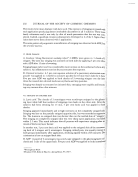
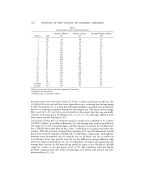
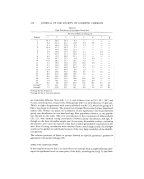
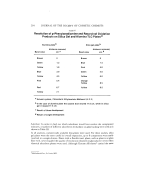
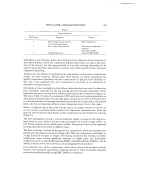
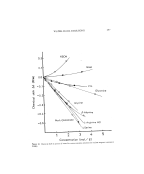
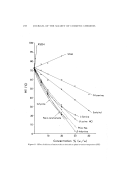
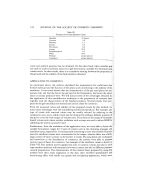
238 JOURNAL OF THE SOCIETY OF COSMETIC CHEMISTS TABLE V Effect of Apolar Residues on the Swelling Properties of Hair Per Cent Swelling • in: Per Cent Alkylating 50 Per Cent 50 Per Cent 20 Per Cent 50 Per Cent Reduction Agent Water Methanol Ethanol Propanol Propanol 0 None 31.4 n.d. b n.d. b 31.6 32.2 45 None 39.9 35.8 37.4 42.6 45.2 45 Methyl iodide 47.2 42.2 46.2 47.8 49.2 45 N-ethyl maleimide 45.3 41.0 45.5 48.6 51.1 45 N-hexyl maleimide 33.9 33.7 37.8 39.5 46.3 45 N-heptyl maleimide 34.8 33.6 37.7 40.9 46.4 82 N-hexyl maleimide 31.0 n.d. • n.d. • 44.9 56.5 82 N-dode cyl maleimide 28.2 n.d]' 31.9 36.4 47.5 82 N-benzyl maleimide 31.5 n.d. b 34.1 35.4 46.1 aCalculated on the treated weight of the fiber. "Not determined. substantial conformational stability to the reduced keratin structure and successfully.•:ii7 resist the swelling pressure. This conformational stability is, of course, lost in aqueous alcohols, where the phobic interactions between the apolar residues present in hair are prevented. Such a differential response to aqueous solvents offers a unique way of hair manipulation, par- ticularly with regard to setting. 7. Mechanicalproperties: Swelling data have shown that the imbibition of water by ratin can be restricted by hydrophobic modification of the fiber. Although, the precise nature of the intermolecular arrangement remains a subject of controversy (10, 1 the stabilization of hydrophobic bonds by water is not disputed. The strength of the hydrophobic bond is represented by the tendency of nonpolar groups to adhere to one another. The free energy of this process has been assessed (12), and in the case of the.. ( interaction of 2 methyl groups, was found to be -0.73 kcal/mole for alkyl sidechains.'"?? The increment in the free energy of binding was in the order of -0.37 kcal/mole per•:is? CHz group. The overall contribution of these hydrophobic crosslinks to the tion of the keratin structure will depend on the size, shape, and number of the in-.7:. troduced apolar residues. : Some further insight on these hydrophobic interactions was obtained from a study o the mechanical properties. It is well known that the wet strength of intact hair bears a linear relationship to the cystine content over a wide range of reduction levels (13). Us- ing this linear relationship as a guide, a preliminary assessment of the stabilization ef -'?' fect arising from hydrophobic interactions was obtained from the mechanical behavior
Purchased for the exclusive use of nofirst nolast (unknown)
From: SCC Media Library & Resource Center (library.scconline.org)