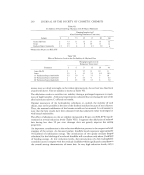
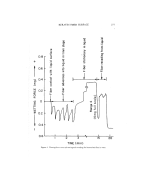
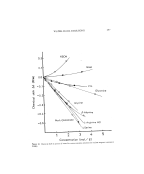
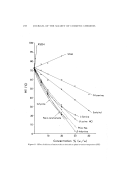
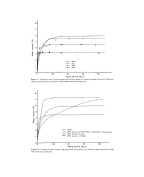
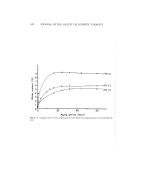
202 JOURNAL OF THE SOCIETY OF COSMETIC CHEMISTS The results were most dramatic with lactic acid. The intensity of stinging increased with each application producing almost intolerable discomfort in all 3 subjects. These hardy volunteers and it was only by dint of much persuasion that the test was corn- pieted. Indeed, superficial erosions subsequently developed in 2 of the 3. Signs tation have never been observed with 1 application. The same pattern of progressive intensification of stinging was observed with ADP, but the severity was less. VI. PRIOR DAMAGE - A. Sunburn.' Using fluorescent sunlamp tubes* 2 MEDs were given to 1 cheek of stingers. The next day stinging was assessed on both sides by applying 5 per cent nolic ADP after 15 rain of sweating. Stinging began earlier and was considerably more intense on the sunburned side in all 3 subjects. An inflammatory reaction thus accentuates the response. B, Chemical irritation.' A 5 per cent aqueous solution of a quaternary ammonium pound• was applied to 1 cheek by occlusive patches for 10 rain twice daily for 2 days• •.•5 :• Five per cent ADP was applied.to both cheeks of 3 sweating stingers one day later•:•? when the treated skin showed moderate erythema and tiny pustules. Stinging was sharply accentuated on irritated skin, emerging more rapidly and ing very intense after a few minutes. : VII. STINOING ON STRIPPED SnN A. Lactic actd.' The cheeks of 3 nonstingers were scotch-tape stripped to the ghsten-5• ing layer while half that number of strippings was made on the other side. After subjects had been sweating for 15 rain, 5 per cent lactic acid was applied to both'•3• cheeks. Stinging appeared immediately and in high intensity on the completely stripped side,•(• Stinging was less on the partially stripped opposite side, but was nonetheless apprecia2•'• ble. The duration on stripped skin was shorter than on the normal skin of"stingers.•.• The stinging on completely stripped skin was very sharp upon application, but within 2.5 min. This result indicates that all persons will experience stinging after moval of the horny layer barrier. In another test, 5 per cent lactic acid was applied to the stripped skin of the nonsweatS•:•3• ing back of 3 stingers and 3 nonstingers. Stinging, indeed pain, was equally intense both groups immediately after application, declining rapidly within a few minutes. Dis'fS• crimination is lost on stripped back skin. B. ADP: A panel of 3 nonstingers was scotch-tape stripped to the glistening layer o n cheek and 1 side of the upper back. Five per cent ADP was applied to both normal *Westinghouse FS 20. *Hyamine 3500, Rohm & Haas Co., Spring House, PA 19477. : .•:•:

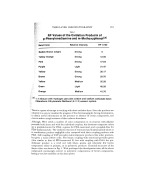
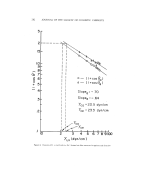
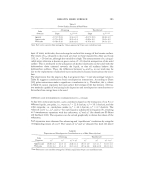
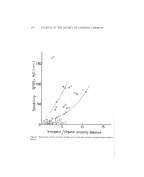
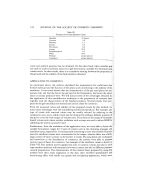
STINGING CAPACITY OF APPLIED SUBSTANCES 203 stripped skin. The first test was carried out on the backs without sweating and on the cheeks after 15 rain of sweating. Stinging did not occur on normal skin. On the stripped sites of the back, as well as the cheek intense immediate stinging developed, disappearing within about a minute. Stripping practically eliminates the distinction between stingers and nonstingers. It should also be noted that almost as severe stinging occurred after application of the ve- hicle, 95 per cent alcohol. It had become evident by this time that the difference between stingers and nonstingers was merely quantitative. To test this idea, 5, 10, and 15 per cent ADP was applied on separate occasions to the profusely sweating cheeks of 3 stingers and 3 nonstingers. The stingers experienced sharp discomfort with 5 per cent ADP the sevek'ity and duration of stinging increased progressively with the 10 and 15 per cent concentrations. With the latter, the distress was not appreciably reduced by leaving the chamber. As expected, 5 per cent ADP had no effect on nonstingers. All 3, however, experienced slight stinging with 10 per cent, while with 15 per cent, 2 of the 3 had moderate stinging. It is clear, then, that stingers merely have lower thresholds. When the stimulus is great enough, even nonstingers will experience mild to moderate stinging. We have repeatedly observed this phenomenon with other drugs at higher concentrations. VIII. REGIONAL DIFFERENCES Five per cent ADP was used on 3 stingers to compare the intensity of stinging in the following regions: central cheek, nasolabial fold, forehead, chin, infraorbital and retroauricular regions, axilla, antecubital fossa, upper back, and scalp. The applications were made after the subjects had been sweating for 15 min. Clear-cut stinging was restricted to the face, being most pronounced on the nasolabial fold, followed by the cheek, chin, infraorbital, and retroauricular region. The forehead reaction was marginal. Stinging was not perceived on the scalp, back, arm, and axilla. These findings conform to those of Weigand and Mershon (6) using tear gas 0-chlorobenzylidene malononitrile (CS) as the stinging agent. Stinging is pre- dominantly a facial phenomenon. IX. CORRELATION OF STINGING WITH IRRITANCY A. c•-hydroxy acids.' The test agents were: lactic acid, pyruvic acid, tartaric acid, and glycolic acid. Five per cent aqueous solutions were evaluated in 3 stingers at different sweating sessions. Comparative irritancy was determined by 24-h occlusive patch tests on the forearms with 5 and 15 per cent concentrations of the respective acids on the same subjects. The intensity of the reaction was scored on a 0 to 3 scale (0 = no erythema I = slight 2 = moderate and 3 = severe). The rank order of descending irritancy was: pyruvic glycolic tartaric lactic.
Purchased for the exclusive use of nofirst nolast (unknown)
From: SCC Media Library & Resource Center (library.scconline.org)