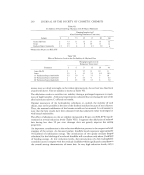
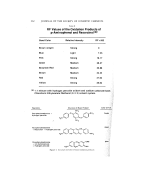
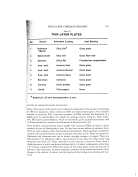
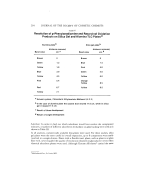
204 JOURNAL OF THE SOCIETY OF COSMETIC CHEMISTS The first 2 produced severe erythema and vesiculation with the 15 per cent concentra... tion. The rank order was the same in stinging tests the correlation was thus very good despite the small size of the sample. pH does not account for these differences (range 1.7 to 2.0). Laden (4) also found that acids of the same pH had quite different stinging capacities. Following his precedent, we compared equimolar (0.3 N) solutions (concentration percentages 2.25 to 2.70). The rank order of stinging was identical, although, stinging tended to be rather weak at these lower co ncentrations. I3. Esters ofp-aminobenzoic acid.' The test agents were glyceryl p-aminobenzoic acid (Gpi •:.•i• :I Escalol 106), (ADP-Escalol 506), and octyl-dimethyl-paba (OCP-Escalol 507). Five perljii" cent solutions in ethanol were tested for stinging in the usual manner on 3 subjects. Five per cent solutions were evaluated for irritancy by occlusive patch tests on the"•: forearm after criss-cross scarification of the skin with a 27-gauge needle. Applications .: were made daily for 3 consecutive days under cutaneous occlusion. : :: As usual, ADP induced sharp stinging. The other 2 esters lacked this property com, il pletely. GP caused modest redness while ADP and ODP were completely innocuous on sacrifled skin. So, in this instance, a stinging ester (ADP) was found to be nonirritating, while an irri-'. rating one (GP) was nonstinging. 5' C. Metalh'c antiperspirants: The test agents were aluminum chloride hexahydrate, alu-:: minum chlohydroxide, aluminum bromhydroxide (basic aluminum bromide), and zir-i conium hydroxychloride. Thirty per cent aqueous solutions of these were evaluated for irritancy by 24-h occlusive patch tests on forearm skin. This same concentration was , also used in stinging tests performed on 3 stingers. The rank order of irritancy was: ß minum chloride zirconium hydroxychloride aluminum chlorhydroxide equals i::• basic aluminum bromide. ß The last two caused no skin reaction, whereas the first two produced erythema and'::!:: ß : small pustules, aluminum chloride being somewhat more severe. As with hydroxy acids, stinging capacity paralleled irritancy. Aluminum chlorideii :i caused slight stinging, followed closely by zirconium hydroxychloride, while the other./ 2 salts lacked this property altogether. D. Effect of strong irritants.' A•'5 per cent aqueous solution of sodium lauryl sulfate produced an intense dermatitis in a 24-h patch test on the forearm of 3 stingers, still this same solution did not induce stinging in any sweating subject when applied to the: face. • Undiluted kerosene caused blisters in a 24-h patch test on the same 3 persons, but was•:: I. utterly without stinging potentiality. . A 5 per cent solution of Hyamine 3500 produced a marked irritant reaction by a 24 ' hr occlusive patch test. It, too, failed to elicit stinging. It is thus apparent that strong irritants may be completely free of stinging capacity.

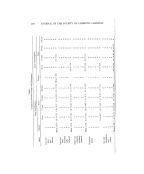
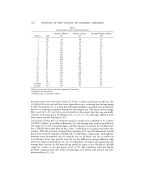
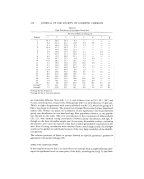
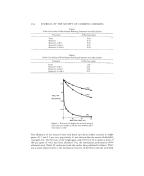
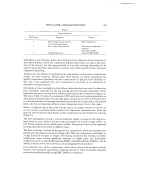
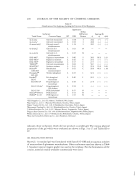
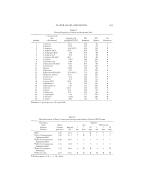
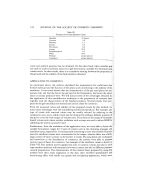
STINGING CAPACITY OF APPLIED SUBSTANCES 205 X. EFFECT OF VEHICLES ADP was evaluated in 5 stingers using 5 per cent concentrations in the following vehi- cles: ethanol, hydrophilic ointment USP, carbowax USP, ethanol: propylene glycol (1:1) and vanishing cream USP. The ethanol:propylene glycol solution stood out above all the others in stinging ca- pacity, followed closely by ethanol. The onset and intensity of stinging was markedly reduced by vanishing cream. Stinging was virtually abolished with carbowax and hy- drophilic ointment. Thus, solutions are more likely to cause stinging than creams and ointments. The effects are no doubt dependent on release from the vehicle. XI. DOSE RESPONSES ADP was tested at 1.0, 3.0, and 5.0 per cent concentrations in ethanol in 3 stingers. The 1 per cent concentration did not cause any stinging. Stinging was mild with 3 per cent in all 3 subjects. The 5 per cent solution produced intense stinging as usual in ad- dition, stinging came on earlier. Thus, clear-cut differences can be detected over a rather narrow concentration range. XII. ASSAY OF MATERIALS OF DEILMATOLOGIC INTEREST Stinging tests were carried out on panels of 5 stingers with a variety of familiar substances. Stinging.was not observed with 3 per cent hydrogen peroxide, 5 per cent ammonium hydroxide, saturated salt solution, vanishing cream USP, hydrophilic oint- ment USP, carbowax Ointment USP, "pool chlorine," and a variety of steroid creams and gels, 1 per cent aqueous neomycin sulfate, 5 per cent p-aminobenzoic acid in hydro-alcoholic vehicle*, 0.2 per cent Uvinul 539 in ethanol (2-ethylhexyl-2-cyano-3- 3-diphenyl-acrylate), 8 per cent homosMate'}'. All the materials in Table II induced de- layed stinging to varying degrees. These have been sorted into 3 groups (slight, mod- erate, and severe). The following agents caused transient but not delayed stinging: methanol, ethanol, 5 per cent concentrations of ascorbic, acetic, citric and sorbic acids, retinoic acid.:• DISCUSSION The essential features of our stinging test are: (1) selection of volunteers who exhibit sharp stinging to 5 per cent lactic acid and (2) application of the test agent to the nasolabial fold after sweating has been induced. The results are highly repeatable there is sufficient sensitivity to permit substances to be accurately rated as mild, moderate, or severe. *Pre-Sun, Westwood Pharmaceuticals, Inc., Buffalo, N.Y. 14213. 'l-Coppertone Cream, Plough Inc., Memphis, TN 38151. •Retin A solution, 0.05 per cent, Johnson & Johnson Co., East Brunswick, N.J.
Purchased for the exclusive use of nofirst nolast (unknown)
From: SCC Media Library & Resource Center (library.scconline.org)