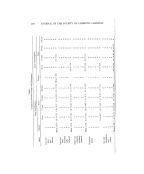
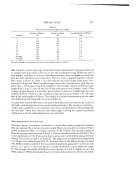
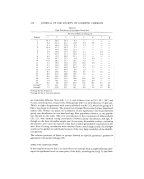
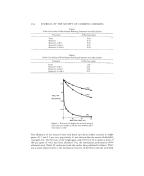
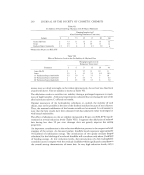
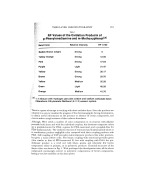
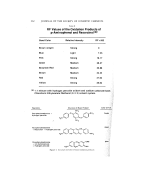
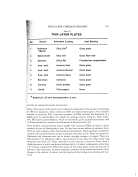
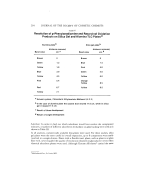
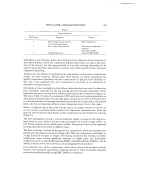
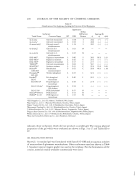
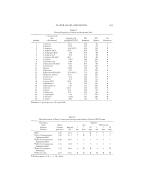
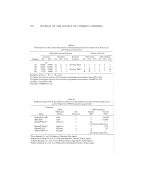
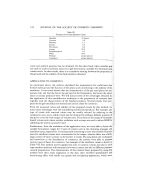
THIN-LAYER CHROMATOGRAPHY Table V 265 Solvent Selection Dye Group Properties Solvent 1 Fast moving, low molecular wt. Ether: chloroform one or two ring structures 2 Two or three ring structures Chloroform: ethylacetate: methanol Chloroform: DMF Alcohol, DMF, DMSO 3 Immobile polymeric solid phase as the thin-layer plates, they did not have the sharpness of the resolution of the analytical plates. All of the components diffused much more, not only in the direc- tion of the elution, but also perpendicular to it as well, showing channeling of the solvents along the fibers which form an isotroric web. This resulted in more extensive component spreading. Alumina was less efficient in performing the total analysis of all product-compositions studies. In some instances, alumina gave much sharper or cleaner separations for specific components. Specificity was not a characteristic of pH, but of the adsorbent it- self, and it was qualitative for most components in the form of no adsorption or extremely strong adsorption. Development time was slightly reduced when a glass adsorbent was used, but there was poor resolution, especially for the fast-moving and slow-moving components. Good resolution was never achieved with cellulose solid phase either in the form of papers or TLC plate. Table IV shows the resolution of PDA and resorcinol oxidation products on silica gel and alumina plates. On silica gel plates, the product is well resolved and there is not much specificity of strongly adsorbed and nonadsorbed components. On alumina plates, the fast-moving pink and many other components stayed close to the origin. So/vent: A difficult task in this study was the choice of a proper solvent or solvents, as no one system was found which resolved all components simultaneously. From the point of view of solvent requirement, all dye components can be divided into 3 groups (Table V). The dyes belonging to Group 1 are low molecular weight, one-ring or two-ring struc- tures (such as nitro aniline) and are compounds which are mostly orange, yellow, or red. These components are usually water soluble. This group of dyes can be separated by using chloroform and ether in different ratios. The dyes in Group 2 include all the specific dye components, which are of primary im- portance for the shade and intensity of hair color. They are components containing 2 or 3 rings bound by nitrogen or oxygen. The elution system for the resolution of these components must contain significant amounts of highly polar and hydrophilic components such as dimethylformamide (DMF), dimethylsulfoxide (DMSO), and al- cohols, as well as low-activity solvents, such as halogenated hydrocarbons. In an arbitrary way, all dye components, which did not elute with the above solvent systems, were grouped as polymeric materials (Group 3). They are mostly immobile and can be resolved partially using DMF, DMSO, or methanol.

266 JOURNAL OF THE SOCIETY OF COSMETIC CHEMISTS Oxidation products are sensitive to both acids and bases used in the solvent system and produce irreversible destruction of a number of components of the product. Their use in solvent systems was avoided. Moisture.' In the resolution of oxidative dyes, a trace amount of moisture is more detri- mental for the reproducibility than other chromatographic separations. It was observed that the resolution of certain components can be eliminated completely by allowing moisture in the system through the plates or from the atmosphere. Actz'•'ation.' Developed plates, on which oxidative dyes cannot be reactivated for a second elution in a similar fashion, because they undergo irreproducible changes or cannot be controlled. Dyes to be applied on the activated plate were dissolved in DMF, since the polymeric component of the dye had a limited solubility in other less polar solvent. When preparing a sample of a solvent, that solution should never be warmed, and fresh solution should always be prepared just before applying it to the plate. Application to plate.' With oxidative dyes, it is preferable to apply the products to the plate as a sharp band, rather than as a spot, for 2 reasons. One, the left-over unreacted dye precursors, which developed during the elution process, causes heavy trailing and interferes with the chromatography of an already formed oxidized product. Second, the oxidized products undergo secondary coupling reactions on silica gel, giving grayish-brown polymeric trailing. When the dye is applied as a band, visual identifica- tion of the components present in smaller amounts can be achieved. Evaluation and documentation.' Evaluation and documentation of the thin-layer plates should be done immediately after elution to record the presence or absence of components and the relative strength of color of individual components. This is re- quired because 3 events may occur on the developed plate. One, a new color may form from untreated precursors two, color may fade from the intensely colored products and three, color may change. For example, green color changes to gray, blue changes to purple, and so on. All of these processes can be slowed down, immediately following elution, if the plates are wrapped tightly to exclude air in polyethylene bags (preferably black) or are kept in a dark place. ELUTION TECHNIQUES Single elution.' Single elution of the spotted plates should be done as soon as the spot- ting solvent has evaporated. A spotted plate cannot be dried at an elevated temperature or even at low temperature for very long. It should be developed immediately after drying. If not completely removed, DMF moved all the components until it was sufficiently diluted by the weaker eluting solvent. Aging at room temperature resulted in a dispro- portionate loss of specific components and caused the formation ofpolymeric material. Complete drying caused the destruction of some components. So it was necessary to choose between complete drying and leaving spotting solvent on the plate. These studies indicated that it was harmful to leave some spotting solvent rather then to dry completely.
Purchased for the exclusive use of nofirst nolast (unknown)
From: SCC Media Library & Resource Center (library.scconline.org)