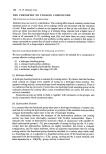
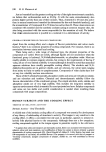
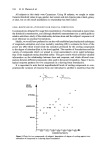
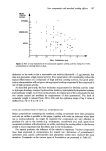
194 H.R. Watson et al. All subjects in this study were Caucasians. Using 50 subjects, we sought to relate forearm threshold values to age, gender, hair colour and skin type (as pale or dark, greasy or dry), but on this small population no relationship has been noted. DOSE--RESPONSE RELATIONSHIPS FOR COOLING COMPOUNDS In compositions designed for usage the concentration of cooling compound is many times the threshold concentration, and although threshold measurements are a useful guide to relative activities a study of the relationship between dose and the subjects' response is of more relevance to practical formulations. Ideally, we would have preferred to use the well established psychophysical techniques of magnitude estimation and cross modality matching (29) to evaluate the form of the power law (30) which would relate the sensation produced by the cooling compounds to the degree of stimulus (that is, the dose) applied. The number of formulations and the variety of compounds which we wished to cover necessitated a more rapid technique, that of the magnitude rating described earlier. This gave results which afforded valuable information on the relationship between dose and response, and which allowed com- parison between different compounds when used in the same formulation. Figure 3 shows typical response patterns for two compounds in a shaving foam formulation. It is important to note that at suprathreshold levels of cooling compounds in com- positions the variation of response from one individual to another is much less than the ONHCH3 MEAN RATING O O STRONG V V o o MODERATE V • V o o o • o o o WEAK o 0 0.02 0,04 0'06 0.08 0.10 0,12 0.14 CONCENTRATION o• Figure 3. Plots, for two compounds, of subjects' description of degree of cooling against con- centration of compound in a shaving foam formulation.

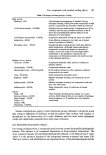
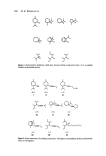
New compounds with menthol cooling effects 195 variation of threshold levels. (If this were not the case, then it is unlikely that menthol would be used so widely in toilet preparations.) The duration of the cooling effect on the skin is related to the dose, higher doses resulting in a more prolonged effect. Also, at a given concentration, the more active the compound then the more prolonged the effect this pertains regardless of compound type. Obviously, volatility is an important factor in determining duration. The cooling effect of volatile compounds, including menthol, is relatively transient and is rarely recorded for more than 15 min. The duration of involatile compounds is considerably longer some produce cooling for more than 4 h. After the initial perception of cooling effect has ceased, it is frequently observed that the cooling sensation is further perceived, but for shorter periods. This effect is more noticeable with strong compounds at high doses, and normally follows washing or sweating. The long duration of involatile compounds, and the repetition of the cooling effect, is consistent with the finding that compounds can still be detected in the stratum corneum 24 h after application. Thus, when Compound II (Fig. 2) was applied as a 10•o solution in ethanol to a 5 x 5 cm area of the forearm, half of the area being stripped with pressure-sensitive tape after 30 rain, and the other half after 24 h, 1-5 mg of compound was detected in strippings 3-6 after 30 min and 0.3 mg in stripping 3-6 after 24 h. OTHER SENSATIONS PRODUCED BY COOLING COMPOUNDS All cooling compounds produce sensations other than pure cooling. They are most readily described by reference to a strong peppermint candy, which produces tingle in the mouth and, if strong enough, a burning sensation. Compounds differ in the relative degree of cooling and side effects those that produce little effect other than cooling are, in our terminology, of high 'quality'. The relative degree of cooling and side effect appears to correlate to some degree to compound type for instance, phosphine oxides and hydroxyesters tend to have particularly low levels of side effect. The side effects are dose sensitive at low doses with most compounds, or at medium doses with compounds having a low level of side effects, they are not apparent. In general, increasing the dose of the cooling compound beyond a certain limit gives no apparent increase in cooling, but causes an increase in side effects, finally to a degree where the side effects dominate the cooling effect. Descriptions of side effects in the mouth, normally tingling, stinging, and burning, are paralleled by descriptions of side effects on the skin, and compounds prone to give oral side effects give side effects on the skin. In general, the more active the compound the less noticeable are the side effects at a given level of perceived cooling. SKIN PENETRATION Hydration or partial stripping of the stratum corneum aids penetration of the cooling compounds considerably, thus according with the established pattern reported by the other workers (27). The brief account of skin penetration which follows is directed to the relationship between the nature of the compounds and their ability to penetrate skin, and refers to non-occluded application where the skin has had no previous treatment, with relative humidity at between 40 and 60•o. When a composition containing a cooling
Purchased for the exclusive use of nofirst nolast (unknown)
From: SCC Media Library & Resource Center (library.scconline.org)