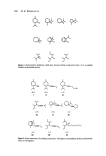
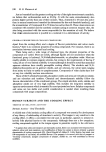
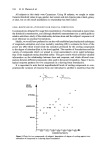
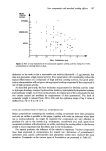
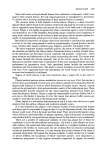
196 H.R. Watson et al. compound is placed on the skin, three processes must occur before a cooling effect is perceived: (i) molecules of the compound must transfer from the vehicle and must penetrate the surface of the stratum corneum. (ii) molecules must diffuse through the skin. (iii) molecules must interact with the receptors. Each of the three processes is influenced by the properties of the compounds, but the properties of the vehicle, in relation to its interaction with the compounds, are also of considerable influence on process (i). Polarity is the most important parameter of the vehicle. This is apparent from results obtained from usage formulations, and also from direct vehicle trials. Nine compounds with the/-menthol stereochemistry, either carboxamides chosen from compounds listed in Table II or hydroxyesters, were tested as 0'25•o solutions in eight vehicles which represented a polarity range from olive oil to aqueous ethanol, using the face test detailed above for shaving foams. Regardless of their intrinsic activity, all compounds gave higher cooling ratings in the more polar vehicles. Indeed, no cooling was noted from solutions in the two vehicles of lowest polarity, olive oil and hexyl laurate. In a corresponding test the Compound III (Fig. 2) was tested as a 0'4•o solution in different ethanol-water mixtures (25 33 50 67•o w/w of water). The cooling score increased progressively from 'weak-moderate' (25•o water) to 'moderate-strong' (67•o water). Onset of cooling effect occurred in less than 2 min, and it is believed that skin hydration had little or no influence on the increase of score. The process of transfer of compound from the vehicle to the outer skin layers may be viewed as a partition between the vehicle and the protein/lipid material which represents the stratum corneum. The cooling compounds are relatively hydrophobic (log P 0) and therefore they will partition only little from less polar vehicles into the skin: increase in polarity of the vehicles will shift the equilibrium in a direction which will favour absorption into stratum corneum. This effect is well established for example, hydro- phobic drugs are absorbed better from hydrophilic than from hydrophobic vehicles (31- 33). Once a cooling compound has been released from the vehicle into the stratum corneum, then its ability to diffuse to receptor sites is of prime importance. It is recog- nised that the size of molecule is a parameter of skin diffusion, and it is noteworthy that of the compounds of our series, those that give effective topical cooling all have molecular weights lower than 250. A degree of water solubility as well as lipid solubility appears essential for skin diffusion, and it is known that for most drugs the limiting parameter is water, rather than lipid, solubility (23). This is also apparent with cooling compounds, where in general compounds with lower log P values are more likely to be effective on the skin. A simple correlation of log P value with cooling effect is not expected, because the log P value influences intrinsic activity, but in those (short) homologous series which we have been able to study, the log P value of the compound with the highest topical score is displaced by approximately one unit, in the direction of more hydrophilic, when compared to the log P value of the compound of highest intrinsic effect. Oral threshold values are of limited use for prediction of topical effects. Figure 4 shows a plot of oral threshold against mean activity scores for 64 compounds in shaving foam (0'15•o concentration). There is clearly no well-defined correlation, and the only

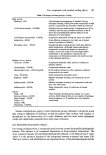
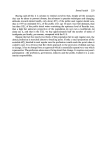
New compounds with menthol cooling effects 197 MEAN TOPICAL RATING STRONG MODERATE WEAK x x x x x x x x x ß x , x x I I I I I I • 0.2 0'5 I 2 5 10 "'- ORAL THRESHOLD (•Jg) Figure 4. Plot of oral threshold of 64 compounds against cooling activity rating for 0'15% concentration in shaving foam on face. deduction to be made is that a reasonable oral activity (threshold 2 gg) permits, but does not guarantee, a high topical activity. Poor penetration will considerably reduce the topical effectiveness of a compound of high intrinsic cooling activity, but good pene- tration characteristics will not give a strong topical cooling compound if the compound is not of high intrinsic activity. As described previously, the four molecular requirements for intrinsic activity relate to hydrogen bonding, compact hydrocarbon skeleton, hydrophilic/hydrophobic balance, and molecular weight. As evolves in this section, for topical use of the compounds the last two criteria named are modified by requirements of skin penetration. The limit of molecular weight is reduced from 350 to 250, and the optimum range of log P value is shifted from 3.0 + 1.0 to 2.0 + 1 '0. COOLING COMPOUNDS IN TOPICAL COMPOSITIONS Many compositions containing the synthetic cooling compounds have been prepared, and only an outline is possible in this paper, together with notes on instances where their use is contra-indicated. As might be expected the compounds are very effective in products for use in the mouth (e.g. toothpastes, mouthwash etc.) and, apart from occasional problems with absorption on solids, matching the cooling effect to the flavour profile is more important that the effects due to the formulation. For topical products, the influence of the vehicle is important. Various compounds have been examined in compositions for topical use derivatives of p-menthane-3- carboxylic acid, acyclic carboxamides and phosphine oxides have received the most attention. Comments on the various types of formulation are presented in Table III.
Purchased for the exclusive use of nofirst nolast (unknown)
From: SCC Media Library & Resource Center (library.scconline.org)