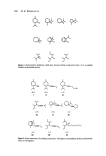
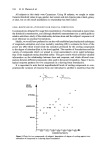
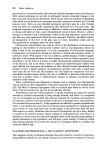
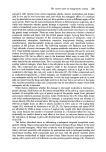
186 H.R. Watson et al. THE CHEMISTRY OF COOLING COMPOUNDS THE COOLING ACTION OF MENTHOL Menthol does not cool by volatilisation. The cooling effect almost certainly results from chemical action at or near those nerve endings which are associated with the sensation of cold. When menthol is placed on the lingual nerve of the cat the cold fibres of that nerve are either provoked into firing or, if already firing, respond with a higher rate of firing (2). Since the neurophysiological bases of the response to cold are essentially the same in all mammals (3-15), including man (16), and since there are many common features in the action of menthol and synthetic cooling agents, as related in this paper, it seems reasonable to assume that all such coolants act by a common mechanism, which is essentially that of a drug-receptor interaction (17). MOLECULAR REQUIREMENTS OF COOLING ACTIVITY We have established that four important criteria need to be satisfied for a compound to possess effective cooling activity: (i) a hydrogen bonding group (ii) a compact hydrocarbon skeleton (iii) a correct hydrophilic/hydrophobic balance (iv) a molecular weight in the range 150-350. (i) Hydrogen Bonding A hydrogen bonding function is essential for cooling action. We believe that the function must contain an oxygen atom capable of acting as a hydrogen bond acceptor. For greatest cooling activity, strong hydrogen bond accepting capability is necessary. There is no indication that the provision of more than one hydrogen bond accepting group in the molecule enhances the cooling effect some p-menthane-diols are active, but none is as active as/-menthol. Functional groups are listed in Table I, together with comments on the groups, and on the compounds which incorporate them. (ii) Hydrocarbon Skeleton It is assumed that the functional group takes part in hydrogen bonding at a receptor site, and that for cooling the hydrocarbon portion or portions of the molecule must provide a compact hydrophobic region near to the site of hydrogen bonding. The relationship between the structure of the hydrocarbon skeleton and cooling activity has been most thoroughly examined with N-alkyl carboxamides. Figure 1 indicates the variety of hydrocarbon structures which, in conjunction with suitable N- alkyl carboxamide groups (-X), give compounds of strong cooling activity. It is note- worthy that the hydrocarbon skeletons are highly branched this forces a compact configuration, and for many skeletons, allows an apparent requirement that for strong cooling activity the functional group should be attached to a carbon atom which itself is a branching site, or is adjacent to a branched carbon atom. If the functional group is separated from the branching by a -CH•- group, cooling activity is much reduced, and when separated by a -CH•CH•- group, activity is almost lost.

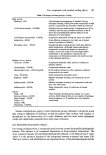
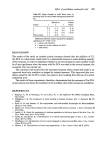
New compounds with menthol cooling effects Table I. Hydrogen bonding groups: cooling 187 High Activity Hydroxyl, -OH N-Alkylcarboxamide, -CONHR N,N-Dialkyl carboxamide, -CONRa Sulphoxido, -S(O) R Phosphine oxide, =P(O)R Medium or Low •lctivity Carboxyl, -COOH Carboxamide, -CONHa Hydroxyalkyl ester, -COOCnH2n0H Urea, -NCONRa Sulphone, -SOAR Sulphonamide, -SOaNRa Sulphinamide, -SONR2 Inactive Ether, -OR Ketone carbonyl, -C(O)R Ester (simple), -COOR Chloro, -C1 Amine, -NHa Thioamide, --C(S)NRa The hydrogen bonding group of menthol. Strong hydrogen bonding, which gives some compounds of high activity. Compounds are normally volatile and odorous. Probably the most useful group. Compounds are of low volatility, and the many possible variations of the R allow the hydrophilic/hydrol•hobic balance of the molecule to be tuned finely. Compounds reasonably strong but many are volatile. Gives effective compounds, but their use is limited owing to problems of stability. Strong hydrogen bonding groups which give effective, useful compounds. (Although organo-phosphoms compounds in general are suspect on ground• of toxicity, we are not aware of a toxicological effect attributable to the phosphine oxide group the compounds are thermodynamically very stable and are of low chemical reactivity.) Compounds relatively weak activity is reduced in alkaline vehicles. Compounds relatively weak. If the hydroxyl group is in the 2-position, moderate- strong activity can result. Some compounds reasonably active. Medium hydrogen bonding, but compounds of low activity. Medium hydrogen bonding, but compounds weak and have very bitter taste. Weak compounds, many of which are of limited stability. These hydrogen bonding groups appear not to give activity, either because they are not capable of hydrogen bond acceptance, or, if capable, give only relatively weak bonds. Similar considerations apply to other functional groups, although it should be noted that owing to difficulties of synthesis, we did not explore fully systems with sulphur or phosphorus as the hetero-atom of a cyclic skeleton, and the most active phosphine oxides and sulphoxides prepared have open chain structures. (iii) Hydrophilic/Hydrophobic Balance For strong cooling activity, a compound must have the correct hydrophilic/hydrophobic balance. This balance is of recognised importance in drug-receptor interactions. The most common measure of hydrophilic/hydrophobic balance is the Hansch log P value, where P is the partition function of the compound between n-octanol and water (18). The log P value is well established as an important factor of the pharmacological activity
Purchased for the exclusive use of nofirst nolast (unknown)
From: SCC Media Library & Resource Center (library.scconline.org)