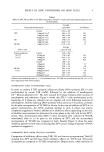
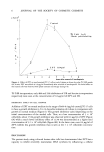
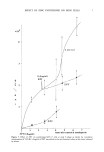
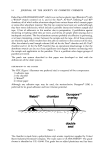
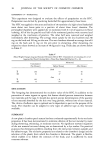
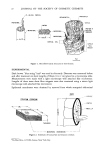
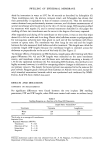
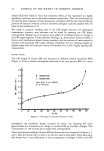
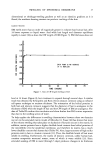
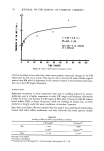
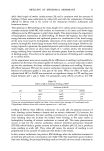
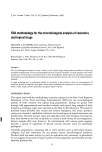
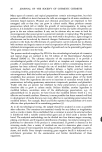
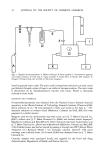
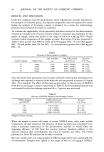
22 JOURNAL OF THE SOCIETY OF COSMETIC CHEMISTS r0•-HELICAL PROTEIN / r PARACORTEX ORTHOCORTEX • / X / F MATRIX f M)CROFIBR IL -- \\ \',.•/f.•\' 11• •-•7 NUCLEAR f •mCROFmBRmL • •00• •0• • •1000 • • aACROFIBRIL CELL {SCALE) Figure 1. Microfibril-matrix structures in wool keratin. EXPERIMENTAL Dark brown "blue string" hair* was used in this study. Diameter was measured before and after treatment on short lengths of fibers (1 to 2 cm) glued to a microscope slide. Measurements were made with a light microscope with attached filar micrometer. Lengths of these same short fiber snippets were also measured using a stereo light microscope with attached filar micrometer. Epidermal membranes were obtained by removal from whole autopsied abdominal STRATUM CORNEUM THICKNESS HAIR •-• CUTICLE j •m CODULLA / MICROFIBRIL ORIENTATION Figure 2. Schematic of human hair and stratum corneum. *De Meo Bros., 135 Fifth Avenue, New York City.

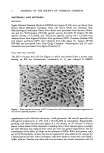
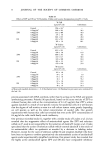
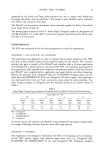
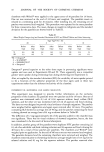
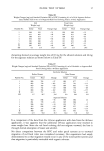
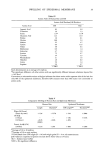
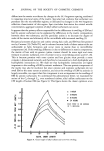
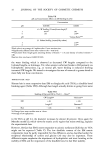
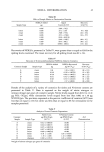
SWELLING OF EPIDERMAL MEMBRANE 23 skint by immersion in water at 55øC for 30 seconds as described by Scheuplein (6). These membranes carry the stratum corneum intact, and Scheuplein has shown that their permeability is equivalent to that of stratum corneum (6). Thus the membrane matter obtained was predominately stratum corneum, and thickness measurements of several membranes were found to be in the 10 to 15 micron range. EM was also purified by treatment with trypsin (7), and in several treatments described in this paper the swelling of these two membranes was the same to the degree of accuracy reported. After separation and drying of the membrane on wire screen, it was cut into thin strips about 0.5 to 0.6 cm wide and 4 cm long. Plastic tabs (cellulose acetate or polypropylene for non-aqueous solvents) were then glued to each end of the membrane with Duco cement or epoxy resin. The membrane was then hung by one end and the length between the tabs measured, both before and after treatment. This length was called the crosswise length (CW length) because the membrane length is oriented across the abdomen or perpendicular to the axis of the body (8). (See Figure 2.) To estimate effects of treatment on EM thickness, weight gains after blotting with filter paper (Whatman No. 42) and CW lengths were measured on the same membrane source, and membrane volume and thickness were calculated assuming a density of 1.55 for dry epidermal membrane (6). For estimating EM thickness, this method is not highly accurate however, it is valid for comparing relative changes in thickness vs. area, our primary concern. The density for bound solvent was assumed to be the same as for pure solvent. Reagent grade chemicals from Eastman or Aldrich were used, except for octyl trimethyl ammonium bromide which was synthesized and confirmed by NMR. Formic Acid 97% from Aldrich was used. RESULTS AND DISCUSSION COMMENTS ON MEASUREMENTS No significant differences were found between the two in-plane EM swelling parameters, CW and LW lengths, when EMs were treated with water or sodium lauryl Table I Swelling Response as a Function of In-Plane EM Orientation Length Ratio: Treated/Dry* Treatments Crosswise Lengthwise Water 1.09 1.08 SLS 1.35 1.32 *Each value is an average of 6 membranes. Statistical Test: Repeated Measures ANOVA Treatments F = 625 Direction of Cut F = 1.78 Interactions F = 1.20 Required F = 4.96 tHuman abdominal cadaver skin was obtained from Dr. A.M. Kligman, Ivy Research Laboratories, Department of Dermatology, University of Pennsylvania, Philadelphia, Pa.
Purchased for the exclusive use of nofirst nolast (unknown)
From: SCC Media Library & Resource Center (library.scconline.org)