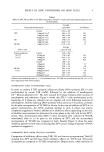
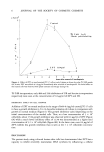
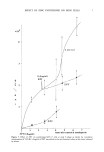
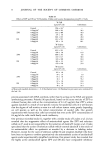
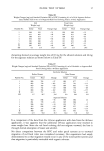
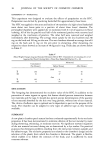
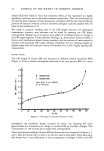
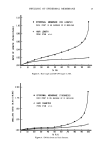
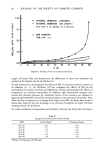
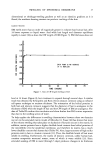
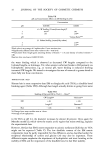
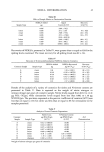
SWELLING OF EPIDERMAL MEMBRANE 33 FORMIC ACID The swelling action of formic acid on keratin fibers has been reported several times (1, 35, 36), and both hair and EM are highly responsive to formic acid. EM is considerably more responsive as evidenced by rapid and large changes in CW length and thickness (Table V) accompanied by a dry membrane weight loss of about 19 percent under these conditions. Once again we view the matrix as the primary region that resists swelling, even though Menefee (1) suggests that formic acid may also act in the microfibrils to produce some helical unfolding at concentrations above 90 percent. Formic acid (97%) is a powerful hydrogen bond breaking agent which can also break ionic bonds and is capable of disrupting structural lipid, since it can be used for disruption of cell membrane material and separation of cells (36). There is evidence that EM contains structural lipid (4, 5, 7) and more non-protein matter than hair. Furthermore, the micro fibrils of EM are believed to be embedded in a matrix of non-fibrous protein and lipid therefore, formic acid probably attacks and disrupts the nonprotein matrix lipid of EM (20) causing uncoiling and extension of the macromolecular chains and expansion of the total membrane. This latter effect is of less importance in human hair because of its low lipid content (Table IV). REFERENCES (1) E. Menefee, A mechanical model for wool, Textile Res. J. 38, 1149-1163 (1968). (2) M. Breuer, The binding of small molecules to hair: the hydration of hair and the effect of water on the mechanical properties of hair, J. $oc. Cosmet. Chem. 23,444-470 (1972). (3) C. R. Robbins, Chemical and Physical Behavior of Human Hair (Van Nostrand Reinhold Co., New York, 1979), p. 178. (4) L. A. Goldsmith and H. P. Baden, Uniquely oriented epidermal lipid, Nature 225, 1052, 1053 (1970). (5) G. Swanbeck, Macromolecular organization of epidermal keratin. An X-ray diffraction study of the horny layer from normal ichtlyatic and psoriatic skin, Acta Dermato- Venereol. 39, Suppl. 43 (1959). (6) R.J. Scheuplein, Mechanism of percutaneous adsorption. I. Routes of penetration and the influence of solubility,J. Invest. Dermatol. 45,334-346 (1965). (7) A.M. Kligman and E. Christophers, Preparation of isolated sheets of human stratum comeum, Arch. of Dermatol. 88, 70-73 (1963). (8) K. Femee and C. R. Robbins, A quantitative index for area swelling of epidermal membrane,J. Soc. Cosmet. Chem. 32, 53-54 (1981). (9) A. Kligman, in The Epidermis, W. Montagna and W. Lobitz, Jr., Eds. (Academic Press, New York, 19(4), p. 408. (10) P. B. Stam, R. F. Katy, and H.J. White, Jr., The swelling of human hair in water and water vapor, Textile ResearchJ. 22,448-465 (1952). (11) I. Blank, Factors which influence the water content of the stratum corneum, J. Invest. Dermatol. 18, 433-441 (1952). (12) J. D. Middleton, The mechanism of water binding in stratum corneum, Br.J. Derm. 80, 437-450 (1968). (13) M. A. Wolfram, N. F. Wolejsza, and K. Laden, Biomechanical properties of delipidized stratum corneum,J. Invest. Dermatol. 59, 421-426 (1973). (14) M. Rieger and D. Deem, Skin Moisturizers. I. Methods for measuring water regain, mechanical properties and transepidermal moisture loss of stratum corneum, J. Soc. Cosmet. Chem. 25, 239-252 (1974). (15) L.J. Wolfram, Some thoughts on skin 'Moisturization', Cutis 21,148 (1978). (16) J. D. Middleton, The effect of temperature on extensibility of isolated stratum corneum and its relation to skin chapping, Br.J. Derm. 81,717-721 (1969).

34 JOURNAL OF THE SOCIETY OF COSMETIC CHEMISTS (17) K.J. Beuttner, Diffusion of water vapor through small areas of human skin in normal environment,.J. Appl. Physiol. 14, 269-275 (1959). (18) G. Barnett, The swelling of hair is aqueous solutions and mixed solvents, M. S. Thesis, Polytechnic Institute of Brooklyn (1952). (19) R. Scheuplein and L. Ross, Effects of surfactants and solvents on the permeability of epidermis,.J. Soc. Cosmet. Chem. 21,853-873 (1970). (20) R. D. B. Fraser, T. P. MacRae, and G. E. Rogers, Keratins, Their Composition, Structure and Biosynthesis (Charles C. Thomas PuN. Springfield, Ill., 1972), p. 143. (21) C. R. Robbins, Chemical and Physical Behavior of Human Hair, p. 9. (22) R. D. B. Fraser et al., ibid., p. 29. (23) A. Matolsty and C. Balsarno, The components of the cornified epithelium of the human skin,J. Invest. Dermatol. 25, 71-75 (1955). (24) M. Spei, W. Stein and H. Zahn, Der Einfluss von Anionischen Tensiden auf die Roentgenkleinuimkel- diagramm non Faserkeratin, Kolloid-geitschrift und geitschrijQfur Polymere, 238, 447-454 (1970). (25) R. G. Crounse in Biology of the Skin and Hair Growth A. G. Lyne and B. F. Short, eds. (Angus and Robertson, Sydney, 1%5) pp. 307-312. (26) R. D. B. Fraser et al., ibid., p. 42. (27) R. D. B. Fraser et al., ihid., p. 7. (28) R. I. C. Spearman, Vertebrate Skin, Nature 276, 442 (1978). (29) J. Garcia-Dominguez, J. L. Parra, Ma R. Infante, C. M. Pelejero, F. Balaguer, and T. Sastre, A new approach to the theory of adsorption and permeability of surfactants on keratinic proteins: the specific behavior of certain hydrophobic chains,.J. Soc. Cosmet. Chem. 28, 165-182 (1977). (30) M. M. Breuer, The interaction between surfactants and keratinous tissue,.J. Soc. Cosmet. Chem. 30, 41-64 (1979). (31) J. Steinhardt, C. H. Fugitt, and M. Harris, Further investigations of the affinities of anions of strong acids for wool protein,.]. Res. N. B. S. 28, 201-216 (1942). (32) G. V. Scott, C. R. Robbins, and J. D. Barnhurst, Sorption of quaternary ammonium surfactants by human hair,J. Soc. Cosmetic Chem. 20, 135-152 (1%9). (33) Y. Noazaki,J. A. Reynolds, and C. Tanford, The interaction of a cationic detergent with bovine serum albumin and other proteins,J. Biol. Chem. 249, 4452-4459 (1974). (34) S. Makino, C. Tanford, and J. A. Reynolds, The interaction of polypeptide components of human high density lipoprotein with detergents,J. Biol. Chem. 249, 7379-7382 (1974). (35) J. H. Bradbury and G. V. Chapman, An investigation by light microscopy of the swelling of wool fibers, Textile Res. J. 33,666-668 (1%3). (36) J. H. Bradbury, G. V. Chapman and N. L. R. King, The chemical composition of wool. III. Analysis of cuticle, skin flakes, and cell membrane material, IIVTRC, Section I, 359-364 (1%5).
Purchased for the exclusive use of nofirst nolast (unknown)
From: SCC Media Library & Resource Center (library.scconline.org)