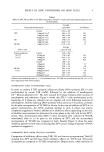
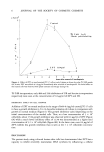
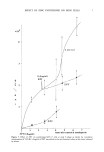
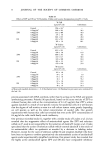
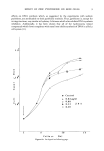
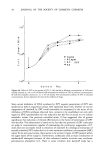
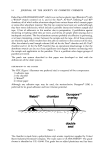
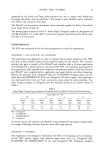
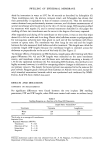
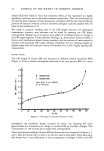
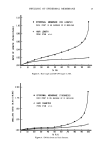
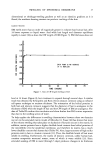
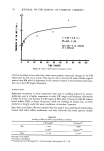
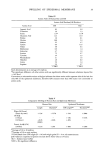
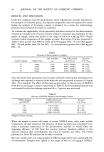
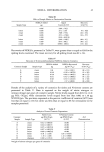
SWELLING OF EPIDERMAL MEMBRANE 27 dimensional or shrinkage-swelling gradient as well as an elasticity gradient as it is flexed, the resultant shearing stresses can produce cracking of the skin. LIQUID WATER EM swells more than an order of magnitude greater in volume than human hair, after 24 hours exposure to liquid water. And while hair length and diameter equilibrate rapidly in water (18), as does the CW length of EM (Figure 7), EM thickness does not 1.14 1.12 1.08 1.06 1.04 1.02 EACH POINT IS AN AVERAGE OF I0 REPLICAS 1.00 0 I0 20 30 40 50 60 70 TIME (HOURS} Figure 7, Rate of CW length swelling in H20. level at 24 hours (Figure 8), but continues to expand through several days. A similar result was obtained by Scheuplein and Ross (19) on stratum corneum using an infrared cell spacer technique to measure thickness. The orientation of the helical proteins in both hair and stratum corneum suggests that the diameter of hair is analogous to the thickness of EM, while the length of hair and the CW length of EM are analogous. The data of Table III confirm this conclusion and show further that EM is more responsive than hair to the swelling-action of water. To help explain the differences in swelling characteristics between these two keratins we turn to the extended matrix model of Menefee (1). Fraser (20) has shown that most of the volume swelling that takes place on hydration of keratins occurs in the matrix. In addition, matrix proteins have a higher disulfide bond content than helical proteins of the microfibrils (21) the epidermal membrane, and therefore its matrix, has a much lower disulfide content than human hair (Table IV). Also, larger amounts of high sulfur proteins exist in hair vs. stratum corneum (22). Thus, the disulfide bonds of hair must inhibit its swelling. Furthermore, the matrix of stratum corneum, unlike human hair, contains nonprotein structural matter, some of which is water soluble (23). Since extended soaking of EM in water (through 5 days) produces changes in its thickness

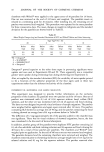
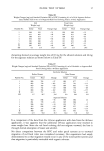
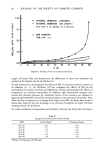
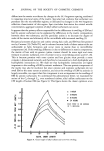
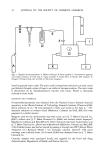
28 JOURNAL OF THE SOCIETY OF COSMETIC CHEMISTS In x R 2, 0.87 F ß 5:• EACH POINT IS AN AVERAGE OF 6 REPLICAS I I I I I I I I I I I o IO 2o :•o 4o 50 60 7o 80 90 IOO TIME { HOURS} Figure 8. Rate of EM thickness changes in water. (19), but leveling occurs with hair, water must produce structural changes in the EM matrix that do not occur in hair. This may be due to removal of water soluble organic matter from EM which is important to the corneum matrix in the thickness dimension, but not in the CW length dimension. SURFACTANTS Epidermal membrane is more responsive than hair to swelling induced by anionic surfactant, and it is highly responsive in both CW length and thickness dimensions (Table V). In fact, the increase in CW length of EM, after 24 hours in 0.069 M sodium lauryl sulfate (SLS), is about 30 percent, while the swelling of human hair in either diameter or length, under the same conditions, is less than 7 percent. Spei, Stein, and Zahn (24) have examined the low angle x-ray scattering of mohair fibers treated with alkyl sulfate surfactants, and they conclude that these species initially Table III Swelling of Hair and EM in Liquid Water at 24 Hours CW Length* Thickness** EM q- 11% + 2O0% Length* Diameter*** Hair + 1.3% + 15.7% *Average of 10 replicas **Average of 30 replicas ***Calculated from CW length (N = 10) and weight measurements (N = 24)
Purchased for the exclusive use of nofirst nolast (unknown)
From: SCC Media Library & Resource Center (library.scconline.org)