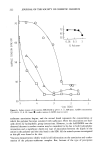
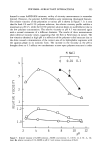
j. Soc. Cosmet. Chem., 41, 213-225 (July/August 1990) Interactions between an amine functional polymer and an anionic surfactant DOMINGO I. JON and DAVID L. CHANG, Clairol Inc., 2 Blachley Road, Stamford, CT 06902. Received June 28, 1990. Synopsis The interactions between an amine functional polymer (adipic acid/dimethylaminohydroxypropyl dieth- ylenetriamine, AADD) and an anionic surfactant (sodium dodecyl sulfate, SDS) in water have been investi- gated via solubility diagram and surface tension measurements. Complex formation between these two components depended strongly on mixing conditions, such as the pH of the solution and mixing ratio. Under conditions where the pH has not been preadjusted, it was found that addition of SDS to a solution of AADD would increase the pH of the solution, indicating an SDS-induced protonation of the polymer. Different types of complex were formed: soluble complex, gummy rubbery precipitate, or redispersible powdery solid. The phase transitions going from one type of complex to another were found to be very sensitive to the mixing ratio of the two components. Surface tension data taken at pH ! 1.5, 9.5, and 2.5 (where the AADD is neutral, partially charged, and fully charged, respectively) showed that while the polymer was only weakly surface-active by itself, mixtures of the polymer and SDS yielded a highly sur- face-active complex that reduced the surface tension of water drastically. Three different forces were ascribed to the complexation between the polymer and the surfactant: One was through hydrophobic interactions in the polymer and surfactant hydrophobic segments. Another force that promoted complex association was the dipole-ion interaction. The third type is the strong coulombic or charge-charge interactions between oppositely charged species. AADD interacted with the anionic surfactant SDS via any one, or combinations, of the three forces. The form which the interaction took was dependent on the pH of the medium due to the nonionic/cationic nature of the polymer. INTRODUCTION Water-soluble polymers have been shown to interact with surfactant species to varying degrees, depending on the properties of the polymers and surfactants. In particular, ionic surfactants bind to both neutral and oppositely charged macromolecules (1-6). The nature of the association complex between neutral polymers and ionic surfactants resembles polyelectrolytes, and the interaction is believed to be mainly hydrophobic in character. Anionic surfactants interact with neutral polymer more readily than cationic surfactants. In these cases, the role of the surfactant head group size seems to acquire added importance (7). Charged polymers, on the other hand, interact strongly with oppositely charged surfactants due to both electrostatic and hydrophobic forces between the surfactant ions and the polyions involved.

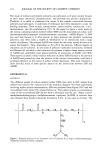
214 JOURNAL OF THE SOCIETY OF COSMETIC CHEMISTS The study of interactions between polymers and surfactants is of great interest because of their many industrial, pharmaceutical, and personal-care product applications. Therefore, it is useful to understand the nature of the complex interactions between polymers and surfactants. A multitude of techniques have been employed to study the binding isotherms. These include, among others, surface tension, conductivity, e.m.f. measurements, and dye solubilization (5,6). In this paper we report a study made on the system containing sodium dodecyl sulfate (SDS) and the macromolecule adipic acid/ dimethylaminohydroxypropyl diethylenetriamine copolymer, AADD (Figure 1). SDS was used here because it is often present in many personal care products containing polymers, and there exists a wealth of information on its interactions with a large variety of polymers. The polymer AADD was chosen for this study mainly because of its amino functionality. Thus, depending on the pH of the solution, different degrees of ionization can be achieved. In one study of polymer-surfactant interactions, Goddard and Hannan (8) included in their selection of polymers a higher charge density version of AADD and established some general patterns of interaction of AADD with SDS. They reported a drastic surface tension reduction in dilute SDS solutions in the presence of AADD and pointed out that the position of the cationic functionality could have a profound influence on the extent of surface tension depression. This work represents a more detailed study of some specific aspects on the interactions between SDS and AADD. EXPERIMENTAL MATERIALS Two different grades of sodium dodecyl sulfate (SDS) were used: A 98% sample from Aldrich was used for the construction of the solubility diagram. For those experiments involving surface tension measurements, SDS was purchased from Sigma (99%) and was recrystallized twice from 95% ethanol before use. The surface tension-vs-concentration curve of this recrystallized SDS did not show a minimum near the cmc. Adipic acid/di- methylaminohydroxypropyl diethylenetriamine copolymer (AADD) in solution form was obtained from Sandoz Chemicals (Cartaretin F-23). It was used as received. The õ ---C (CH2)4 C--N CH2•H2--N CH2•H2--N-- H I H CH• I CHõH I CH• I N HaC CHa Figure 1. Proposed structure of the monomeric unit of Cartaretin F-23, adipic acid/dimethylaminohy- droxypropyl diethylenetriamine copolymer.
Purchased for the exclusive use of nofirst nolast (unknown)
From: SCC Media Library & Resource Center (library.scconline.org)