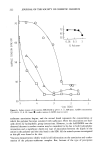
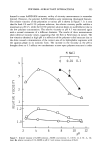
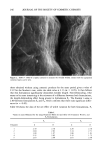
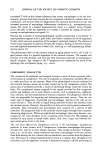
246 JOURNAL OF THE SOCIETY OF COSMETIC CHEMISTS Figure 2. SEM ( x 1500) of a replica utilized to measure the wrinkle widths Zones with the superposed corneous layers can be seen. those obtained without using cosmetic products for the same period gives a value of 2.22 for the Student t-test, while the table value is 2.13 (o• = 0.05). It then follows that this formulation significantly diminishes wrinkle length. Notwithstanding, what seems to be more interesting is the existence of a difference between both formulations, the length-diminishing effect being greater in formulation F 2. The Student t-value is 2.89 between formulations F• and F2, which confirms that there exist significant differ- ences (tx = 0.05). Table III shows the data of the net effect of width variation for both formulations, Ft Table I Values (in mm) Obtained for the Long Parameter Before (li) and After (If) Treatment With F• and F 2 Formulations F• F 2 Volunteer li If li If 1 2.39 2.30 2.28 2.10 2 2.84 2.82 3.14 2.71 3 1.99 1.97 1.98 1.93 4 2.21 2.05 2.11 1.75 5 2.63 2.60 2.61 2.50

METHOD FOR STUDY OF WRINKLE-REDUCING COSMETICS 247 Table II Variation Fractions for the Length in F• and F 2 Formulations F• F 2 0.038 - 0.079 0.007 - 0.137 -0.010 -0.025 -0.072 -0.171 -0.011 -0.042 Table III Variation Fractions for the Width in F• and F 2 Formulations F• F 2 O.273 O.684 0.114 0.196 0.000 0.295 0.313 O.848 0.138 0.221 and F 2. The experimental results give a value of 2.96 for the Student t-test when the F1 formulation effect is compared with the state of the skin that had no application. Thus, the technique permits detection of a significant effect in wrinkle width when applying the base moisturizing formulation. On the other hand, if both formulations are com- pared, a width mean of 0.1676 for formulation F1 and one of 0.4488 for formulation F 2 are obtained. The Student t-test is 3.14 for the four degrees of freedom, which means that there are significant differences in the wrinkle width determinations between both formulations. Formulation F 2 has a greater effect on wrinkle width than formulation Fl. CONCLUSIONS This work leads to the conclusion that the use of the replica technique together with scanning electron microscopy permits us to characterize in a noninvasive manner the condition of a skin forearm area and to track the evolution of a wrinkle. The results with the microphotographs are reproducible according to the above-mentioned measure- ments and according to the standardization of the negative replica, the positive replica, and microphotography. The formulation with the sodium salt of pyrollidone carboxylic acid (F2) turned out to be much more effective as a wrinkle smoother than the base formulation (F). This is confirmed by both width and length wrinkle variations. ACKNOWLEDGMENTS We gratefully acknowledge the expert linguistic assistance of Prof. Claudio Telha and the helpful typewriting of Miss Ximena Ruiz.
Purchased for the exclusive use of nofirst nolast (unknown)
From: SCC Media Library & Resource Center (library.scconline.org)