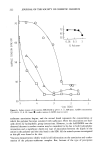
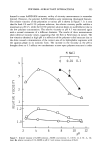
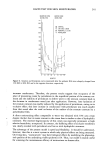
RAPID TEST FOR SKIN MOISTURIZERS 241 DESORPTION CURVE SORPTION CURVE (RH 90%•33%) (RH33%•90%) mU O: CONTROL O: 10% UREA CREAM a: HYDROPHILIC OINT •: PETROLATUM 0 11] 20 30 0 10 20 30. M I NUTES Figure 6. Sorption and desorption curves monitored after the ambient RHs were abruptly changed from 33% RH to 90% RH and to the opposite direction, respectively. increases conductance. Therefore, the present results suggest that occupancy of the place of preexisting water by petrolatum in the superficial portion of the stratum cor- neum and the inability of petrolatum to deliver water to the stratum corneum leads to the decrease in conductance noted just after application. However, later hydration of the stratum corneum was readily induced by the application of petrolatum, owing to its occlusive effect this later increase in conductance with petrolatum was much smaller than that noted after the total occlusion of the surface of the stratum corneum by a polyethylene film. A direct moisturizing effect comparable to water was obtained with 10% urea cream despite the fact that its water content in the cream base is similar to that of hydrophilic ointment. The extreme hygroscopicity of this cream was especially prominent at high relative humidities, as expected. In contrast, the buffering effect of occlusive emollients was clearly revealed with petrolatum and less so with hydrophilic ointment. The advantage of the present model is speed and flexibility. It should be understood, however, that this is a static system in which only physical effects are being measured. On living skin, "moisturizers" may have biological effects by modifying the physiolog- ical qualities of the underlying viable epidermis (19). Thus, our model is mainly useful for screening the instantaneous efficacy of moisturizers on human skin.

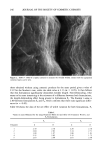
J. Soc. Cosmet. Chem., 41, 243-248 (July/August 1990) A quantitative method for assessing cosmetics for efficacy at reducing wrinkles A. M. THIELEMANN, H. CHAVEZ, M. A. SANDOVAL, and I. ORREGO, Departamento de Ciencias y Tecnologoea Farmacguticas, Facultad de Ciencias Quoemicas y Farmacguticas, Universidad de Chile, Casilla 233, Santiago, Chile. Received February 8, 1990. Synopsis This study postulates a quantitative method to assess cosmetics for wrinkle diminution. For this effect, the replica technique and scanning electron microscopy (SEM) were used. The technique used in this study consists essentially of three steps: obtaining a negative skin replica using a mixture of silicone plus a catalyst obtaining a positive skin replica from the negative replica and, finally, coating the positive replica with a gold-palladium mixture for further SEM observation and photography. The method was standardized and assessed using a base emulsion. When the effectiveness of the method was validated, a study was done of the potential effect of a sodium salt of 2-pyrollidone-5-carboxilic acid as a wrinkle diminisher. Two creams, only one of them containing the active principle, were applied to a female volunteer group for a certain period. A negative replica was taken before and after each cream application period. The assess- ment parameters used were length and width of a previously selected forearm wrinkle. The results showed that the proposed method can detect variations in the length and width of a previously selected wrinkle and that it can also be effectively used in the assessment of cosmetics used to diminish wrinkles. INTRODUCTION Skin dryness and wrinkle formation have increased the demand for cosmetic products. This has led to the development of methods for evaluating the various formulations used as wrinkle smoothers. There are various subjective methods to evaluate skin characteristics: the Kligman re- gression method (7), stereomicroscopy (8), magnified photography (3,4,9), and others. All these techniques require highly trained evaluators and a large number of volunteers. There are at present various in vivo and in vitro methods to assess quantitatively the hydrated state of the corneum stratum. The criteria vary widely, depending on the technique used. The methods may be either direct, such as transpirometry (1-3), or indirect, such as measurement of the skin elastic module (3,4) and in vivo conductance determination (5,6). A good review of these mechanical methods is that of Salter (3). Another direct method for evaluating the hydrated state of skin is one that uses electron 243
Purchased for the exclusive use of nofirst nolast (unknown)
From: SCC Media Library & Resource Center (library.scconline.org)