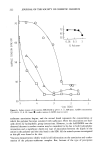
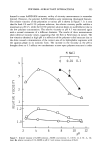
232 JOURNAL OF THE SOCIETY OF COSMETIC CHEMISTS trating from 10% solution. Thus, the obtained result differs from that expected from theory. However, others have also found similar phenomenon in both dialysis (18) and ultrafiltration (19) experiments, as well as with biological materials (20,21). Thus, the monomer activity may not be constant above the CMC but may increase when the concentration of micelies increases. Above the CMC, the SLS activity seemed to be proportional to the increase in concentration (the same p-Kp for 1.0 and 10% SLS), whereas an increase from 0.1 to 1.0% SLS increased the activity much more. Thus, a practical outcome may be that skin damage from surfactants is not linearily related to the concentration of surfactant in the washing solution. The increase in permeability of skin to water appears to parallel that of SLS. The pene- tration of water was approximately the same during the exposure to 1.0 and 10% SLS, whereas a lower rate was obtained during the exposure to 0.1%. A more detailed de- scription of the correlation was difficult, because of the rapid decrease in radiochemical concentration of water in the donor solution during the exposure. This clearly shows that formulations applied to the skin can easily change composition. The penetration rate of water was in the same range as reported by other workers measuring the transepidermal water loss (TEWL) in irritation studies in viva (4, 5). The TEWL has been proposed to be a signal for recovery of the barrier function via regula- tion of epidermal biosynthesis (12,22-24). The irritation studies in viva usually involve exposure of the skin to a filter paper saturated with the SLS solution, whereafter the TEWL is measured. In these studies, values between 1.5 and 8.4 mg/cm2/hr x after exposure to 2.0% SLS were reported (4,5). In the present study the penetration rates of water were about 3 and 10 mg/cm2/hr • when 1.0 and 10% SLS were present, respec- tively. Differences in results might be due to at least two things. First, it is reasonable to expect that the degree of hydration of the skin in the present study was well above the degree of hydration in viva. In viva the TEWL is measured after equilibration of the skin to the atmosphere, whereas in the present study the diffusion of water was mea- sured during exposure of the skin to water. As the degree of hydration increases, the penetration rate also increases, since the diffusing water molecules encounter lower restraining forces (25). Second, there is much variability in permeability among indi- viduals and skin sites (3,5,14-16,26-28). In conclusion, above the CMC the influence of SLS on the barrier properties seems to be the same for 1.0 and 10% SLS, and the amount of SLS penetrating the skin was propor- tional to the applied concentration. This indicates that the monomer activity is not constant above the CMC. Below the CMC, SLS influenced the skin less, and, accord- ingly, penetrated the skin at a lower rate. ACKNOWLEDGMENTS I would like to thank Dr. Magnus Lindberg, Karolinska Institute, for valuable criticism of the manuscript, and Ms Mona Fabricius-Hansen and the other members of the staff at the Department of Plastic Surgery, Sabbatsbergs Hospital, Stockholm, for kindly supplying the skin samples. REFERENCES (1) R. Scheuplein and L. Ross, Effects of surfactants and solvents on the permeability of epidermis, J. Soc. Cosmet. Chem., 21, 853-873, 1970.

PENETRATION OF WATER AND SLS 233 (2) (3) (4) (5) (6) (7) (8) (9) (10) (11) (12) (13) (14) (15) (16) (17) (18) (19) (20) (21) (22) (23) (24) (25) (26) (27) (28) E. Novak and S. F. Francom, Inflammatory response to sodium lauryl sulfate in aqueous solutions applied to the skin of normal human volunteers, Contact Dermatitis, 10, 101-104, 1984. S. Freeman and H. Maibach, Study of irritant contact dermatitis produced by repeat patch test with sodium lauryl sulfate and assessed by visual methods, transepidermal water loss, and laser Doppler velocimetry, J. Am. Acad. Derm., 19, 496-502, 1988. E. Berardesca and H. I. Maibach, Sodium-lauryl-sulphate-induced cutaneous irritation. Comparison of white and hispanic subjects, Contact Dermatitis, 19, 136-140, 1988. P. G. van der Valk, J. P. Nater, and E. Bleumink, Skin irritancy of surfactants as assessed by water vapor loss measurements,J. Invest. Dermatol., 82, 291-293, 1984. P. G. M. van der Valk, M. H. Kruis de Vries, J. P. Nater, E. Bleumink, and M. C. J. M. de Jong, Eczematous (irritant and allergic) reaction of the skin and barrier function as determined by water vapour loss, Clin. Exp. Dermatol., 10, 185-193, 1985. A. W. Fulmer and G. J. Kramer, Stratum corneum lipid abnormalities in surfactants-induced dry scaly skin, J. Invest. Der matol., 86, 598-602, 1986. P. M. Elias, E. R. Cooper, A. Korc, and B. E. Brown, Percutaneous transport in relation to stratum corneum structure and lipid composition, J. Invest. Dermatol., 76, 297-301, 1981. G. Grubauer, K. R. Feingold, R. M. Harris, and P. M. Elias, Lipid content and lipid type as determinants of the epidermal permeability barrier, J. Lipid Res., 30, 89-96, 1989. G. Imokawa, S. Akasaki, Y. Minematsu, and M. Kawai, Importance of intercellular lipids in water- retention properties of the stratum corneum: Induction and recovery study of surfactant dry skin, Arch. Dermatol. Res., 281, 45-51, 1989. P. W. A. Tovell, A. C. Weaver, J. Hope, and W. E. Sprott, The action of sodium lauryl sulphate on rat skin--An ultrastructural study, Brit. J. Dermatol., 90, 501-506, 1974. G. Grubauer, K. R. Feingold, P. M. Elias, Relationship of epidermal lipogenesis to cutaneous bar- rier function, J. LipidRes., 28, 746-752, 1987. D. D. Perfin, W. L. F. Armarego, and D. R. Perrin, Purification of Laboratory Chemicals, 2nd ed. (Pergamon Press, Oxford, 1980), p. 530. M. Lod•n, The in vitro hydrolysis of diisopropyl fluorophosphate, DFP, during penetration through human full thickness skin and isolated epidermis, J. Invest. Dermatol., 85, 335-339, 1985. M. Lod6n, The in vitro permeability of human skin to benzene, ethylene glycol, formaldehyde, and n-hexane, Acta. Pharmacol. et Toxicol., 58, 382-389, 1986. M. Lod•n, The synthetic peptide GRF (1-29)-NH 2 with growth hormone releasing activity penetrates human epidermis in vitro, Acta Pharm. Suec., 25, 27-30, 1988. S. M. Harrison, B. W. Barry, and P. H. Dugard, Effects of freezing on human skin permeability, J. Pharm. Pharmacol., 30, 261-262, 1984. M. Abu-Hamdiyyah and K. J. Mysels, The dialysis of sodium dodecyl sulfate, its activity above the critical micelie concentration, and the phase-separation model of micelie formation, J. Phys. Chem., 71,418-426, 1967. H. Schott, Ultrafiltration of nonionic detergent solutions, J. Phys. Chem., 68, 3612-3618, 1964. J. A. Faucher and E. D. Goddard, Interaction of keratinous substrates with sodium lauryl sulfate: I. Sorption, J. Soc. Cosmet. Chem., 29, 323-337, 1978. W. T. Gibson and M. R. Teall, Interactions of Ca2 surfactants with the skin: Studies on enzyme release and percutaneous absorption in vitro, Fd. Chem. Toxic., 21, 581-586, 1983. G. Grubauer, P.M. Elias, and K. R. Feingold, Transepidermal water loss: The signal for recovery of barrier structure and function. J. LipidRes., 30, 323-333, 1989. G. K. Menon, K. R. Feingold, A. H. Moser, B. E. Brown, and P. M. Elias, De novo sterologenesis in the skin. II. Regulation by cutaneous barrier requirements. J. Lipid Res., 26, 418-427, 1985. K. R. Feingold, B. E. Brown, S. L. Lear, A. H. Moser, and P.M. Elias, Effect of essential fatty acid deficiency on cutaneous sterol synthesis. J. Invest. Der matol., 87, 588-591, 1986. I. H. Blank, J. Moloney, A. G. Emslie, I. Simon, and C. Apt, The diffusion of water across the stratum corneum as a function of its water content, J. Invest. Dermatol., 82, 188-194, 1984. D. Southwell, B. W. Barry, and R. Woodford, Variations in permeability of human skin within and between specimens, Int. J. Pharm., 18, 299-309, 1984. P. Langguth, H. Spahn, E. Mutschler, and K. Hubnet, An approach to reduce the number of skin samples in testing the transdermal permeation of drugs, J. Pharm. Pharmacol., 38, 726-730, 1986. R. Rietschel, Advances and pitfalls in irritant and allergen testing, J. Cosm. Sci., 33, 309-313, 1982.
Purchased for the exclusive use of nofirst nolast (unknown)
From: SCC Media Library & Resource Center (library.scconline.org)