2 JOURNAL OF THE SOCIETY OF COSMETIC CHEMISTS The effect of salts, while relatively small, depends on gum concentration in solution. At 0.3% gum there is a negligible change in viscosity in the presence of up to 0.01 M sodium or calcium chloride. At higher gum concentrations, the viscosity is raised somewhat by salts, while at lower concentrations, the opposite occurs. Further information has been obtained from dynamic rheology measurements. Santore and Prud'homme explored the behavior of a 4.7% XG broth at shear rates as low as 10-5 s- • (2). Both dynamic viscosity (Xl*) and steady shear viscosity (x I) followed the power law over several orders of magnitude of shear rate. In the ultra-low shear range there was no indication of either a positive deviation (which would signify the existence of a yield value) or a negative deviation that is typical of most simple polymer solutions. Values of Xl* were higher than corresponding values of Xl (at the same shear rate), suggesting the existence of long-range order. Rochefort and Middleman utilized both oscillatory and steady shear measurements to assess the influence of salt and temperature on flow behavior of gum concentrations of up to 0.5% (3). The measurements confirmed the existence of an order-- disorder transition at about 55øC in water solutions containing low salt and at higher temper- atures with high salt present. In the presence of salt, the "healing" of structure disrupted by shear or temperature is rapid and essentially complete. Veegum ©, a colloidal magnesium aluminum silicate (MAS), is a smectite clay whose platelets are capable of aggregating to form a "house of cards" structure in aqueous dispersions (4). The dispersions are highly thixotropic they are disrupted by shear but then regain their structure over time. Unlike XG, the properties of these clay disper- sions are highly sensitive to electrolytes. Combinations of MAS and several polymers, including XG and carboxymethylcellulose, have been promoted as having rheologic properties superior to either of the materials alone. Mixtures of MAS and XG appear to be synergistic with respect to viscosity and yield value, based on steady shear measurements using a Brookfield viscometer (5). Thixotropy was eliminated within optimum mixtures, in which the XG:MAS ratio was 1:9 to 1:2. Furthermore, single-point viscosity of dispersions of the mixtures is affected much less by aging than are dispersions of MAS alone. Continuous shear viscometry is widely used and the flow curves obtained by this technique contain a great deal of information about the behavior of non-Newtonian materials. However, the initial structure of the material under investigation is broken down during the course of measurement. In many cases, this structure is the most important attribute under consideration. Dynamic small strain methods have the ad- vantage of deforming a sample without necessarily disrupting its structure. These methods provide information about elasticity as well as viscous flow. A popular method for measuring viscoelasticity in the linear region utilizes oscillatory shear (6). The complex shear modulus, G*, is defined by Equation 1. c•(t) G*(co) - [1] ?(t) In this equation, c•(t) represents the time-dependent shear stress and •(t) is the strain. G* may be divided into real and imaginary parts, G' and G", respectively. G' is called the storage modulus (or dynamic rigidity) and refers to energy stored because of elas-

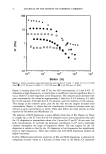
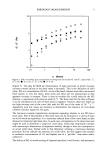
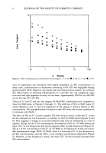
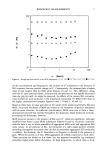
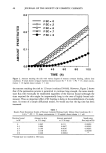
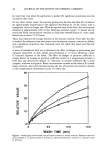
RHEOLOGIC MEASUREMENTS 3 ticity. G" is the loss modulus, referring to the loss of energy through viscous flow. The relationship among the moduli is given in Equation 2, G* = G' + i G" [2] in which i = %/-1. The loss tangent, a measure of the relative contributions of elasticity and viscous flow, is defined as G"/G'. Values of loss tangent below 1 indicate that elasticity dominates rheologic behavior. In this paper we describe rheologic measurements of MAS and XG and mixtures of the two using a dynamic technique. EXPERIMENTAL XG (Keltrol T ©, Kelco Division, Merck & Co., San Diego, CA), MAS (Veegum ©, R. T. Vanderbilt, Norwalk, CT), and methylparaben and propylparaben (both Fisher Scientific, Springfield, NJ) were used as received. Concentrated dispersions of XG and MAS in aleionized water containing 0.1% methylparaben and 0.03% propylparaben were prepared in a homomixer (30% scale). The mixing time for XG dispersions was 24 minutes that for MAS dispersions was 50 minutes. Dispersions of either a pure com- ponent or mixtures of XG and MAS were made by appropriate dilution with water containing the preservatives and agitation for five minutes at 1000 RPM using a small propeller mixer. The concentrations indicated are the final concentrations in the dis- persions. All were stored at room temperature for approximately 12 days prior to measurement. All comparisons were made on systems stored for exactly the same length of time. These mixing and storage times, though arbitrary, were chosen to ensure that the shear history of all MAS samples would be uniform so that reliable comparisons among various combinations with XG could be made. Rheologic data obtained with other preparation equipment and conditions might differ from those reported below, but we anticipate that the trends observed should be the same. The Bohlin VOR constant strain rheometer (Bohlin Rheologi, Cranbury, NJ) was used for most measurements of viscoelastic behavior. Studies at constant stress were per- formed using a Bohlin CS rheometer. Concentric cylinder measuring geometry (27.5- mm diameter cup, 25-mm bob) was utilized in all cases. All measurements were made at 25øC after equilibration for 15 minutes. RESULTS AND DISCUSSION The first step in measurement of viscoelasticity is performance of a "strain sweep" to evaluate the degree of strain that can be tolerated before the samples behave in a nonlinear fashion. Figure 1 contains data for two XG solutions, a 3% MAS dispersion, and combinations of 1% MAS with XG. The XG solutions can tolerate 50% strain without showing significant variation in the values of G', the storage modulus. The G' values for MAS are approximately constant over less than 10% strain. The linear range for combinations of MAS with XG falls between the values for the component materials. To ensure that all measurements were made within the linear range, gum solutions were subjected to a strain of 20%, and 4% was used for MAS dispersions and MAS-XG combinations.
Purchased for the exclusive use of nofirst nolast (unknown)
From: SCC Media Library & Resource Center (library.scconline.org)