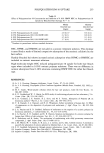
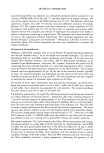
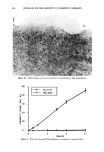
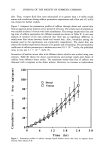
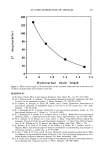
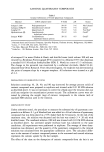
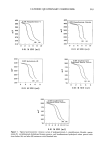
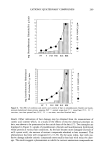
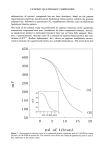
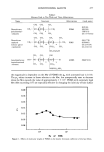
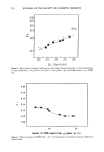
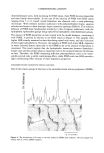
ARTIFICIAL MEMBRANES 245 Table I Lipid Components of Different Synthetic Lipid Membranes Composition (weight percent) Cholesteryl Membrane type Cerebrosides Ceramides Cholesterol sulfate Fatty acid Palmitic (standard) -- 38 28 17 17 Stearic -- 38 28 17 17 Carnauba -- 38 28 17 17 Cerebroside/carnauba 5 40 25 18 12 Each membrane is referred to by its fatty acid component. All quantities are expressed as weight percent. to covalent linkages between corneocytes and their lipid envelopes. These lipid enve- lopes, in turn, are interdigitated with the lipid bilayers in the stratum corneum, giving rise to a remarkably cohesive unit. Indeed, the increase in partitioning of hydrophobic compounds into delipidized stratum corneum reported by Surber et al. (24) has been explained in terms of regions within the stratum corneum that are exposed upon delipidization and that were inaccessible to the drugs in intact stratum corneum. The implication of strong lipid-corneocyte interactions within the stratum corneum also 60 50 40 30 20 10 ß progesterone o estradiol o cortisol ß sucrose 0 1000 I 2000 time, minutes Figure 4. Typical permeation profiles of various markers across artificial model membranes.

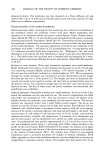
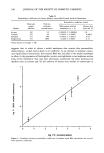
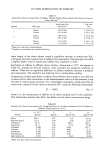
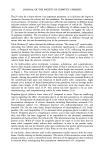
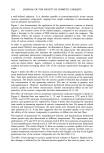
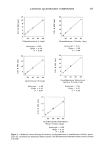
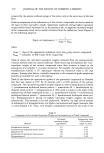
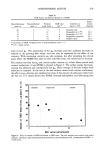
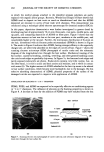
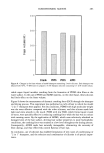
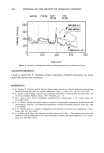
246 JOURNAL OF THE SOCIETY OF COSMETIC CHEMISTS Table II Permeability Coefficients of Various Markers Across BSA-Treated Artificial Membranes Marker Permeability coefficient (cm/h) Molecular Partition weight coefficient BSA-treated artificial Human skin (daltons) (octanol/water) membranes (n = 6) (from ref 15) Sucrose Cortisol Estradiol Progesterone 342 •0 0.000224 ñ 0.000063 •0 363 40 0.00255 ñ 0.00067 0.0003 272 490 0.00536 ñ 0.00273 0.03 315 5890 0.0266 ñ 0.0064 0.15 Values shown are average ñ SD. suggests that in order to obtain a model membrane that mimics skin permeability characteristics, a lipid matrix alone is not sufficient. In an attempt to simulate corneo- cyte-lipid bilayer interactions, heat-treated BSA was included in the model membrane to allow (i) the generation of hydrophobic protein microglobules or microspheres within areas of the membrane that may have previously constituted the polar pathways for markers such as sucrose and (ii) the creation of anchor sites similar to corneocytes in -4 ' I ' I ' I ' I ' I ' I -6 -4 -2 0 2 4 6 log PC (octanol/water) Figure 5. Correlation between permeability coefficients of markers across BSA membranes and octanol- water partition coefficients.
Purchased for the exclusive use of nofirst nolast (unknown)
From: SCC Media Library & Resource Center (library.scconline.org)