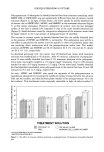
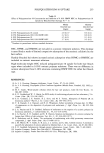
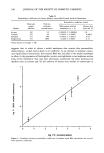
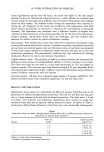
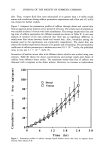
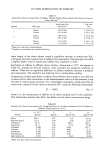
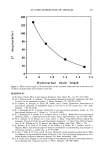
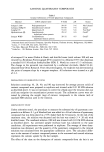
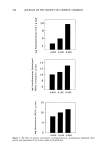
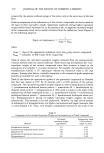
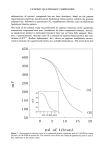
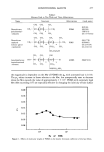
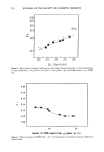
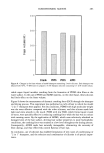
232 JOURNAL OF THE SOCIETY OF COSMETIC CHEMISTS Table I Effect of Added Nonionic Cellulosic Polymers on Polyquaternium-10 Uptake by Bleached Hair (Average N = 3) Mildly Harshly bleached hair bleached hair (mg/g) (mg/g) 0.10% Polyquaternium- 10 0.10% HMW HEC/0.10% Polyquaternium-10 0.10% LMW HEC/0.10% Polyquaternium- 10 0.10% HMHEC/0.10% Polyquaternium-10 0.10% HPMC/0.10% Polyquaternium-10 2.6 (0.1) a 8.6 (0.2) 1.8 (0.2) 7.3 (0.2) b 2.8 (0.2) 8.5 (0.2) 2.2 (0.2) 9.7 (0.3) 2.4 (0.1) 11.4 (0.8) a Numbers in parentheses indicate standard deviation. b Polyquaternium-10 uptake control = 7.3 (0.7). quaternium-10 solutions containing either HPMC or HMHEC (p = 0.06 and p = 0.025, respectively), but not from those containing LMW HEC. HEC adsorbs slightly onto the surface of a hair fiber, even though the polymer is uncharged (7). This behavior is apparently extended to solutions containing cationic polymer, where the nonionics can compete with the latter for adsorption sites on hair. In keeping with general trends noted for the effect of molecular weight on polymer adsorption, HMW HEC, once adsorbed, would be less easily displaced than LMW HEC. This phenomenon would explain the relative effectiveness in modifying the adsorption of polyquaternium- 10. '%', 2 z rr 1 0 o TREATMENT SOLUTION •'•[] POLYQUAT-10 '•[] POLYQUAT-10AND ONLY NONIONIC CELLULOSIC POLYMER ALL SOLUTIONS ARE 0.1% ON/V) IN NONIONIC POLYMER AND/OR POLYQUATERNIUM-10 Figure l. The effect of nonionic cellulosic polymers on polyquaternium-l0 adsorption by mildly bleached hair.

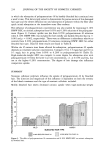
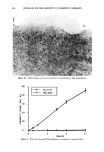
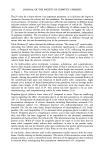
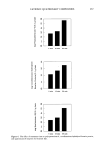
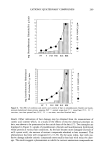
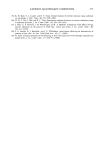
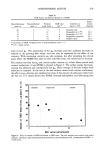
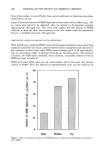
POLYQUATERNIUM- t0 UPTAKE 233 Polyquaternium-t0 adsorption by harshly bleached hair from solutions containing either HMW HEC or LMW HEC was not significantly different from that of cationic control solutions (Figure 2). In light of these results, the lower uptake by mildly bleached hair of cationic due to HMW HEC, HPMC, and HMHEC in the treatment solutions (Figure t) at first seems anomalous. However, adsorption of cationic onto the less damaged surface of this hair is already low compared to that of the more harshly bleached hair (Figure 2). Small decreases caused by competitive adsorption of the nonionic would then be larger relative to the total amount of polyquaternium-t0 adsorbed. The increase in cationic uptake by harshly bleached hair (but not mildly bleached hair) in the presence of HPMC and HMHEC is noteworthy. The explanation may well be a rate effect occasioned by the surface activities specific to these two polymers rather than one involving direct interactions with the polyquaternium and/or hair. The surface activities of HPMC and HMHEC are 60-65 dynes/cm @ 0.1% (12) and 46-5 t dynes/ cm @ 0.1% (13), respectively. As described previously (t0), the contact time of bleached hair tresses with treatment solutions was standardized to 45 minutes. After 45 minutes, adsorption of polyquater- nium-t0 onto mildly bleached hair from 0.1% treatment solutions of the polyquater- nium alone was largely complete at 2.6 mg/g longer treatments of up to 180 minutes resulted in only a 0.9 mg/g increase to 3.5 mg/g. On the other hand, harshly bleached hair had adsorbed considerably more polyquaternium in the interval between 45 and 180 minutes (at 8.6 and 12.6 mg/g, respectively). As such, HPMC and HMHEC may speed the approach of the polyquaternium to equilibrium adsorption by lowering the interfacial surface tension between the solution bulk and hair surface, and thus facilitate phase transfer of the polyquaternium-t0 to the hair surfaces. This mechanism seems especially reasonable in light of earlier studies (7) ,',- 12 8 10 I,LI o ½ 8 •o 6 =' 4 :=, 2 ._1 .o 0 TREATMENT SOLUTION • POLYQUAT-10 ONLY POLYQUAT-10 AND NONIONIC CELLULOSlC POLYMER ALL SOLUTIONS ARE 0.1% ON/V) IN NONIONIC AND/OR POLYQUATERNIUM-10 Figure 2. The effect of nonionic cellulosic polymers on polyquaternium-10 adsorption by harshly bleached hair.
Purchased for the exclusive use of nofirst nolast (unknown)
From: SCC Media Library & Resource Center (library.scconline.org)