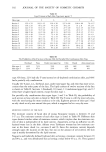
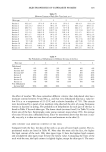
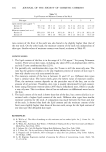
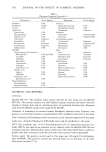
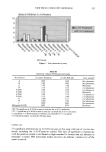
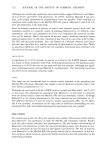
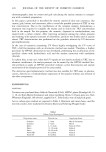
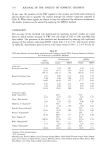
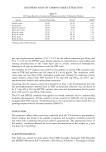
TRETINOIN ASSAY BY CARBON PHASE EXTRACTION 3 3 5 Table IV TRT Assay Results in Commercial Pharmaceuticals by UV-Derivative Method Sample Nominal (mg/100g) Found a RSD% Airol© cream 50.00 49.20 2.03 Airol lotion 50.00 51.02 2.41 Apsor© ointment 10.00 9.68 1.82 Retin-A© cream 10.00 9.70 2.25 Retin-A cream 25.00 24.53 1.96 Retin-A cream 50.00 48.45 3.15 Retin-A gel 25.00 25.58 2.63 Retin-A lotion 50.00 49.30 1.56 aAverage of five determinations. rect spectrophotometric analysis, 97.8 --- 4.2% for the carbon extraction procedure, and 95.4 + 5.2% for the HPTLC assay. Several substances, reported above, were added with varying concentrations to the cream bases and to several commercial formulations, showing in all cases no interference with the TRT assay. The linearity for UV analysis was carried out by analysis of twenty TRT standard solu- tions in THF and pyridine over the range of 0.3 to 60 p•g/ml. The correlation coeffi- cients were not less than 0.998. Analogous results were obtained by analyzing twenty cream samples, spiked with TRT between 0.1% and 200 mg/100 g, by direct spec- trophotometric analysis and carbon phase extraction. Assuming that the signal-to-noise ratio should be at least 3, the determination limit for the spectrophotometric method both in THF and pyridine solutions was calculated to be 0.1 mg/100 g. For the HPTLC method, detection and determination limits proved to be 0.05 and 0.1 mg/100 g, respectively. The UV and HPTLC methods were applied to several cosmetics and to commercially available pharmaceutics. All the cosmetics tested, reported in Table III, did not present an appreciable TRT amount. For pharmaceutics, the concentration values found were in good agreement with the declared amounts (Table IV). CONCLUSION The proposed carbon phase extraction combined with the UV-derivative spectrophoto- metric analysis was found to be suitable to separate and determine tretinoin accurately and selectively in pharmaceutical and cosmetic preparations. The appropriate choice of the analytic conditions allowed for an accurate determination of the analyte at a very low limit (0.1 mg/100 g). ACKNOWLEDGMENTS This work was carried out with grants from CNR (Consiglio Nazionale delle Ricerche) and MURST (Ministero dell' Universit• e della Ricerca Scientifica e Tecnologica) of Italy.

336 JOURNAL OF THE SOCIETY OF COSMETIC CHEMISTS REFERENCES (1) G. L. Peck, T. G. Olsen, F. W. Yoder, J. S. Strauss, D. T. Downing, M. Pandya, D. Butkus, and J. Arnaud-Battanier, Prolonged remission of cystis ache and conglobate ache with retinoic acid, N. Engl. J. Med., 300, 329-333 (1979). (2) W. Bollag, C. E. Orfanos, O. Braun-Falco, E. M. Farber, Ch. Grupper, M. K. Polano, and R. Schuppli, Retinoids: Advances in Basic Research and Therapy (Springer, Berlin, ! 98 !), pp. 7-11. (3) W. Bollag, Ed., Retinoids: New Trends in Research and Therapy 0. H. Saurat, Basle, 1985), pp. 274-277. (4) R. Hermitre, Aged skin, retinoids and alpha hydroxy acids, Cosmet. Toilets, 107, 63-67 (1992). (5) E.J. Hixson, J. A. Burdershaw, E. P. Denine, and S. D. Harrison, Comparative subchronic toxicity of all-trans and 13-cis•retinoic acid in Sprague-Dawley rats, ToxicoL Appl. PharmacoL, 47, 359-365 (1979). (6) D. M. Kochar, J. D. Penner, and C. I. Tellone, Comparative teratogenic activities of two retinoids: Ef- fects on palate and limb development, Teratogen. Carcinogen. Mutagen., 4, 377-387 (1984). (7) R. Wyss and F. Bucheli, Determination of highly protein bound drugs in plasma using high-perform- ance liquid chromatography and column switching, exemplified by the retinoids. J. Chromatog•, 456, 33-43 (1988). (8) L. Gagliardi, A. Amaro, L. Turchetto, D. Tonelli, and F. Chimenti, Identificazione e dosaggio della tretinoina nei prodotti cosmetici mediante HPLC, Costa. DermatoL, 5, 19-24 (1989). (9) M. B. Kril, K. A. Burke, J. E. Dinunzio, and R. R. Gadde, Determination of tretinoin in creams by high-performance liquid chromatography. J. Chromatog•, 522,227-234 (1990). (10) United States Pharmacopeia, 23rd ed. (United States Pharmacopeia Convention, Rockville, MD, 1995). (11) G. M. Landers and J. A. Olson, Absence of isomerization of retinyl palmirate, retinol and retinal in chlorinated and nonchlorinated solvents under gold light,J. Assoc. Off Anal Chem., 69, 50-54 (1986). (12) L. Bonhomme, B. Duleba, T. Beugre, and G. Fredj, HPLC determination of the stability of retinoic acid in gel formulation, Int. J. Pharm., 65, R9-R10 (1990). (13) S.C. Kundu, A.D. Cameron, N.M. Meltzer, and T. W. Quick, Development and validation of method for determination of in vitro release of retinoic acid from creams, Drugs Dev. Ind. Pharm., 19, 425-438 (1993). (14) M. J. Lucero, J. Vigo, and M. J. Leon, Stability of hydrophilic gels of tretinoin, Int. J. Pharm., 110, 241-248 (1994). (15) I. Abe, H. Kamaya, and I. Ueda, Adsorption of local anesthetics on activated carbon: Freundlich ad- sorption isotherms,J. Pharm. Sci., 79, 354-358 (1990).
Purchased for the exclusive use of nofirst nolast (unknown)
From: SCC Media Library & Resource Center (library.scconline.org)