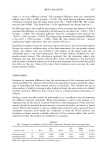
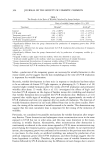
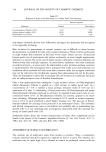
META-ANALYSIS 287 chance if no true difference existed. The estimated difference from the unweighted analysis was 0.168 + 0.080 (p-value -- 0.036). The visual dryness difference between treatments estimated from the larger study was 0.194 + 0.040 (Table III). The p-value was less than 0.0001. This showed bar 1 to be significantly less drying than bar 2. For lBS capacitance, the weighted meta-analysis of the screening data shown in Table II estimated the difference on a logarithm scale between the two bars to be -0.039 + 0.013 (p-value -- 0.004). The estimated difference from the unweighted meta-analysis was -0.042 + 0.015 (p-value = 0.006). The larger study estimated the treatment difference to be 0.023 + 0.004 (p-value = 0.0001, Table III). Sites treated with bar 1 showed significantly higher capacitance than sites treated with bar 2. Data from five subjects from the screening studies could not be used in the meta-analysis because the subjects withdrew prior to the final examination for non-product-related reasons. Six subjects were not included in the analysis of the larger study due to withdrawal prior to the final examination. Five of these subjects withdrew for non- product-related reasons. The investigator indicated that the remaining subject who withdrew may have had a product-related effect. Upon investigation it was discovered that the subject exhibited redness on one of the eight treatment sites, but had also spilled hot coffee on this site. None of the other three treatments sites receiving the same product showed redness. CONCLUSION Estimates of treatment differences from the meta-analyses of the screening study data closely paralleled the estimates derived from the large-based study and had the advan- tage of controlling for more external sources of variability. This validates the use of meta-analysis of smaller screening studies conducted under the same protocol to reliably estimate treatment differences from clinical tests to evaluate product performance at- tributes. Pooling a series of smaller studies by meta-analysis is a cost-effective way of estimating the difference between treatments. When meta-analysis is used in this manner, it is important that all the data be included. Otherwise a clear explanation of why data were omitted should be provided because selective inclusion of studies can lead to a biased answer. When meta-analysis is used to combine data collected under a protocol that is reasonably consistent with normal use conditions, as with the FCAT protocol, the treatment estimates provide a reliable indication of the treatment effects that will be experienced when the products are marketed to consumers. Table II Day 5 Changes From Baseline in Log10 (Skin) Capacitance Estimates From Screening Studies Std. Std. Mean Clinical trial n Bar 1 error Bar 2 error delta P -value Screening study 1 22 -0.033 0.009 -0.069 0.013 -0.036 Screening study 3 20 -0.032 0.018 -0.079 0.018 -0.047 0.0227 0.0635 Note: skin capacitance was not collected in screening study 2.

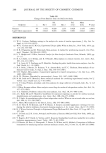
288 JOURNAL OF THE SOCIETY OF COSMETIC CHEMISTS Table III Changes From Baseline from the Definitive Study Std. Std. Mean Endpoint n Bar 1 error Bar 2 error delta P-value Dryness 99 1.041 0.028 1.235 0.028 0.194 .0001 Log10 (skin capacitance) 99 -0.023 0.003 -0.046 0.003 -0.023 .0001 REFERENCES (1) W. G. Cochran, Problems arising in the analysis of a series of similar experiments,•J. Roy. Stat. Soc. Suppl., 4, 102-118 (1937). (2) W. G. Cochran and G. M. Cox, Experimental Designs (John Wiley & Sons, Inc., New York, 1957), 115-129, 545-568. (3) R. B. D'Agostino and M. Weintraub, Meta-analysis: A method for synthesizing research, Clin. Phar- macol. Therapeut., 58, 606-616 (1995). (4) L. V. Hedges and I. Olkin, Statistical Analysis for Meta-Analysis (Academic Press, Orlando, 1985), pp. 27-117. (5) K. A. L'Abbe, A. S. Dersky, and K. O'Rourke, Meta-analysis in clinical research, Ann. Intern. Med., 107, 224-233 (1987). (6) T. A. Louis, H. V. Fineberg, and F. Mosteller, Findings for public health from meta-analyses, Ann. Rev. Publ. Health, 6, 1-20 (1985). (7) H. S. Sacks, J. Berrier, D. Reitman, V. A. Ancona-Berk, and T. C. Chalmers, Meta-analysis of ran- domized control trials, N. Engl. •J. Med., 316, 450-455 (1987). (8) S. B. Thacker, Meta-analysis: A quantitative approach to research integration,J. Am. Med. Assoc., 259, 1685-1689 (1988). (9) K. W. Wachter, Disturbed by meta-analysis?, Science, 241, 1407-1408 (1988). (10) N.M. Laird and F. Mosteller, Some statistical methods for combining experimental results, Intl. Technol. Assess. Health Care, 6, 5-30 (1990). (11) G. V. Glass, Primary, secondary, and meta-analysis of a large collection of research, Educ. Res., 5, 3-8 (1976). (12) I. Olkin, Keynote address: Meta-analysis: reconciling the results of independent studies, Stat. Med., 14, 457-472 (1995). (13) T. C. Chalmers, Problems induced by meta-analyses, Stat. Med., 10, 971-980 (1991). (14) J. C. Bailar III and F. Mosteller, Guidelines for statistical reporting in articles for medical journals: Amplifications and explanations, Ann, Intern. Med., 108, 266-273 (1988). (15) R.J. Light, Accumulating evidence from independent studies: What we can win and what we can lose, Stat. Med., 6, 221-228 (1987). (16) C. Mann, Meta-analysis in the breech, Science, 249, 476-480 (1990). (17) K.D. Ertel, B. H. Keswick, and P. B. Bryant, A forearm controlled application technique for esti- mating the relative mildness of personal cleansing products,.]. Soc. Cosmet. Chem., 46, 67-76 (1995). (18) B.J. Winer, Statistical Principles in Experimental Design (McGraw-Hill, New York, 1971), pp. 685-711, 397-398. (19) G. D. Steel and J. H. Torrie, Principals and Procedures of Statistics (McGraw-Hill, New York, 1960), pp. 146-159. (20) V. Rogiers, M.P. Derde, G. Verleye, and D. Roseeuw, Standardized conditions needed for skin surface hydradon measurements, Cosmet. Toiletr., 105, 73-82 (1990). (21) S. Dikstein, M. Katz, A. Zlotogorski, ¾. Broun, D. Wilson, and H. Maibach, Comparison of different instruments for measuring stratum corneum moisture content, Intl..]. Cosmet. Sci., 8, 289-292 (1986).
Purchased for the exclusive use of nofirst nolast (unknown)
From: SCC Media Library & Resource Center (library.scconline.org)