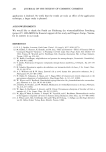
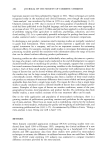
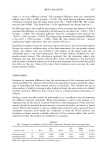
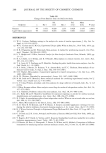
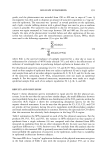
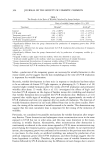
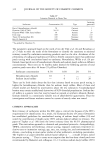
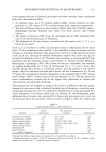
312 JOURNAL OF THE SOCIETY OF COSMETIC CHEMISTS Table IV Irritation Potential in Draize Test Irritation Surfactant Concentration (%) Type potential* Roccal (benzalkonium chloride) Hyamine 2389 (CTAC) Duponol WAT (TEA lauryl sulfate) Ivory soap Tween 80 (polysorbate 80) Brij 30 (laureth-4) 50 Cationic 1 50-52 Cationic 1 50 Anionic 20 100 Anionic 10 100 Nonionic 100 100 Nonionic 20 * As graded by Hazelton (5). The parametric approach based on the work of van der Valk et •l. (6) and Berardesca et az/. (7) fails to meet the needs of the formulator to identify the transitory or minimal irritancy caused by surfactant-containing products used on the skin. Avoidance of the phenomena of scaling and tightness are likely to benefit consumers more than additional patch testing with conclusions based on erythema. Nevertheless, Willis et M. (9) per- formed closed patch tests of benzalkonitu-n chloride and sodium lauryl sulfate at different concentrations. Their tests on 42 healthy males showed the following pattern of total positive patch tests after 48 hours (15 lal/Finn Chamber): Surfactant concentration 0.5 % 1.0 % 2 % 5 % Benzalkonium chloride Sodium lauryl sulfate 10 7 -- 6 12 2O There can be little doubt about the fact that irritancy based on acute patch testing is higher for benzalkonium chloride than for sodium lauryl sulfate. Most of these and related studies are flawed by uncertainties about the test substances: Cocamidopropyl betaine may contain unalkylated derivatives of N,N-dimethylpropylamine. Sodiurn lau- ryl sulfate is a generic mix that may be based on natural or synthetic alkanols. Benzal- konium chloride is a notoriously variable mix of alkyl-derived quaternaries. Thus the investigators and future students cannot be certain of exactly what was tested. CURRENT APPROACHES Skin irritancy of surfactants within the EEC plays a critical role because of the EEC's requirements for classification. As a result, the European Society of Contact Dermatitis has established guidelines for standardized testing of sodium lauryl sulfate (10) and noted the contribution of (high) purity (99% sodium dodecyl sulfate) to irritancy. The paper of Tupker et •l. (10) notes the lower irritancy from the 96.5% pharmacopeial grade. This meticulous approach to chemical and procedural protocols--histopathology, TEWL, colorimetry (of erythema), clinical scoring, exposure conditions (repetitive oc- clusive tests or immersion testing), age, race, sex, testing site, and environmental con- ditions--was lacking in most earlier studies of other surfactants, including quaternaries. The Tupker et•/. paper identifies sodium lauryl sulfate as "... a model irritant, suited for precise testing..." Thus it comes as no surprise that the four-hour closed patch test recommended by Basketter and colleagues (11-13) utilizes sodium lauryl sulfate (20%)

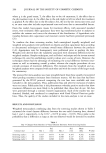
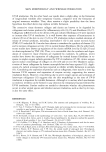
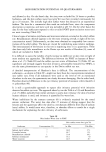
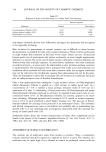
SKIN IRRITATION POTENTIAL OF QUATERNARIES 313 as the standard irritant to eliminate intersubject and other variations. Some conclusions from these investigations follow: 1. At moderate doses, up to 5% sodium dodecyl sulfate, irritant responses are more prevalent at 7.0øC than at 16.5øC (outside average daily maximum temperature). 2. The skin of Chinese subjects is more readily irritated than that of British subjects. Surprisingly, German volunteers were found to be more sensitive than Chinese subjects. 3. The pattern of irritancy of Skin Type VI individuals did not differ materially from that of the total British group of volunteers. 4. The likelihood of eliciting irritancy increased with the contact time (1, 2, 3, or 4 hours) of the patch. York et al. (14) wished to confirm the European Union's classifications (R-34 causes burns, R-38 is irritating to skin, and NC is not classified) without an animal test and through use of human volunteers. This research led to the now widely adopted four-hour closed patch test, although the method development started only a few years ago [as reviewed by Basketter et aL (13)]. The patch test procedure is conventional (Hill Top Chambers), and the customary scoring is used (Fregert, S., Manual of Contact Dermatitis, Munksgaard, Copenhagen, 1981). Since severe reactions are undesirable, test materials are applied progressively for 15 and 30 minutes and for 1, 2, 3, and 4 hours. Any reaction during these periods is considered positive, and the panelist is not exposed further. After the maximum four-hour patch period, the site is examined at 24, 48, and 72 hours. The interpretation requires comparison to the standard irritant (20% sodium lauryl sulfate). Table V presents some of the data obtained (13,15). The data show only minor interlaboratory variation and do not suggest that quaternaries at cosmetic-use concentrations are particularly irritating. This program was not designed to compare the irritancy of different surfactant groups. Instead, the plan was to find a relatively harmless way of designing a predictive non- animal skin irritation test. The test itself meets reproducibility criteria and should be a useful alternative to the Draize rabbit skin test. During the test development, some additional data of interest were reported (12). Atopics and non-atopics were tested via the four-hour patch test procedure, with the results recorded in Table ¾I. Atopics and Table V Irritancy Ratings Based on 4-Hour Patch Test Tested No. of positive Chemical concentration reactions a Classification b Benzalkonium chloride 7.5% 4/27 15/29 R38 Cocotrimonium chloride 35% 8/32 12/57 NC Sodium dodecyl sulfate 1% 21/100 15/100 16/31 NC Sodium dodecyl sulfate 10% 79/100 53/100 42/64 29/31 R38 Sodium dodecyl sulfate 20% 354/530 R38 Polysorbate 80 98% 1/25 1/29 NC Dodecyl betaine 20% 30/32 R38 C•2_•5 pareth-5 phosphate 1/30 NC a Results from different laboratories are included: No. of reactors/No. of subjects. b Classification based on Annex I of the EC Dangerous Substances Directive: R-38 = irritancy to skin (significant irritation) NC = nonclassified (minor irritation).
Purchased for the exclusive use of nofirst nolast (unknown)
From: SCC Media Library & Resource Center (library.scconline.org)