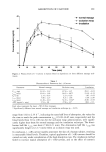
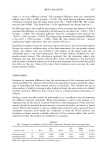
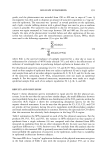
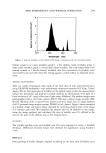
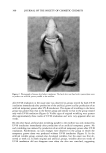
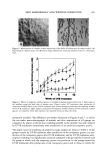
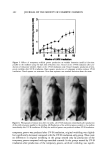
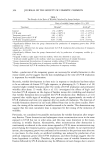
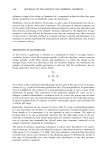
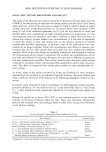
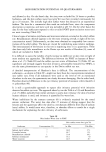
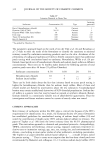
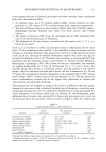
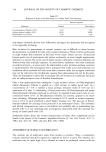
ABSORPTION OF CARVONE 281 40- 30- 10- O: -a- normal masage • ß occlusion wrap ' _ , o Time (min) Figure 2. Plasma levels of (-)-carvone in human blood in dependence on three different massage tech- niques. Table I Pharmacokinetic Parameters for (-)-Carvone Parameter Normal massage Occlusion wrap Irradiation C•,a• (ng) 23.92 + 2.32 32.56 + 3.35 28.31 + 4.01 tma x (min) 25.81 + 3.05 36.65 + 4.87* 23.49 + 4.35 ka (l/h) 2.34 + 0.53 2.23 + 0.29 1.82 + 0.22 t•/2,• (min) 7.80 + 2.27 9.21 _+ 1.96 6.69 + 2.87 t•/2• (min) 33.49 + 6.10 74.45 + 15.62' 26.81 + 4.93 AUC (ng/ml x min) 1713 + 28 2746 + 33* 1843 + 113 Each value represents the mean _+ SD of three massages. * Significantly different from normal massage and irradiation technique (p 0.05). range from 1.82 to 2.34 h -1, indicating the same half lives of absorption, the values for the time to reach the peak concentration tma x (23.49--36.65 min, respectively) and the blood levels from 30 to 100 min for the occlusion wrap administration, were signifi- cantly higher than those for normal massage and the irradiation technique. The distri- bution half-life tl/2• was short (7.80-9.21 min). The elimination half life tl/2[ 3 was significantly longer (2.2-2.7 times) when an occlusion wrap was used. In conclusion, (-)-(R)-carvone rapidly penetrates the skin of a human subject, resulting in measurable blood levels. Therefore, topical application of (-)-(R)-carvone should be carried out only under consideration of the high absorption rate. The irradiation method failed to increase topical absorption of (-)-(R)-carvone, and so the effect of cosmetic

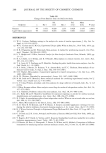
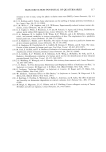
282 JOURNAL OF THE SOCIETY OF COSMETIC CHEMISTS application is doubted. To verify that the trends are truly an effect of the application technique, a larger study is planned. ACKNOWLEDGMENTS We would like to thank the Fonds zur F/Srderung der wissenschaftlichen Forschung (project P 11606-MED) for financial support of this study and Dragoco Comp., Vienna, for its interest in our study. REFERENCES (1) (2) (3) (4) (5) (6) (7) (8) (9) (10) (11) (12) D. L.J. Opdyke, I-carvone, Food Cosmet. ToxicoL, 11 (suppl.), 1057-1058 (1973). M. Kubota, T. Ikemoto, R. Komaki, and M. Inui, "Odor and Emotion--Effects of Essential Oils on Contingent Negative Variation," in Proceedings 12th Intl. Congr. Flay. Fragr. Essent. Oils, October 4-8 1992, Vienna, H. Woidich and G. Buchbauer, Eds. (Austrian Association Flay. & Fragr. Industry, Vienna, 1992), pp. 456-461. W. Rulffs, Grundlagen, m/Sglichkeiten und grenzen der massagetherapie, J•rztezeitschr. Naturhei/verf, 29, 858-861 (1988). Y. Jimbo, Penetration of fragrance compounds through human epidermis,J. Dermatol., 10, 229-239 (1983). H. Schaefer, Quantitative aspekte der aufnahme yon kosmetika durch die haut, J. Soc Cosmet. Chem., 25, 93-96 (1974). A. C. Williams and B. W. Barry, Essential oils as novel human skin penetration enhancers, Int. J. Pharmaceutics 57, R7-R9 (1989). H. Okabe, K. Takayama, A. Ogura, and T. Nagai, Effect of limonene and related compounds on the percutaneous absorption of indomethacin, Drug Design Deliv., 4, 313-321 (1989). W. Weyers and R. Brodbeck, Hautdurchdringung iitherischer/31e, pharmakokinetische untersuchun- gen, Pharmazie in u. Zeit, 18, 82-86 (1989). J. Kalbitz, R. Neubert, and W. Wohlrab, Modulation der wirkstoffpenetration in die haut, Pharmazie, 51, 619-637 (1996). W. Jiiger, G. Buchbauer, L. Jirovetz, and M. Fritzer, Percutaneous absorption of lavender oil from a massage oil,J. Soc. Cosmet. Chem., 43, 49-54 (1992). W. Jiiger, B. Nasd, R. Binder, T. Stimpfl, W. Vycudilik, and G. Buchbauer, Pharmacokinetic studies of the fragrance compound 1,8-cineol in humans during inhalation, Chem. Senses, 21,477-480 (1996). A. Wilson and L. Bek, Farbtherapie, Der sanfte Weg der Heilung., 3. Auflage, aus dem Engl. tibersetzt von M. Dehne (Scherz Verlag, Bern, Munich, Vienna, 1988).
Purchased for the exclusive use of nofirst nolast (unknown)
From: SCC Media Library & Resource Center (library.scconline.org)