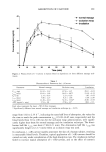
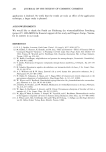
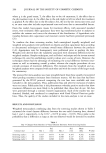
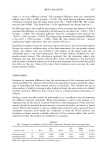
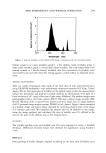
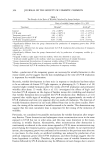
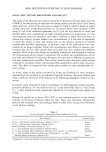
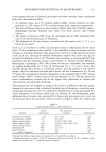
HIGH-SPF SUNSCREENS 293 0.09 - 0.075 - 0.060- 0.045- 0.030- 0.015 • c5 c15 ........ c25 - - - c30 .... c50 0 i I I i i I I I i •l 290 300 310 320 330 340 350 360 370 380 390 400 Wavelength, nm Figure 2. The absorption spectra of organic chemical sunscreen products normalized to equal area. Table I SPFs Obtained From Each Physical Sunscreen Quoted Sunscreen SPF A1 A2 A3 A4 B C D E F G Mean + SD P8 8 7.0 10.2 8.9 8.9 11.2 11.3 7.4 9.3 8.6 9.9 9.3 + 1.4 P15 15 15.3 15.7 14.0 13.9 14.3 9.8 13.9 13.4 12.7 11.3 13.4 _+ 1.8 P25 25 24.4 27.9 17.7 23.4 23.2 26.0 17.6 26.1 22.1 19.0 22.7 _+ 3.6 P35 35 23.4 20.7 22.1 31.4 22.6 21.0 18.1 21.1 26.4 24.9 23.2 + 3.7 P35+ •35 __a __ __ -- 41.3 43.1 18.3 38.7 36.9 35.0 35.6-+8.9 Al•4 represent the measurements on four samples of epidermis from subject A, and B-G represent measurements on epidermis from six other subjects. a Not evaluated with epidermis from subject A. light and that of a xenon arc solar simulator used for the in vivo testing of sunscreens. The in vitro method for determining SPFs described in this paper assumes a solar spectrum that represents the spectral irradiance expected at noon, on a clear midsum- mer's day, at latitude 40øN. In vivo testing of sunscreens, on the other hand, employs a xenon arc filtered by WG320 and UG11 optical filters. The purpose of the UG11 filter is to remove visible radiation, but it also attenuates the longer UV-A wavelengths (11). Hence, UV radiation from a solar simulator is deficient in UV-A1 (340-400 nm) relative to natural sunlight, and SPFs measured by in vivo testing would be expected to differ from those expected in natural sunlight. In the case of a sunscreen with strong UV-B absorption but weak UV-A absorption, the deficiency in UV-A absorption will be

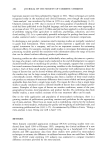
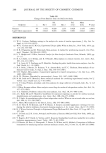
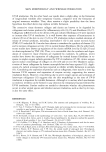
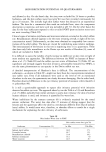
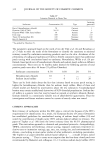
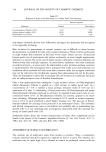
294 JOURNAL OF THE SOCIETY OF COSMETIC CHEMISTS Table II SPFs Obtained From Each Organic Chemical Sunscreen Quoted Sunscreen SPF H I J K L M Mean + SD C5 5 6.2 6.0 6.8 6.6 6.8 5.9 6.4 + 0.4 C15 15 16.1 19.0 17.9 18.2 14.7 17.6 17.3 + 1.6 C25 25 19.6 22.2 22.1 25.7 26.8 29.2 24.3 _+ 3.6 C30 30 20.7 27.8 39.7 27.4 28.1 22.0 27.6 _+ 6.7 C50 50 22.6 31.1 20.9 24.2 28.5 27.0 25.7 + 3.8 H-M represent measurements on epidermis from six subjects. compensated for by the relatively low levels of UV-A from the solar simulator, and the sunscreen will therefore appear to have a higher SPF than would be obtained in natural sunlight. In order to evaluate the importance of the above effect, we recalculated our SPFs using the COLIPA xenon-arc solar simulator spectrum (1) in Equation 1. The results are shown in Table Ill, and it can be seen that for most of the sunscreens there is little difference between the calculated SPFs obtained using a natural solar spectrum and a xenon-arc solar simulator spectrum. This is not surprising since the majority of the sunscreens studied provided broad-spectrum protection. However, for product C50, which offers relatively little UV-A protection, the SPF calculated using the solar simulator spectrum is significantly higher than that calculated using the solar spectrum. We infer from these data that the use of solar simulators for i, vivo measurements of products with a high ratio of UV-B to UV-A absorption will overestimate the protection provided against natural sunlight. In conclusion, i. vitro determination of SPF using excised human epidermis is a quick and reliable alternative to i. vivo measurement for sunscreens expected to have high photoprotection, particularly since it yields SPFs more representative of natural sunlight for products that do not provide broad-spectrum protection. Table III Comparison of SPFs Calculated Assuming a Natural Solar Spectrum (clear sky at noon in midsummer at a latitude of 40øN) and the COLIPA Standard Xenon-Arc Solar Simulator Spectrum Sunscreen SPF calculated assuming natural solar spectrum SPF calculated assuming xenon- arc solar simulator spectrum P8 9.3 10.0 P15 13.4 14.0 P25 22.7 24.9 P35 23.2 25.6 P35+ 35.6 43.5 C5 6.4 6.6 C15 17.3 19.0 C25 24.3 27.3 C30 27.6 32.0 C50 25.7 35.9
Purchased for the exclusive use of nofirst nolast (unknown)
From: SCC Media Library & Resource Center (library.scconline.org)