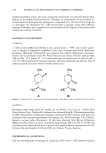
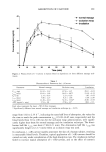
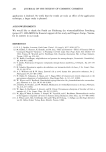
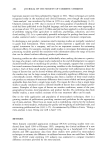
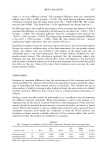
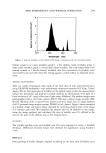
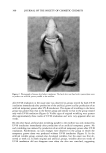
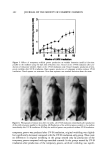
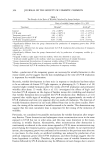
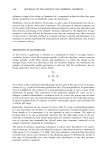
300 JOURNAL OF THE SOCIETY OF COSMETIC CHEMISTS Figure 2. Photographs of mouse skin before irradiation. The back skin was fixed with cyanoacrylate resin to produce an artificial groove parallel to the midline. after UV-B irradiation in the usual state was observed in groups treated by both UV-B irradiation immediately after production of the artificial groove and by production of an artificial temporary groove after UV-B irradiation. The degree of wrinkling in the latter group was greater than that in the former group and similar to that in the group treated only with UV-B irradiation (Figure 4). Visible signs of original wrinkling were present after approximately three weeks of UV-B irradiation and were very apparent after ten weeks. On the other hand, artificial skin wrinkling parallel to the midline was only induced by UV-B irradiation immediately after production of an artificial temporary groove. No such wrinkling was induced by production of an artificial temporary groove after UV-B irradiation. Furthermore, no such changes were observed in the group in which the temporary groove alone was produced without UV-B irradiation (Figure 5). In the artificial wrinkle group, animals also developed wrinkles, but the onset was first ob- served at week six. In both original and artificial groups, wrinkles after ten weeks of UV-B irradiation did not disappear even when the skin was stretched, suggesting

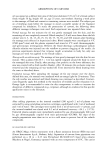
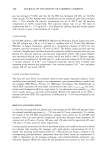
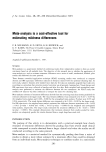
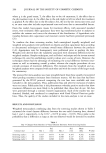
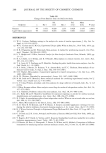
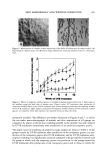
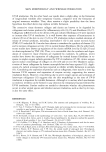
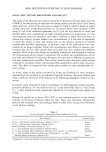
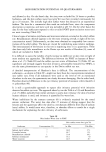
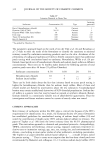
SKIN MORPHOLOGY AND WRINKLE FORMATION 301 Figure 3. Measurement of wrinkles on skin impressions of the backs of hairless mice by image analysis. (A) Representative shadow image and (B) binary image obtained by extracting shadowed areas at a fixed gray level. 3 0 2. .c_ .=_ 1 o 0 2 2 4 6 8 10 Weeks of UVB Irradiation Figure 4. Effects of temporary artificial groove on wrinkle formation (original direction: at right angle to the midline) using the back skin of hairless mice. Closed circles: UV irradiation after production of temporary wrinkle. Open circles: UV-B irradiation only. Closed triangles: production of temporary wrinkle after UV-B irradiation. Open squares: production of temporary wrinkle without UV-B irradiation. Closed squares: no treatment. Error bars represent one standard deviation about the mean. permanent wrinkles. The differences are further illustrated in Figures 6 and 7, in which the ten-weeks macro-photographs of animals and skin impressions of all groups are compared. As shown, artificial skin wrinkling parallel to the midline was only induced by UV-B irradiation immediately after production of an artificial temporary groove. The degree ratios of wrinkling calculated by image analysis are shown in Table I. In the groups treated by UV-B irradiation after production of the temporary groove, by pro- duction of the temporary groove after UV-B irradiation, and by UV-B irradiation only, original wrinkling was significantly increased compared with age-matched controls and the group in which only the temporary groove was produced. In the groups treated by U¾-B irradiation after production of the temporary groove and in those in which the
Purchased for the exclusive use of nofirst nolast (unknown)
From: SCC Media Library & Resource Center (library.scconline.org)