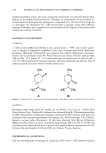
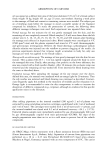
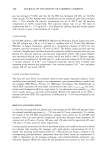
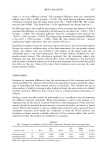
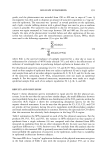
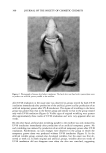
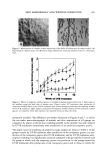
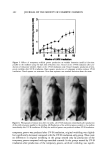
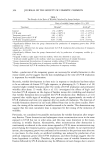
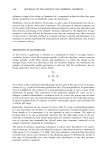
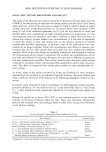
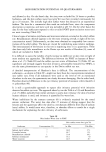
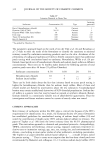
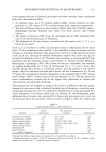
SKIN MORPHOLOGY AND WRINKLE FORMATION 303 ? Figure 7. Photographs of skin impressions (replicas) after ten weeks. (A) UV-B irradiation immediately after production of the artificial groove parallel to the midline. (B) Production of the artificial groove parallel to the midline immediately after UV-B irradiation. (C) Only the artificial groove was produced without UV-B irradiation. cantly increased compared with all other groups. There were no differences in artificial wrinkling in the group treated by production of the temporary groove after UV-B irradiation compared with the group treated by production of the temporary groove only. In the group in which only the temporary groove was produced, artificial wrin- kling was significantly increased compared with age-matched controls. DISCUSSION We previously evaluated the effects of temporary skin fixation on wrinkle formation after 20 weeks of UV-B irradiation using the back skin of hairless mice, and suggested that both production of a temporary groove in the skin and UV-B irradiation are necessary for wrinkle formation (13). In this study, we examined the first ten-week period quan- titatively to determine how early wrinkle formation can occur, and we also studied the different effects of production of a temporary groove. Our results confirm that both the artificial temporary groove in the skin and UV-B irradiation immediately after--but not

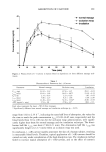
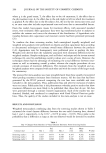
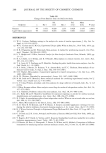
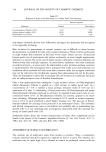
304 JOURNAL OF THE SOCIETY OF COSMETIC CHEMISTS Table I The Results of the Ratio of Wrinkle Calculated by Image Analysis Treatment Ratio of wrinkle (image analysis %) + S.D. Original a Artificial b Control 1.74 + 0.80',-• 0.56 + 0.43*,%:• UV-B only 21.68 +_ 2.06*,%•c 2.12 + 1.32*,%•c Temporary groove only • 3.81 + 1.89',? 4.32 + 1.30' Temporary groove after UV-B d 14.05 + 5.35:1: 5.68 + 3.70* UV-B after temporary groove e 16.91 + 4.58•c 13.74 + 4.07',•c * Significantly different from the group characterized by production of temporary groove after UV-B irradiation (p 0.01). ? Significantly different from the group characterized by UV-B irradiation after production of temporary wrinkle (p 0.01-0.05). • Significantly different from the group characterized only by production of temporary wrinkle (p 0.01-0.05). a Original wrinkle at right angles with the midline, which was observed in usual state. b Artificial wrinkle parallel to the midline, which was unusual direction of wrinkle formation. c Group characterized by production of temporary wrinkle without UV-B irradiation. d Group characterized by production of temporary wrinkle after UV-B irradiation. e Group characterized by UV-B irradiation after production of temporary wrinkle. before--production of the temporary groove are necessary for wrinkle formation in this mouse model, and we suggest that the skin morphology at the time of UV-B irradiation is important for wrinkle formation. Recently, wrinkle development in these mice in response to irradiation has been taken to be an indicator of chronic UV light exposure, or photoaging (4-7). Bissett et aL (8) reported slight wrinkle formation after five weeks of UV-B irradiation and permanent wrinkles after about 15 weeks. Kiss et aL (11) investigated the effects of high- and low-dose UV-B exposure on the degree of hairless mouse skin wrinkling and observed that wrinkle formation does not parallel the UV-B irradiation dose. Moloney et aL (12) reported that visible signs of wrinkling were present after approximately six weeks of UV-B irradiation and were very apparent after ten weeks of irradiation. The direction of wrinkle formation observed in our study differed from that in the above studies. How- ever, the timing of the initiation of wrinkles seemed to be similar. This observation may suggest that the total cumulative dose is important for the timing of the initiation of wrinkles. Previously, we considered two possible mechanisms for wrinkle formation after tempo- rary fixation. Tissue destruction and subsequent tissue reconstruction occur in the areas exposed to UV-B but not in other areas, and this may cause distortion in the tissue, resulting in wrinkle fixation. Alternatively, when reconstruction after destruction is continuously accelerated in the entire tissue exposed to UV-B, tissue reconstruction may proceed along the temporary groove, causing fixation of the wrinkle. In our experimental system, the temporary groove was confirmed to be restored to the previous state after one to two hours. In this study, no artificial wrinkling was induced by production of an artificial temporary groove after UV-B irradiation, and these findings suggest that the latter hypothesis is unlikely. Therefore, the primary cause of wrinkle formation after fixation followed by UV-B irradiation may be differences in local changes due to uneven
Purchased for the exclusive use of nofirst nolast (unknown)
From: SCC Media Library & Resource Center (library.scconline.org)