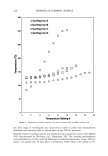
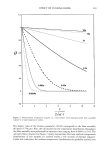
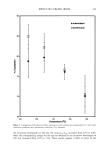
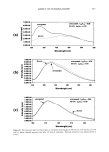
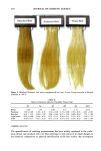
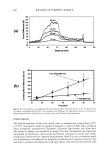
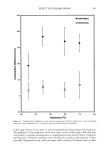
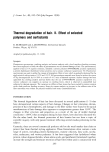
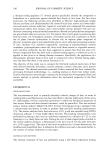
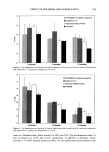
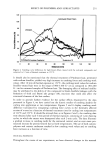
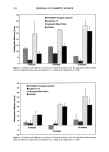
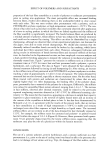
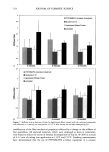
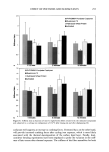
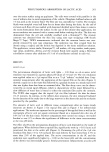
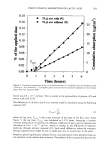
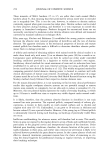
226 JOURNAL OF COSMETIC SCIENCE 350 300 250 E i•, 150 lOO 5o O Curling Iron A [] Curling Iron B O Curling Iron C X Curling Iron D x x o ¸ 0 oooooo oøø0 x E] o o o o o 0 2 4 6 8 10 12 14 Temperature Setting # Figure 1. Temperature profile comparison of several commercially available curling irons. 16 nm. This range of wavelengths was monitored in order to probe hair chromophores absorbing and emitting light in various parts of the UV/Vis spectrum. Spatially resolved combing analysis was achieved using a miniature tensile tester (Model 160), manufactured by Dia-Stron, Ltd., Hampshire, UK. The combing measurements were performed on wet hair with the following instrumental parameters: range, 2000 G gauge, 2 G sample size, 50 mm phase 1 (extension), 350% phase 2, 0% phase 3, 0%

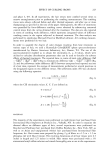
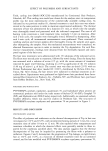
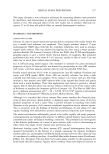
EFFECT OF CURLING IRONS 227 and phase 4, 0%. In all experiments, the hair tresses were combed several times to remove entanglements prior to performing the combing measurements. The combing traces were always collected before and after thermal exposure, and after one or more shampooings as specified in the text of the paper. Subsequently, the effect of treatments was quantified by force-difference combing curves obtained by subtracting untreated control traces from the curves obtained after the treatment. The data are also reported in terms of combing work difference, which represents integrated values of difference combing curves in the region subjected to thermal treatment. The data analysis was performed by employing Microsoft Excel or MathCad software. All combing measure- ments were performed on wet hair. In order to quantify the degree of color changes resulting from heat treatment in various types of hair, we used a HunterLab ColorQUEST sphere spectrocolorimeter manufactured by Hunter Associates Laboratory, Inc., Reston, VA. The use of the spectrocolorimeter enabled us to obtain the tristimulus (oe, •, b) values, which were utilized to calculate discoloration parameters that can be used to describe the adverse effects of thermal treatments. The reported data, in terms of total color difference {AE = •J(AL) 2 + (A•) 2 + (Ab) 2} (Eq.1), chromaticity difference {AC = •/(A•) 2 + (A•) 2} (Eq. 2), and the yellowness index difference (AYI) between unexposed and exposed sections of a hair tress, represent the average of measurements performed at several positions in the designated region on two different tresses. The yellowness index (YI) was calculated using the following equation: 1.28 X- 1.06 Z YI = 100 (Eq. 3) Y where the CIE tristimulus values X, Y, Z are defined as: Y = 0.01 L 2 (Eq. 4) X = 0.9804 0.01 k 2 + 1'-• (Eq. 5) Z-- 1.181 0.01 L2 - •-• (Eq. 6) MATERIALS The majority of the experiments were performed on light-brown hair purchased from International Hair Importers & Products Inc., Valhalla, NY. In order to examine the thermal effects on different types of hair, several experiments were performed on bleached and Piedmont hair purchased from DeMeo Brothers Inc., New York, NY, as well as on Asian and unpigmented (white) hair purchased from International Hair Importers, Inc. Hair tresses were prepared by gluing 2 g of fibers to a 1.5-in x 1.5-in plexiglass tab with Duco Cement. The resulting dimensions of all hair tresses were 6.5 inches in length and 1.25 inches in width. Hair tresses were precleaned with a 3% ammonium lauryl sulfate solution and rinsed thoroughly prior to use in the experiments.
Purchased for the exclusive use of nofirst nolast (unknown)
From: SCC Media Library & Resource Center (library.scconline.org)