224 JOURNAL OF COSMETIC SCIENCE studied by using differential scanning calorimetry (DSC) (5,8), thermomechanical analy- sis (8), and thermogravimetric analysis (8). The key structural elements found in hair and wool that could undergo thermal deg- radation on contact with hot curling irons or hot air include the cuticle and its outermost layer (epicuticle), which is constructed of fatty acids covalently bound to the protein the cortex, which accounts for the major portion of the fiber's dry mass and holds most of the water intercellular binding material, known as the cell membrane complex, which provides adhesion between cortical cells and the crystalline phase, which is responsible for the mechanical strength of the fibers (10). DSC was used to identify the thermal transitions in hair when subjected to temperatures ranging from 30øC to 250øC (5,8). This study characterized three processes: removal of water (50ø-120øC), which occurs during drying a "toughening transition" in the amorphous matrix (140ø-170øC) and denaturation of the crystalline phase (233øC) (5). A detailed study of water desorption/ absorption curves related to heat drying of hair at temperatures ranging from 50øC to 110øC, followed by equilibration at 55% relative humidity and 22øC, has shown a reduction in moisture regain (6). Based on this, it was concluded that heat-dried hair becomes more susceptible to static charge accumulation and flyaway during subsequent grooming procedures. The processes occurring at temperatures ranging from 100øC to 170øC are of interest to cosmetic scientists, since conventional curling irons typically operate in this range. One of the physical transformations in hair structure, occurring as a result of annealing between 70øC and 180øC, is an increase in fiber crystallinity, demonstrated by Milczarek et •l. (5). This effect is similar to wool fiber strengthening, which has been observed after short-term (6-30 mid) heat treatments ranging from 130øC to 150øC (11). According to the same paper, longer heating times can also cause destabilization of the o•-helical component, as detected by mechanical stress-strain or relaxation measurements. Furthermore, using low-angle X-ray diffraction, Lee was able to postulate the formation of amide cross-links in wool heated at temperatures ranging from 170øC to 235øC (12). Earlier work, completed by Asquith and Otterburn (13) and Medefee and Yee (14), also provides evidence for the formation of cross-links as a result of heat application. Crosslinking could also be responsible for a decrease in urea-bisulfite solubility and a loss in moisture regain (15), observed as a result of short thermal treatments of wool at temperatures ranging from 110øC to 230øC, for as little as 30 seconds. Chemical reactions in thermally treated keratin fibers were investigated by analyzing the gaseous product of wool degradation at 160øC. Identified products include H20 , CO2, CH4, CO, H2S , and COS, suggesting decarboxylation and other decomposition path- ways for keratin protein (16). The effects of temperature on hair were also investigated using electron spin resonance (ESR) spectroscopy to monitor the signal produced from melanin (9). The yellowing of wool represents another important aspect of thermally induced keratin degradation, which has been of great interest within the textile industry. This phenom- enon is also significant from a cosmetic scientist's point of view, since hair yellowing is commonly perceived as undesirable, especially in the discoloration of unpigmented grey hair. In wool, yellowing can be produced by irradiation and by thermal treatments exceeding 100øC. Several papers were published on this topic, but the mechanism of color formation has not yet been firmly established. Decomposition of cysteine and tyrosine and oxidation of tryptophan (Trp) to kynurenine were proposed as likely path-

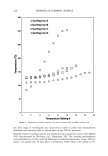
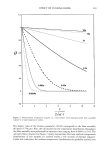
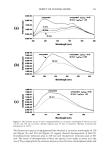
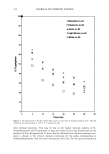
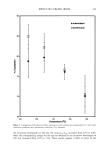
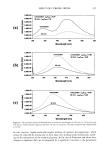
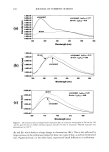
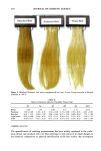
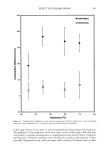
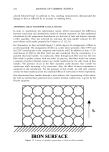
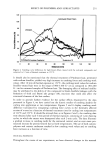
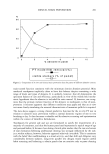
EFFECT OF CURLING IRONS 225 ways for the formation of yellow-colored chromophores (17-19). In the case of thermal degradation, the process of yellowing is accelerated at high pH levels and can be controlled under acidic conditions or in the presence of certain reactive reagents, such as maleic anhydride or various antioxidants (20,21). Our results, discussed below, indicate that white, Piedmont, and bleached hair also experience yellowing as a result of short- term thermal treatments induced by hot irons. The objective of this communication is to analyze hair damage resulting from the use of conventional curling irons. We have employed fluorescence spectroscopy to quantify the decomposition of hair chromophores (i.e., Trp), and color analysis to measure the extent of color changes resulting from thermal treatments. In addition to this, combing mea- surements were used to detect changes in the fiber frictional properties of hair, which could reflect thermal damage to the surface elements (e.g., surface lipids) of the fiber structure. EXPERIMENTAL INSTRUMENTATION Thermal treatment of hair was performed using curling irons purchased from several manufacturers. We have elected to refer to these as curling iron A, curling iron B, curling iron C, and curling iron D. Figure 1 presents a dependence of temperature as a function of temperature setting for the four appliances employed in this work. The results indicate that the temperatures produced by these devices can range from 80øC to 300øC. These measurements and the analysis of similar appliances suggest that a more typical range is 130øC to 170øC. Within these limits, the process of hair drying occurs very rapidly, and fiber damage may be controlled by proper timing, even at 170øC. In order to maintain uniformity of the experimental conditions and to assure reproduc- ibility of the obtained data, the thermal treatment to each hair tress was administered in the same position, as indicated by the discolored band present on the hair tresses in Figure 9. Throughout this report we will refer to intermittent and continuous conditions with respect to the mode of curling iron application. Intermittent are those conditions in which heat treatment of a short duration (15 s) was applied to hair. Between each treatment interval the tresses were rinsed and towel-dried to a moist condition. The sum of all heating cycles constitutes a total treatment time. Continuous conditions of thermal exposure, on the other hand, represent the case in which a tress (initially containing 15-25 % water) is subjected to thermal exposure for a long period of time, typically 5-15 rain, without interruption. The intermittent mode of treatment emulates consumer usage conditions more closely than the continuous mode. Several experiments, discussed in subsequent paragraphs of this paper, were designed to compare the extent of hair damage resulting from both procedures. Fluorescence measurements were performed using a Fluorolog-2 fluorescence spectro- photometer (Model 212) manufactured by Spex Industries, Edison, NJ. The experimen- tal conditions were similar to those described previously (4). We used a bifurcated fiber optics probe to collect the spectra directly from the surface of hair. The emission and excitation slits were set at 2-nm bandpasses. The measurements were performed in both emission and excitation modes by irradiating hair in the wavelength range of 290-380
Purchased for the exclusive use of nofirst nolast (unknown)
From: SCC Media Library & Resource Center (library.scconline.org)