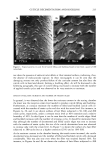
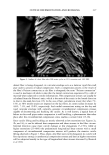
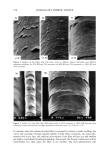
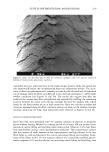
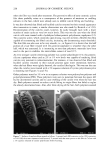
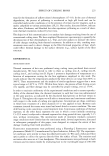
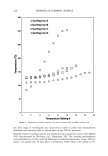
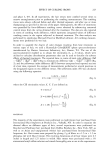
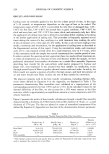
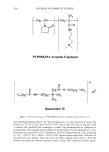
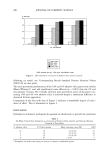
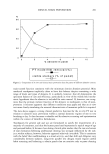
214 JOURNAL OF COSMETIC SCIENCE treatments on the cuticle (5,6). Cuticle lifting and decementation resulting from the imposition of high extension strains (30%) to hair have also been reported by Reutsch et aL (10). These workers have shown that depending on the hair conditions, cuticle lifting may occur by two main mechanisms: 1) cuticle decementation or failure of the cement layer at the cell membrane complex and 2) mechanical failure of the endocuticle. Since an analysis of hair cuticles from a panel of 100 individuals showed that cuticle lifting and buckling at the cuticle edges is a common phenomenon, we decided to investigate the conditions under which this type of damage occurs. In this paper it is shown that localized cuticle decementation leading to lifting and buckling of the cu- ticles starts to take place when dry hair fibers are cyclically extended at strains higher than 7%. It is also shown that this type of damage can be prevented and even repaired with the use of adequate cosmetic actives. EXPERIMENTAL METHODOLOGY Cyclical extensions ranging from 7% to 30% were applied to hair with a Diastron tensile tester in the automatic mode. The number of cycles applied varied between 50 and 200. The extension speed was 120 mm/min, and there was an interval of about two seconds between each cycle. The hair used for all these experiments was from a subject whose hair was washed only with a 10% aqueous SLS solution for a period of one year. The hair fibers used were snippets 2.5 inches long, cut close to the root. Hair from International Hair Importers was also used when needed. Some hair fibers were also allowed to swell for 36 hours in DMSO, IPA, and ethanol, and were then stress-cycled to investigate the effect of swelling on cuticle damage. Hair from a panel of 100 individuals was also analyzed by SEM for cuticle lifting at least ten fibers per each individual were tested. Also, in order to test the effect of some cosmetic chemicals on cuticle damage, a different set of fibers was treated with each one of the following aqueous solutions: glycerin, propylene glycol, a cationically modified gluconamide compound (11), hydrolyzed wheat protein polysiloxane copolymer (12), cystine polysiloxane (13), polyacrylate poly- mer, and polyethylenimide, each of these at a level of 3% w/w. After treatment the fibers were dried at 65 % relative humidity (RH) and stressed cyclically. The experiments were carried out in a controlled humidity chamber at 10, 65, 80, or 100% RH. After stressing, the hair fibers were immediately prepared for SEM analysis. RESULTS AND DISCUSSION Figures la and lb show typical patterns of cuticle lifting found in the hair of people from the panel. The analysis showed that this type of cuticle damage is present, although to different extents in about 80% of the hair population from the panel. In an attempt to reproduce these patterns of cuticle lifting in the laboratory, first a set of 2.5-inch hair snippets was subjected systematically to tension, torsion, and thermal cyclical stresses. The experiments showed that only the tensile cyclical stresses lead to such patterns of cuticle lifting. The other stresses produced very distinct forms of cuticle damage, and they will be described elsewhere (14). Most of the patterns of cuticle lifting found in this investigation were seen to occur by cuticle decementation or failure of the cuticular cement. For instance, in Figures 1-3 it can be seen that the sections of lifted cuticles do

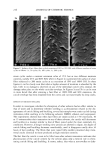
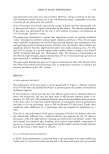
CUTICLE DECEMENTATION AND BUCKLING 215 •. ??kx 2. •Skx 8k Figure 1. Typical patterns (la and lb) of cuticle lifting and buckling found in hair from a panel of 100 individuals. not show the presence of endocuticular debris at their internal surfaces, indicating, thus, the absence of endocuticular rupture. In these micrographs it can be seen that the damaging stresses not only produce failure of the cuticular cement but also force the cuticle cells to bend and distort, forming a buckling effect. As will be discussed in the following paragraphs, this type of cuticle lifting was found to increase with the number of applied tensile cycles and was observed to be very sensitive to moisture. EFFECTS OF RELATIVE HUMIDITY AND NUMBER OF STRAIN CYCLES In general, it was observed that the lower the moisture content in the testing chamber the lower was the inception strain level needed to produce cuticle lifting and buckling. Furthermore, at constant moisture the number of lifted and buckled cuticle cells in- creased with the number of strain cycles and also with the strain level. For instance, in Figures 2a, 2b, and 2c are shown surfaces of hair fibers subjected to 50, 100, and 200 strain cycles, respectively, under a constant strain level at 10% extension and a relative humidity of 10%. In this figure it can be seen that the number of cuticle edges lifted and buckled increases with the number of stressing cycles. It should be mentioned here that although the number of decemented and lifted cuticle edges was seen to increase with the number of strain cycles, the size of the cuticle decemented area was observed to increase only with the strain level. In Figure 3 is shown the surface of a hair fiber subjected to 200 cycles but at a higher extension (25%) and at 10% RH. As the moisture content in the chamber housing the tensile tester increased, the cuticle decemented area decreased and the number of lifted and buckled cuticle cells decreased considerably. This was also true even when the fiber was strained beyond 30%. For instance, in Figures 4a and 4b are shown the surfaces of hair fibers subjected to 200
Purchased for the exclusive use of nofirst nolast (unknown)
From: SCC Media Library & Resource Center (library.scconline.org)