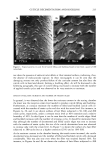
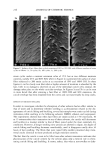
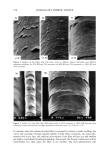
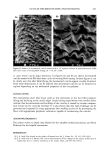
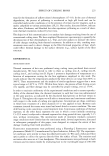
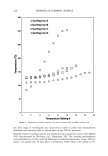
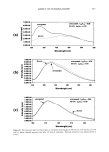
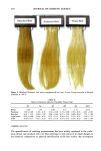
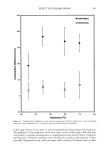
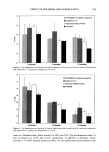
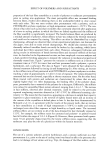
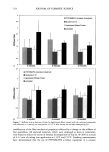
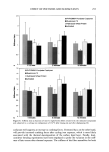
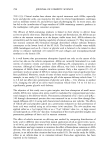
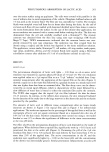
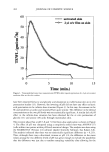
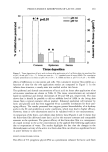
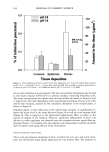
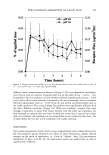
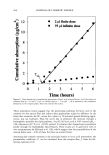
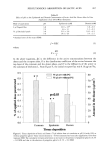
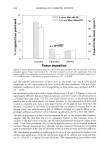
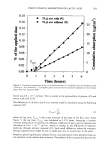
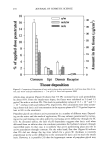
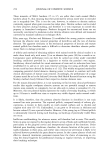
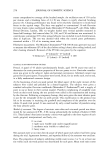
216 JOURNAL OF COSMETIC SCIENCE 2a 2b " x • 2½ e. ?&kx : . ??kx 8 77 x Figure 2. Surfaces of hair fibers after cyclical extension of 10% at 10% RH with different numbers of strain cycles as follows: la, 50 cycles lb, 100 cycles lc, 200 cycles. strain cycles under a constant extension value of 15% but at two different moisture contents, namely 65% and 80% RH, while in Figure 4c is presented the surface of a hair fiber subjected to 200 strain cycles at an extension of 30% and 100% RH. In these figures it can be clearly seen that when a higher amount of moisture is absorbed by the hair, little to no damage is observed on any of the individual cuticle cells instead, the damage takes place on the whole cuticular envelope. In Figures 5a and 5b it can be seen in more detail that after stressing a hair fiber at 100% RH and 30% extension, the cuticle envelope has been detached from the cortex and cut transversally by deep cracks. EFFECTS OF SOLVENT SWELLING In order to investigate whether the absorption of other solvents had an effect similar to that of water and to determine whether swelling is a phenomenon related to the dis- appearance of cuticle lifting and buckling, several hair samples were strain-cycled during immersion while swelling in the following solvents: DMSO, ethanol, and isopropanol. The experiments showed that when hair fibers are strain-cycled at 15% extensions, 10 or 15 minutes after their immersion in any of these solvents, the cuticle still decements and buckles in a manner similar to that of fibers tested under the most extremely dry conditions. However, if longer swelling time periods are allowed to elapse, the degree of cuticle lifting and buckling decreases considerably, until it disappears totally after 36 hours of hair swelling. The fibers that were tested fully swollen presented deep trans- versal cracks identical to those produced at high moisture contents. The fact that the cuticle is seen to be lifted soon after solvent immersion indicates that plasticization of the cuticle cement by the solvent plays only a limited role in elimi- nating cuticle lifting and buckling. It seems, rather, that when a non-swollen or dehy-

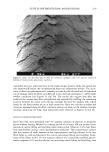
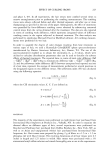
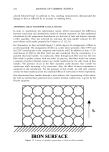
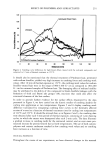
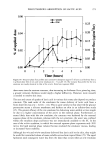
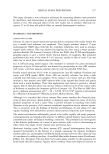
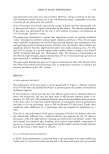
CUTICLE DECEMENTATION AND BUCKLING 217 ..'. %. • . .. . 77kx 8kv Figure 3. Surface of a hair fiber after 200 strain cycles at 25% extension and 10% RH. drated fiber is being elongated, its cuticular envelope acts as a laminar rigid thin-wall pipe under a process of radial compression. Such a compression process is the result of the fiber's Poisson contraction as the fiber is elongated the term "Poisson contraction" is used in mechanics of solids to describe the lateral contraction experienced by a slab of material when subjected to tensile deformations. The compression stresses can usually be calculated from the Poisson's ratio, which is the ratio of the strain in the lateral direction to that in the axial direction (15). In the case of hair, calculations reveal that when 7%, 15%, or 30% tensile strains are imposed on the hair fiber, its cortex radius decreases by 4.6%, 7.1%, and 12.0%, respectively. Such radial contractions acting on the dry and rigid cuticular envelope will, certainly, generate circumferential compression stresses capable of decementing and buckling the cuticle. As is well known, a typical form of failure in thin-wall pipes under compression is wall buckling, a phenomenon that takes place after the circumferential compression stress reaches a certain limit (15,16). Since cuticle lifting and buckling are mostly observed at low extensions (see Figures 2a, 2b, and 2c), it can be inferred that compression and shear stresses in the fiber circum- ferential direction cause more cuticle damage at low elongations (7-15%), while at higher extensions (25-40%) the predominant longitudinal shear stresses with a small component of circumferential compression stresses will produce the massive cuticle lifting observed in Figure 3. Thus, when a dry fiber starts to be elongated, its cuticle will first experience strong circumferential compression stresses and later at higher extensions will be subjected mostly to the type of longitudinal shear stresses discussed by Reutsch et al. (10).
Purchased for the exclusive use of nofirst nolast (unknown)
From: SCC Media Library & Resource Center (library.scconline.org)