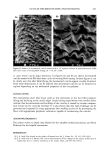
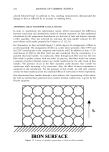
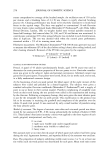
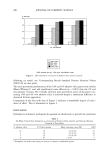
242 JOURNAL OF COSMETIC SCIENCE colored (bleached hair). In addition to this, combing measurements demonstrated the damage to hair as reflected by an increase in combing forces. APPENDIX: HEAT TRANSFER CALCULATIONS In order to complement the experimental results, which investigated the differences between continuous and intermittent modes of thermal treatment, we have performed calculations for the temperature distribution as a function of time and distance through a fiber assembly. This was achieved by utilizing the heat-transfer solution for the semi-infinite solid model proposed by Carlsaw et al. (22,33). For illustration, we have included Figure 12, which depicts the arrangement of fibers in an ideal assembly. The arrangement of fibers in a cubic lattice provides a fiber (79%) and air (21%) contribution to the composite semi-infinite solid. In addition to this, a 15% contribution of H20 to the fiber itself was also considered. For the calculations, it is assumed that heat transfer, via conduction, flows through each fiber and into the next fiber while in perfect contact with one other. In practice, the fibers would not assume a position of perfect thermal contact nor would conduction be the only mode of heat transfer. The presence of air in the fiber assembly could decrease heat transfer by conduction while increasing it by convection. Also, the effect of water evaporation is neglected in the calculations. For the purposes of this model, we will only consider conductive heat transfer and not the combined effects of convection or water evaporation. One-dimensional heat transfer through a semi-infinite slab, representing a fiber assem- bly with no internal heat generation and constant thermal conductivity, is given by the Fourier equation: qx IRON SURFACE Figure 12. A series of cylinders representing an ideal hair fiber assembly.

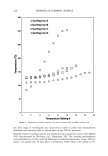
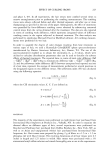
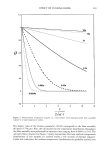
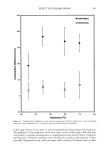
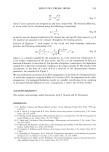
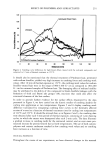
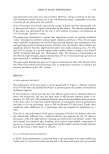
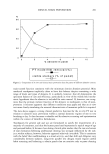
EFFECT OF CURLING IRONS 243 OT 02T Ot - ot -- (Eq. 7) Ox 2 where T and t represents the temperature and time, respectively. The thermal diffusivity, ix, of the solid can be calculated using the following relationship: k tx- (Eq. 8) p'cp in which case the thermal conductivity (k), density (p), and specific heat capacity (cp) of the material are assumed to be constant throughout the heating process. Solution of Equation 7, with respect to the initial and final boundary conditions, provides the following relationship (34): •c T- T o 2 f 2X/• . t e-? du (Eq. 9) -- -- 0-T,-To 1 o where u is a dummy variable for the integration, T o is the initial hair temperature, T, is the surface temperature of the heat source, and T(x,t) is the temperature of hair as a function of distance (x) and time (t). For the sake of algebraic convenience, the dependent variable T(x,t) has been normalized, resulting in the single variable, 0. The results of the calculations, in the form of a plot of 0 as a function of the dimensionless distance parameter, are presented in Figure 2. We also performed calculations for a fiber arrangement in the form of a hexagonal lattice in which the composite consisted of fiber (91%) and air (9%). In comparison to the cubic arrangement, the hexagonal formation results in a smaller contribution of air, resulting in decreased thermal diffusitivity and, consequently, a slower rate of heat transfer. ACKNOWLEDGMENTS The authors acknowledge useful discussions with J. Kosiek and K. Krummel. REFERENCES (1) C. Robbins, Chemical and Physical Behavior of Hair, 3rd ed. (Springer-Verlag, New York, 1994), pp. 120-152. (2) M. L. Garcia, J. A. Epps, and R. S. Yare, Normal cuticle-wear patterns in human hair, J. Soc. Cosmet. Chem., 29, 155 (1976). (3) E. Hoting and M. Zimmermann, Photochemical alterations in human hair. Part III: Investigations of internal lipids,J. Soc. Cosmet. Chem., 47, 201 (1996). (4) C. Pande and J. Jachowicz, Hair photodamage--Measurement and prevention, J. Soc. Cosmet. Chem., 44, 109 (1993). (5) P. Milczarek, M. Zielinski, and M. Garcia, The mechanism and stability of thermal transitions in hair keratin, Colloid Polym. Sci., 270, 1106 (1992). (6) R. Crawford, C. Robbins, and K. Chesney, A hysteresis in heat dried hair,J. Soc. Cosmet. Chem., 32, 27 (1981). (7) L. Rebenfeld, H. Weigmann, and C. Dansizer, Temperature dependence of the mechanical properties of human hair in relation to structure, J. Soc. Cosmet. Chem., 17, 525 (1966). (8) W. Humphries, D. Miller, and R. Wildnauer, The thermomechanical analysis of natural and chemi- cally modified human hair, J. Soc. Cosmet. Chem., 23, 359 (1972).
Purchased for the exclusive use of nofirst nolast (unknown)
From: SCC Media Library & Resource Center (library.scconline.org)