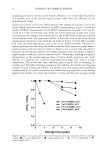
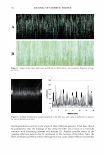
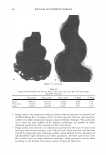
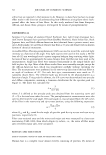
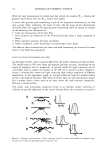
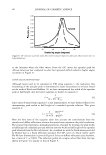
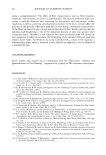
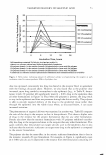
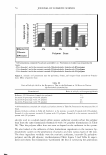
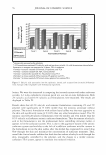
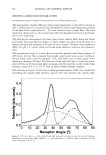
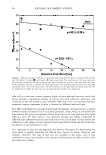
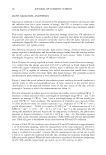
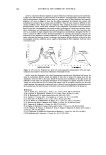
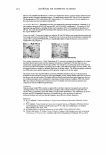
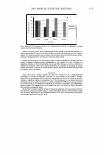
60 JOURNAL OF COSMETIC SCIENCE 0.16 0.14 0.12 0.10 ta -:i 0.08 · C 0.06 - C \ 0.04 0.02 0.00 20 40 60 80 Scattering angle (degrees) Figure 8. GP intensity scan from nylon fiber with increased ellipticity index and when twisted over its longitudinal axis. at the locations where the fiber twists. From the GP curves the specular peak for African-American hair compared to other hair appeared shifted indeed to higher angles (as shown in Figure 5). LUSTER CALCULATIONS REVISED Although luster used to be calculated at TRI using equation 1, the realization that broadening of the specular peak is detrimental to luster necessitates its revision. Based on the work of Reich and Robbins (1), we have incorporated the width of the specular peak at half height into the luster equation, as shown in equation 3: s L= - -- (S + D) · W112 (3) Since luster obtained from equation 3 is not dimensionless, we have further refined it by incorporating peak width at half height of a standard specular reflector. This gives equation 4: S w, tandard L =---. 112 (S + D) \V,ample · 1/2 (4) Here the first term of the equation takes into account the contributions from the specular and diffuse reflectance, whereas the second term represents the peak broadening. The second term represents a normalization factor, obtained by dividing the peak width at half height of a standard specular reflector into the width at half height of the specular peak obtained from the fiber of interest. As a standard we used the black mirror provided by Hunter Lab as a black reflection standard. The GP curve of a black mirror under He-Ne laser illumination is given in Figure 9. It has no diffuse reflectance and, therefore, has a luster of 1, or 100%. The reflection profile of a single carbon fiber from the tape shown in Figure 4 is similar to that of Figure 9.

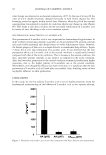
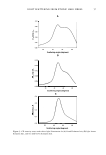
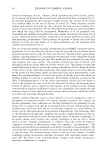
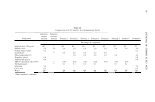
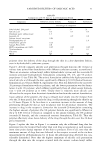
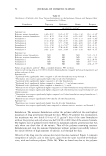
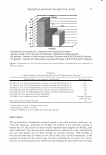
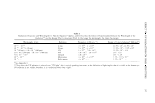
LIGHT SCATTERING FROM ETHNIC HAIR FIBERS 61 0.4 0.3 0.2 · C 0.1 C 0.0 -0.1 0 20 40 60 80 Scattering angle Figure 9. Goniophotometric intensity scan under He-Ne laser illumination for a standard black mirror from Hunter Lab. Hair origin Piedmont Light brown European Dark brown European Indian Japanese Chinese African -American Table II Luster Calculated by Equations 1 and 4 Luster(%) by equation 1 (He-Ne laser illumination) 17.35 21.53 27.91 35.6 34.25 24.05 35.95 Luster(%) by equation 4 (He-Ne laser illumination) 8.4 12.6 17.8 27.2 19.1 15.7 20.8 The luster values calculated from equations 1 and 4 are given in Table II. The absolute luster values calculated by equation 4 progressively decrease because of the nature of this equation. However, we note that there are comparable changes in the luster values calculated using equations 1 and 4 for European hair with various pigmentation levels. This indicates that in the case of European hair the peak broadening is dominantly caused by a gradual decrease in pigmentation, leading to increased scattering by the hair's interior. However, for hair of Asian origin the use of the latter equation differ entiates similar luster values (e.g., Indian and Japanese hair) obtained by using equation 1. Hence, equation 4 is more discriminating. For hair with Asian origin the pigmen tation is similar, and therefore the peak broadening should be explained by differences in the hair's internal structure, e.g., the presence or absence of the medulla. Japanese hair is known to have a high medullation, leading to increased internal light scattering. SUMMARY In this study the optical properties of hair from various ethnic backgrounds are studied
Purchased for the exclusive use of nofirst nolast (unknown)
From: SCC Media Library & Resource Center (library.scconline.org)