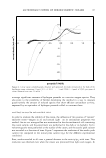
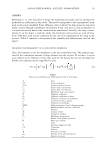
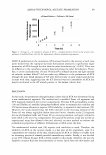
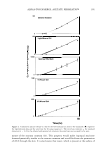
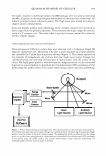
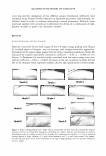
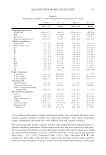
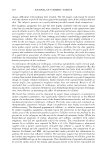
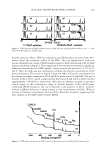
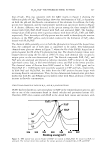
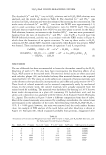
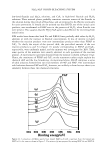
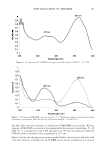
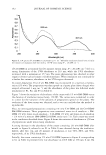
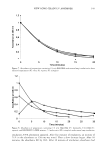
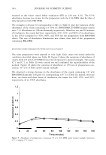
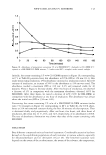
H 2 O)NaF TOOTH-BLEACHING SYSTEM 131 low-level fluoride and H 2 0 2 solutions, and CaF2 in high-level fluoride and H20 2 solutions. These mineral phases probably constitute reservoir sources of the fluoride in the solution during the periods of bleaching, and are proposed to be effective eventually for caries prevention. It should also be pointed out that DCPD, one of the initial caries products, was transformed to FHAP even in the presence of H 2 O 2 , when fluoride ions were present. This suggests that the H2O2/NaF agent is also effective for recovering from initial caries. XPS results have shown that both Fls and F(KLL) lines gradually shift either by H 2 O2 addition or with the increase in fluoride concentration. It was of interest to know whether the reaction products were new intermediate products other than FHAP or CaF2 . To clarify the origin of the spectral shift, the prescribed amount of the two reaction products (a and f in Figure 11) mostly corresponding to FHAP and CaF2 , respectively, were uniformly mixed, and the mixture was investigated by XPS. Then, some spectra of the mixtures were mostly identical to each spectrum of the reaction product. A representative spectrum obtained from the mixture is shown in Figure l l(g). Hence, the coexistence of FHAP and CaF2 on the outermost surface might explain the chemical shift and the line broadening. As mentioned above, FHAP comprises a series of solid solutions formed from two end members of FAP and HAP. The intermediate solid solutions between FAP and CaF 2 , however, are unlikely to form because there is no similarity between these two chemical structures. 604 602 600 598 596 594 592 Binding energy(eV) Figure 11. Comparison of F(KLL) spectra from treated HAP (a-f) with a spectrum from the mixture (g). HAP (a-f) is the same as shown in Figure 5. The mixture (g) was prepared by mixing HAP (a) and HAP (f).

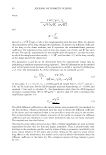
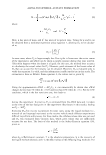
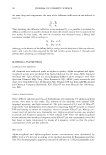
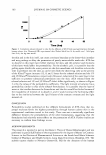
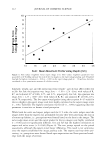
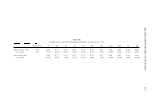
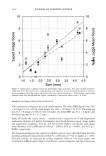
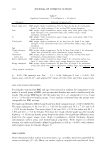
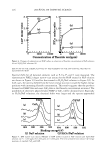
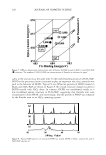
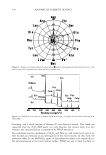
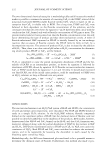
132 JOURNAL OF COSMETIC SCIENCE The two-dimensional chemical-state plot is methodologically useful because this method makes it possible to estimate the amount of coexisting CaF 2 in the FHAP, instead of the potassium hydroxide (KOH)-soluble fluoride method (48), which is based on the as sumption that CaF2 is soluble only in KOH. For a long time, FHAP and CaF2 were believed to form dependent on the fluoride concentration of the solutions, and the consequent mechanisms (3 3) shown by equations 7 and 8 have been often cited, with the condition that CaF2 formed only with a fluoride concentration of 500 ppm or more. The present results, however, have pointed out that the fluoride concentration is not the only factor determining the type of product and that other mechanisms coexist. A series of fluoride-substituted HAP expressed as FHAP is initially formed by an ion-exchange reaction then an excess of fluoride converts the FHAP little by little to CaF2 by a decomposition reaction. The amount of produced CaF2 is also increased by the addition of H2O2. Thus, there is no clear critical pH value or H2O2 concentration for determin ing which product, FHAP or CaF2, will be formed. Ca 10 (PO 4 ) 6 (OH) 2 + 2F- ➔ Ca10(PO4)c F2 + 2OH- (7) (8) H 2 O 2 is considered to cause the partial incongruent dissolution of HAP and the for mation of DCPD as an intermediate product, as shown by equation 9, followed by dissolution of DCPD, shown by equation 10. If fluoride ions exist under this situation, CaF 2 or FHAP would form by equations 11, 12, and 13 below. It should also be pointed out that DCPD, one of the initial caries products, could be transformed to FHAP even in H 2 O2 solution, as long as fluoride ions are present. Ca 10 (PO 4 ) 6 (OH)2 + SH+ ➔ 9Ca2+ + SHPO42- + CaHPO4 · 2H2O (9) CaHPO4 • 2H2O + H+ ➔ Ca2+ + H2PO4- + 2H2O (10) CaHPO4 · 2H 2 O + 2F- ➔ CaF2 + HPO/- + 2H2O (11) Ca2+ + 2F- ➔ CaF 2 (12) lO{CaHPO4 · 2H2O} + (4 - n)OH- + nF- ➔ Ca10(PO4)6(OH)2_nFn CONCLUSIONS + 4H2PO4- + 22H2O (13) The reaction mechanisms in an H2O)NaF system of HAP and DCPD, the constituents of teeth and dental caries respectively, were elucidated. The HAP and DCPD dissolved easily in a simple H2O2 solution. In the H2O2/NaF solution, fluoride compounds formed on the outermost surface of HAP, but the chemical states of fluorine were not possible to identify by XRD due to the smallness of the products. XPS studies, however, demonstrated that FHAP and CaF2 formed on the HAP, and that CaF2 formation was, moreover, enhanced along with the partial dissolution of HAP by the increase in NaF and H 2 O2. DCPD also transformed easily to FHAP and CaF2 by NaF, even under the coexistence of H 2 O 2 . Both FHAP and CaF 2 were considered to enhance the remineral ization, and to be responsible for lessening the discomfort in teeth caused by the bleaching agent containing H 2 O 2 . Methodologically, the XPS two-dimensional plot was found to be a powerful means to determine the chemical states of fluoride. Furthermore, this method also made it pos-
Purchased for the exclusive use of nofirst nolast (unknown)
From: SCC Media Library & Resource Center (library.scconline.org)