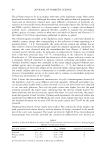
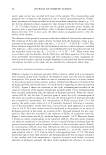
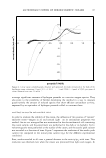
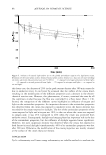
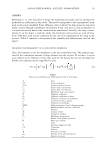
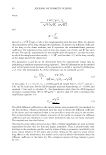
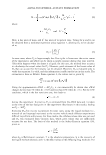
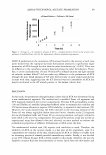
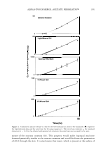
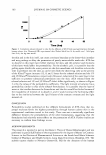
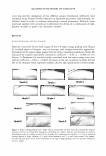
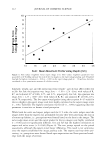
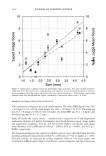
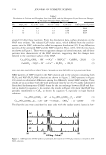
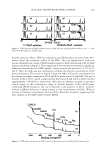
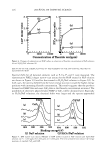
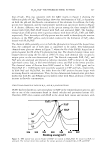
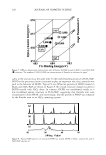
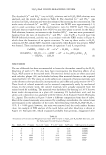
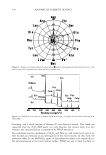
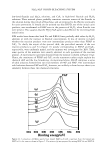
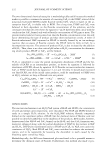
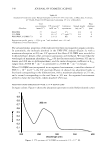
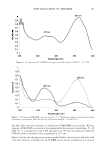
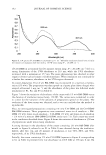
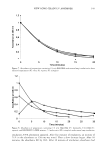
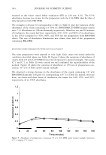
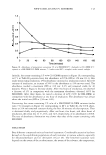
84 JOURNAL OF COSMETIC SCIENCE The pH was chosen to be in accordance with that of the depilatory cream. Both curves presented an anodic wave. Although the nature and the physicochemical properties of a cream and an electrolytic solution were quite different, comparison of potentials ob tained in the two media clearly demonstrated that antioxidant species like thiolactic acid and BHA could be detected in a dermocosmetic cream by a simple electrochemical method. Cyclic voltammetry appeared therefore suitable to evaluate the antioxidant global capacity of creams, similar to what was concluded by Chevion and Chevion (17) and others (18,19) from experiments performed in plasma or plants. The voltammograms recorded in the depilatory cream (Figure 2, solid line) showed no cathodic current, except that corresponding to the reduction of water appearing at a potential below -1.2 V. Consequently, the cream did not contain any oxidant species that could be detected electrochemically under the adopted operational conditions. In contrast, the curve obtained with the antioxidant-free base (Figure 2, dashed line) revealed several cathodic peaks. In particular, an amperometric response was recorded with a half-wave potential near -0.3 V, corresponding to the reduction of oxygen. Korotkova et al. (18) demonstrated the diminution of the oxygen reduction current on a platinum electrode immersed in aqueous solution containing antioxidant species. Actually dissolved oxygen was contained in the cream sample prepared without anti oxidant species since an upper potential boundary, i.e., 1.1 V, was chosen in order to avoid oxidation of water into oxygen at the electrode surface during experiments. These last results confirm that cyclic voltammetry is a suitable method to reveal directly the presence of antioxidant species in the cream and to evaluate its antioxidant properties without any pretreatment of the sample. Table I shows the electrochemical characteristics of cyclic voltammograms obtained in the depilatory cream by using different electrode materials. Although antioxidant spe cies are generally studied with a carbon electrode (22,23), the best results were obtained in our case with platinum. Not only the peak current was higher, but also the peak potential presented the lowest value, indicating that the electron transfer kinetics be tween platinum and the electroactive species was faster. For each electrode, the experi ment was repeated at least six times. Between each experiment, the electrode surface was regenerated (see Materials and Methods) and a new cream sample was used. In all cases the standard deviation was at most 10% for the peak current and 70 m V for the peak potential. Adopting this protocol, eleven creams were studied. The conductivity of the samples, the peak potential and current density, and the amount of charge consumed in the anodic part of the curve were measured. The results are listed in Table II. First, electrochemical measurements were possible, provided the conductivity differed from zero. Second, an Table I Influence of Electrode Material on Anodic Peak Current Density and Potential of Cyclic Voltammogram Obtained in Depilatory Cream Electrode material Platinum Vitreous carbon Gold 6.0 ± 0.3 5.2 ± 0.3 5.4 ± 0.6 E p eak (V /MSE) 0.29 ± 0.04 0.38 ± 0.06 0.42 ± 0.07 All electrodes were cleaned as described in Materials and Methods. Number of measurements 6 10 7

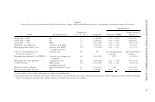
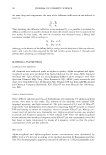
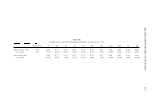
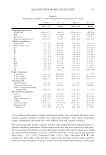
Table II Values of Conductivity and Anodic Peak Current Density, Charge, and Potential Recorded with 11 Antioxidant-Containing Creams or Free Bases Reproducibility Conductivity Current density i P Cream Antioxidant species oo-3 n-1 /cm- 1 ) Charge (mC) Potential (V /ESM) (mA/cm-2) Cream (pH = 4.86) 1 No 1.5 0.16 (4%)3 0.71 ± 0.02 0.78 (4%) Cream (pH = 6.88) 1 No 3.1 0.18 (6%) 0.59 ± 0.02 0.81 (4%) Cream (pH = 6.95 ) 1 BHT 3.3 0.21 (16%) 0.60 ± 0.02 0.95 (13%) Depilatory cream (Klorane) Thiolactic acid, BHA 3.4 3.52 (3%) 0.29 ± 0.04 6.0 (5%) Anti-aging cream (Nivea Vital) Ascorbic acid, BHT, 1.6 2.3 (16%) 0.34 ± 0.07 3.1(13%) tocopheryl acetate Corrective dermatological care Ascorbic acid 0.0 0.0 No voltammogram No voltammogram for wrinkles (Active C) recorded recorded Depigmenting emulsion (Trio D[LED}) Ascorbic acid polypeptide, 8.6 0.23 (25%) 0.702 0.6 (30%) tocopherol Whitening day cream (Decleor) Tocopheryl acetate 0.4 0.24 (16%) 0.91 ± 0.06 0.51 (13%) Ystheal emulsion BHT retinal, 0.9 0.35 (16%) 0.87 ± 0.03 0.9 (15%) tocopheryl glucoside Epithelial cream (A Derma) Retinal, tocopheryl acetate 0.1 0.133 (5%) 1.202 0.25 (4%) After-sun repair balm (Uriage) No 3.7 0.24 (9%) 0.70 ± 0.03 0.76 (12%) 1 Creams made in Pierre Fabre Laboratory (see Materials and Methods). 2 No peak potential was observed. The standard deviarion was calculated from the current at the indicated potential, where a significant anodic wave was observed. 3 Values in parentheses represent the standard deviation, evaluated with at least six samples. z """"1 """"" 0 s � ""Cl 0 � t'I1 � 0 u'Tj t'I1 � � 0 n 0 C/) � t'I1 """"1 n n � t'I1 � C/) 00 VI
Purchased for the exclusive use of nofirst nolast (unknown)
From: SCC Media Library & Resource Center (library.scconline.org)