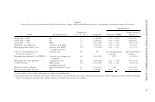
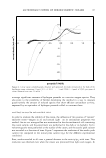
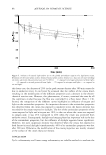
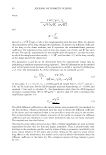
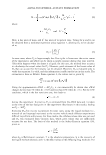
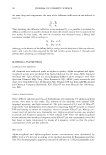
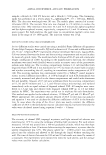
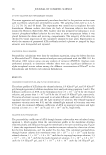
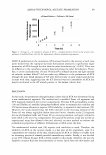
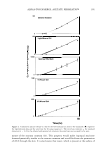
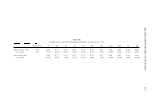
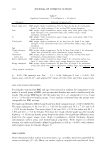
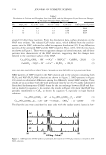
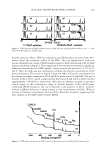
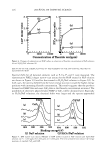
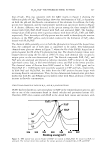
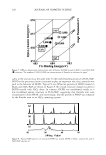
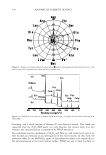
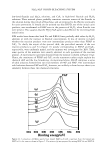
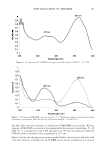
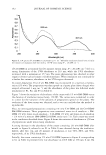
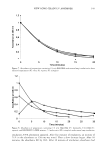
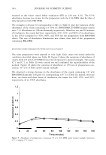
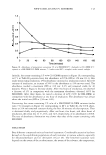
NEW LONG-CHAIN UV ABSORBER 147 bance for the preparation containing Cl0-DBM and an 92% decrease for the preparation with BM-DBM. However, the molar absorption coefficient of ClO-DBM is lower than that of the BM-DBM. In the creams, the molar absorption coefficient at 358 nm of C 10-DBM in the enol form was estimated at 1 7 000 M- 1 cm - 1, whereas that of BM-DBM was estimated at 40 000 M- 1 cm- 1 . Thus Cl0-DBM should not be used alone in cosmetic preparation, but in association with BM-DBM. High initial UV A absorbance will be given by the presence of BM-DBM and it will be preserved by the presence of ClO-DBM, which under irradiation will supply BM-DBM. Therefore, a cream containing a mixture of BM-DBM/ClO-DBM (molar ratio 7:3) was prepared. Looking at the triangles in Figures 8 and 10 (preparations Ml and M' 1, respectively, in Tables I and II), we can confirm that the UV A absorption of these creams was more stable than the UVA absorption of creams Pl and P' 1. ClO-DBM, which is a BM-DBM precursor under irradiation, allowed us to preserve the UV A absorption of the prepara tion containing the mixture. Moreover, creams Ml and M' 1 showed an initial absor bance that was higher than the absorbance of creams C 1 and C' 1. Thus cosmetic preparations containing both ClO-DBM and BM-DBM exhibit UVA absorbance that remains at useful levels for longer than cosmetic preparations containing only BM-DBM. Studying the curves in Figure 8 and 10, we note that the efficiency of the ClO-DBM molecule was greater under natural sunlight irradiation. Indeed, absorbance of creams C' 1 and M' 1 (Figure 10) can be considered stable under natural sunlight for three hours, corresponding to the period of strongest light intensity (12:00 h-15:30 h solar time, in May and June, Toulouse, latitude 43° North, France). Irradiation with the 150-W xenon lamp was performed without any UVC filter. Therefore, the xenon lamp emitted short wavelength rays, hence more energetic than natural sunlight. Thus the photodegradation of the filters was much faster under xenon lamp irradiation than under natural light. CONCLUSION In this paper, we present a new UV absorber, the l-(4-tert-butylphenyl)-2-decanyl-3- (4' -methoxyphenyl)-propane-1,3-dione called ClO-DBM, derived from BM-DBM by grafting a long alkyl chain. The present work reports the absorbance photostabilities of UVA sunscreen preparations containing BM-DBM and ClO-DBM in water-in-oil prepa rations similar to those currently used in cosmetics. Although Cl0-DBM shows a weaker molar absorption coefficient in the UV A than BM-DBM, its absorption is more pho tostable in this domain, especially under natural sunlight. The use of both filters together, BM-DBM and ClO-DBM, the first one for its high UVA absorption and the second one for its ability to supply BM-DBM under irradiation, results in good stability in UV A protection. ACKNOWLEDGMENTS The authors thank C. Lebreton and M. P. Dulau of Bioderma, Dipta, Aix-en-Provence, France, for the water-in-oil preparation. REFERENCES (1) International Agency for Research on Cancer, !ARC Monographs on the Evaluation of Carcinogenic Risks to Humans: Solar and UV Radiation (IARC, Lyon, Vol. 55, 1992).

148 JOURNAL OF COSMETIC SCIENCE (2) F. R. De Gruijl, H. J. Sterenborg, and P. D. Forbes, Wavelength dependence of skin cancer induction in albino hairless mice, Cancer Res., 53, 53-60 (1993). (3) W. Schwack and T. Rudolph, Photochemistry of dibenzoylmethane UVA filters. Part 1,j. Photochem. Photobiol. B: Biol., 28, 229-234 (1995). (4) M. Dubois, P. Tiercet, A. Deflandre, and M.A. Lefebvre, Photoisomerisation of the sunscreen filter Parsol 1789,J. Chim. Phys., 95, 388-394 (1998). (5) 0. Karl-Fred De Polo, 4-(1,1-dimethylethyl)-4' -methoxydibenzoylmethane, US patent 4,387,089 (Givaudan Corporation, Clifton, NJ, 1983). (6) A. C. Weedon, "Photochemical Reactions Involving Enols," in The Chemistry of Enols, Zvi Rappaport Ed. (The Hebrew University, Jerusalem, 1990), pp. 602-633. (7) X. B. Chen and W. H. Fang, Norrish I vs II reactions of butanal: A combined CASSCF, DFT and MP2 study, Chem. Phys. Lett., 361, 473-482 (2002). (8) H. Sakurai and S. Kato, A theorical study of the Norrish type I reaction of acetone,]. Mol. Struct. (Theochem), 461-462, 145-152 (1999). (9) N. M. Roscher, M. K. 0. Lindemann, S. B. Kong, C. G. Cho, and P. Jiang, Photodecomposition of several compounds commonly used as sunscreen agents,]. Photochem. Photobiol. A: Chem., SO, 417-421 (1994). (10) J.M. Allen, S. K. Allen, and B. Lingg, Photostabilities of several chemical compounds used as active ingredients in sunscreens. Drugs: Photochem., Photostabil., 225, 171-181 (1998). (11) J. N. Thorel, Procede de photostabilisation du 4-(tert-butyl) 4' -methoxy dibenzoylmethane, compo sitions filtrantes ainsi obtenues et leurs utilisations, FR patent 2 7 68 7 3 0 A 1 (Paris, 1997). (12) D. Allard and S. Forestier, Compositions comprenant du 4-ter-butyl-4' -methoxydibenzoylmethane, un derive de 1,3,5-triazine et un (alpha-cyano)-beta, beta' -diphenylacrylate d'alkyle et utilisations, FR patent 2 750 335 Al (L'Oreal S.A., Paris, 1996). (13) I. Hansenne and K. De Chabannes, Composition filtrante photostable comprenant un derive de dibenzoylmethane et un alkylether de polysaccharide et ses utilisations, FR patent 2 747 038 A2 (L'Oreal S.A., Paris, 1996). (14) D. Candau, Cosmetic solar protection compositions based on a synergic mixture of filters and uses, WO 02149598 A2 (L'Oreal S.A., Paris, 2001). (15) C. Cole and F. Natter, Sunscreen compositions containing a dibenzoylmethane derivative, US patent 6,444,195 Bl Qohnson & Johnson Consumer Companies, NJ, 2001). (16) S. Tobita, J. Ohba, K. Nakagawa, and H. Shizuka, Recovery mechanism of the reaction intermediate produced by photoinduced cleavage of the intramolecular hydrogen bond of dibenzoylmethane,]. Photochem. Photobiol. A: Chem., 92, 61-67 (1995). (17) M. J. Rosen, "Characteristic Features of Surfactants," in Surfactants and Interfacial Phenomena (Wiley Interscience, New York, 1989), pp. 1-32. (18) J. H. Clark and J.M. Miller, Hydrogen bonding in organic synthesis. Part 6. C-alkylation of [3-di carbonyl compounds using tetra-alkylammonium fluorides,]. C. S. Perkin I, 1743-1745 (1977). (19) J. H. Clark and J.M. Miller, Mono-C-alkylation of [3-dicarbonyl compounds using tetra alkylammonium fluorides,]. C. S. Chem. Comm., 64-65 (1977). (20) A. L. Marzinzik and E. R. Felder, Solid support synthesis of highly functionalized pyrazoles and isoxazoles: Scaffolds for molecular diversity, Tetrahedron Lett., 37, 1003-1006 (1996). (21) T. Rudolph, Photoreactions of chemical UVA filters in cosmetics, GIT Laboratory]., 1, 17-20 (1997). (22) A. Deflandre and G. Lang, Photostability assessment of sunscreens: Benzylidene camphor and diben zoylmethane derivatives, Int.]. Cosmet. Sci., 10, 53-62 (1988). (23) P. Markov and I. Petkov, On the photosensitivity of dibenzoylmethane, benzoylacetone and ethyl benzoylacetate in solution, Tetrahedron, 33, 1013-1015, 0977). (24) P. Markov, I. Petkov, and D. Jeglova, Photochemistry of enolizable [3-dicarbonyl compounds: Study on the photoketonization of some esters of aroylacetic acids,]. Photochem., S, 277-284 (1978). (25) J. Emsley, The composition, structure and hydrogen bonding of the [3-diketones, Structure and Bonding, 57, 147-191 (1984). (26) H. Watarai, M. Takano, and N. Suzuki, Tautomerization and dissociation equilibria of [3-diketones in microemulsions, Bull. Chem. Soc. Jpn., 65, 170-174 (1992). (27) F. Wetz, C. Routaboul, D. Lavabre, J.-C. Garrigues, I. Rico-Lattes, I. Pernet, and A. Denis, Photo chemical behaviour of a new long-chain UV absorber derived from 4-tert-butyl-4'- methoxydibenzoylmethane, Photochem. Photobiol., SO, 316-321 (2004).
Purchased for the exclusive use of nofirst nolast (unknown)
From: SCC Media Library & Resource Center (library.scconline.org)