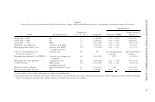
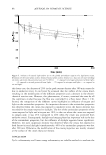
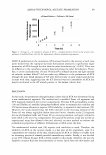
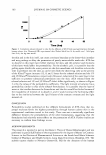
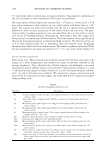
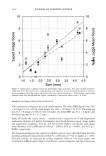
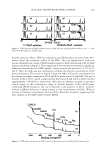
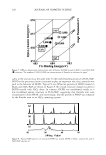
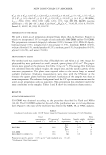
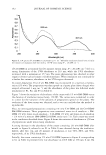
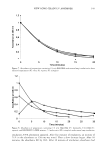
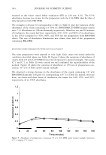
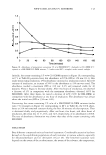
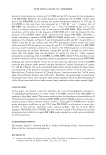
NEW LONG-CHAIN UV ABSORBER 145 1,2 1 E C: a:, 0,8 m � 0,6 .c 0,4 .c 0,2 0 0 20 40 60 80 100 120 140 160 180 Time (minutes) Figure 10. Absorbance of preparations containing 1% w/w BM-DBM (P'l: diamonds) or ClO-DBM (C'l: squares) or a BM-DBM/ClO-DBM mixture, 7:3 molar ratio (M'l: triangles) under natural sunlight. Initially, the cream containing 1 % w/w ClO-DBM (squares in Figure 10, corresponding to C'l in Table II) presented very low absorbance in UVA (OD at 358 nm: 0.13). Like under xenon lamp irradiation, UVA absorbance increased as irradiation started. After 60 minutes of irradiation, an increase of 58% in the absorbance at 358 nm was noted. The absorbance reached a maximum (OD at 358 nm: 0.27) and remained stable for 30 minutes. Then it began to decrease slowly. After two hours of irradiation, we observed a decrease of 3% in comparison with the maximum absorbance obtained (85% for BM-DBM). After three hours, we noted a decrease of 22% (92% for BM-DBM) in comparison with the absorbance at one hour of irradiation. The absorbance was always above the initial one (OD at 358 nm: 0.21). Concerning the cream containing 1 % w/w of a BM-DBM/ClO-DBM mixture (molar ratio 7:3) (triangles in Figure 10, corresponding to M' 1 in Table II), the UV A absor bance at 358 nm remained constant during the first 30 minutes of solar exposure. Then it decreased slowly and progressively. After one hour, two hours, and three hours of irradiation, the cream lost 11 %, 16%, and 34%, respectively, of its absorbance in UVA. The rate of absorbance diminution was slower than that of the cream containing only BM-DBM. DISCUSSION Beta-diketone compounds exist as keto/enol tautomers. Considerable attention has been focused on the equilibrium populations of each tautomer in various solvents, especially for dibenzoylmethane and its derivatives (16,22-24). The keto/enol tautomer ratio depends on the nature of the a-substituents, the nature of the solvents, the temperature,

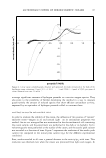
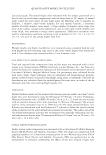
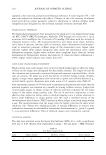
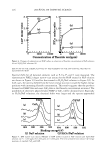
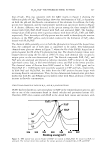
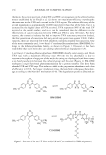
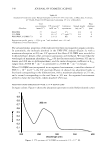
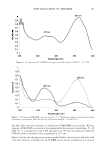
146 JOURNAL OF COSMETIC SCIENCE and the presence of traces of proton acceptors and/or donors (25). For most of them, the enol form is the major one. The conjugated system of the enol form spreads further than that of the keto form due to the formation of a pseudo-six-membered ring with OH. This induces a bathochromic shift in absorbance. ClO-DBM and BM-DBM were modelled, and the predicted log (P) values were calcu lated. Log (P) for BM-DBM was estimated at 4.0, whereas for the enol form of ClO DBM, log (P) was estimated at 7 .9 and the keto form at 8.2. It is, of course, the long aliphatic carbon chain of the ClO-DBM that induces its partition toward an apolar environment and hence an original behavior. When ClO-DBM was incorporated in an organized environment, a micellar solution of SDS, absorbance shifted from UVB to UV A. One hypothesis is that the keto-enolic equilibrium was displaced to the enol form (absorbance maximum at 361 nm). The environment has an important influence on this equilibrium: indeed a particular mi cellar distribution of ClO-DBM in the solutions examined can result in the modification of the solute-solvent interactions and of the polarity environment. We can easily imag ine the insertion of Cl0-DBM into micelles, favoring the enol isomer. Indeed, it seems that the keto-enolic equilibrium is shifted towards the enol form in apolar environ ments. Watarai et al. (26) described the tautomerization of benzoylacetone, benzoyltrifluoroac etone, and 2-naphthoyltrifluoroacetone in anionic, cationic, and non-ionic microemul sions by means of UV spectrophotometry. The ratio of the two absorbance maxima (around 300-350 nm for the enol form and 250 nm for the keto form) reflected the degree of enolization. They studied the effect of dissolving the molecules in SDS micellar media on the absorbance ratio of these 13-diketones. They noted an increase in the absorbance ratio (Aeno/A keto ) when the SDS is above its critical micellar concentration. They explained this increase by a preferential solubilization of the enol form in micelles. In our case, almost all Cl0-DBM molecules were in the enol form in the micellar solution of SDS. ClO-DBM seems to have a different behavior from other 1,3-dicarbonyl compounds. Unlike BM-DBM, in organic solvents, ClO-DBM is in its keto form. Irradiated for a few minutes, the absorbance shifted from UVB to UVA. Spectral changes can be due to the conversion of the diketone form of ClO-DBM ("-max = 263 nm) to the enol form ("-max = 357 nm) or to its photodegradation into UVA-absorbing species. The mechanism of this phenomenon was studied in more detail and is the subject of a second article (27). HPLC-MS indicated the coexistence of two processes: • in organized media, a shift of the keto-enolic equilibrium towards the enol • under irradiation, decomposition of ClO-DBM leading to BM-DBM (Norrish II photoreaction) In water-in-oil preparations, the same phenomenon as in micellar solutions of SDS was observed. We noted weak UVA absorbance of the cream containing 1 % w/w ClO-DBM before irradiation. Irradiation with either xenon lamp or natural sunlight induced an increase in UV A absorbance for five minutes for the xenon lamp or one hour for sunlight (Figures 8 and 10, respectively). Furthermore, UVA absorbance of the preparation containing ClO-DBM is more stable than that of the preparation containing BM-DBM. After three hours under natural sunlight, we noted a 22% decrease in the UVA absor-
Purchased for the exclusive use of nofirst nolast (unknown)
From: SCC Media Library & Resource Center (library.scconline.org)