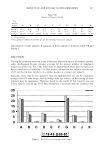
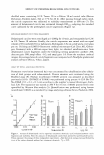
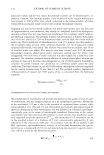
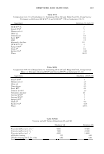
224 JOURNAL OF COSMETIC SCIENCE 300 6 � ........... li... cu 250 5 . (\J .c b.D b.D -4 ' 200 b.D '-"' C · 150 3 +-' a 0 a i- a.. ,-- 100 -2 en "'C "'O 50 1 w 0 0 0 0.3 1 3 Thioglycholate (%) Figure 3. Total protein and S 1 00A3 eluted from hair into permanent waving lotion. Total protein (gray box) and S100A3 (black box) levels were determined by Bradford assay and Western blot analysis, respec tively. n.d., not detected. of cuticle delamination processes largely depends on the experienced perming and bleaching treatments. Our results indicate that cuticles delaminated from permed hair are remarkably larger than those from untreated hair. Those from harshly bleached hair can, however, be smaller. Based on these findings, we present now a more precise model for chemically induced hair damage, which encompasses both SlO0A3 elution and oxidization during various hair treatment procedures (Figure 5). We detected a close correlation between the concentration of S 1 00A3 in the permanent waving lotion and the enlargement of the delaminated cuticles. We propose that re ducing permanent waving lotion releases S 1 00A3 from the inner part of the endocuticle (5) so that the cuticle becomes more easily delaminated. This study shows that the cuticles of permed hair tend to delaminate into large fragments. Interestingly, the loss of a low amount of S 1 00A3 already damages the adhesion sites between the cuticles, and is sufficient to enlarge the cuticle fragments. This reinforces our postulation that SlO0A3 is a structural component linking adjacent cuticles. Our previous hair damage model could not explain why in bleaching treatments induced hair damage occurs without loss of Sl00A3. Recent observation by transmission electron microscopy showed severe damage in the endocuticle upon bleaching treatment (11). This study has shown that several SlO0A3 spots were observed on 2D-PAGE without any chemical treatment, but the oxidized forms, shifted to acidic pl, increased dramati cally by employing hydrogen peroxide. The acidic pl shift of Sl00A3 is observed within

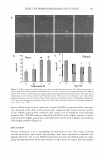
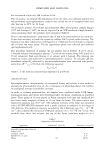
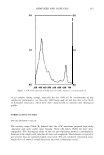
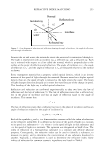
kDa 3.0 I 21.5- 14.4- 6.0- 3.5- EFFECT OF PERMING/BLEACHING ON CUTICLES 3.5 .,, .,, I pl 4.0 I 3.93 ,. ,. ,. ,. ,, 4.5 I / ., ., 1------- .,, .,, .,, .,, ,. 10 o t I I I I I I ' I I I I I 20 40 60 80 Contents of isoelectric variants of S1 00A3 (%) I ' I ' ' I 225 5.0 I 100 Figure 4. Proportion of various isoelectric variants of S l00A3 in bleached hair upon 2D PAGE analysis. The upper panel shows the shift of S 1 00A3 protein oxidized by 1 % hydrogen peroxide to the lower pl. Each spot is at indicated pl. The lower panel shows the acidic pl shift of S 100A3 spots in an H 2 02 concentration dependent manner. the range of the concentration of hydrogen peroxide needed for cuticle delamination and its fragmentation into small peptides. We postulate that this molecular transformation represents whole cuticle oxidation, as most cuticle proteins, including S100A3, contain a higher portion of cysteines (12). Although most oxidized proteins were retained in cuticles even if some of the disulfide bridges were converted into cysteic acid, we postulate that the oxidized cuticles become more fragile due to the cleavage of disulfide bridges between cuticle proteins. A decrease in intermolecular crosslinks by bleaching treatment may result in the fragmentation of the cuticles into smaller peptides. Our advanced model now suggests that the individual cuticles exhibit distinct physical properties, namely cuticle durability against mechanical stress, depending on the expe rienced hair treatment chemicals. This will enable us to improve our hair-care products suitable for each hair condition.
Purchased for the exclusive use of nofirst nolast (unknown)
From: SCC Media Library & Resource Center (library.scconline.org)